
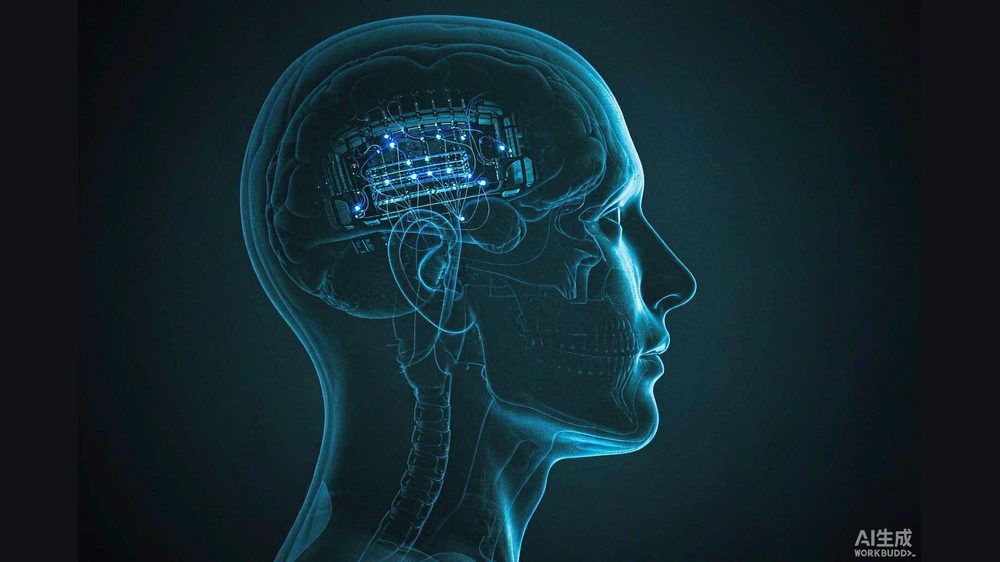
A young man with quadriplegia, after having a brain-computer interface device implanted, said he had once won a game using nothing but his thoughts, and with it regained a sense of control over his own life. He does not need to move a single finger: he merely thinks, and the cursor on the screen follows, the character in the game moving just as he intends.
There is no magic behind it, only neural signals that have been read and understood.
This is a real story unfolding at Neuralink, the company founded by Elon Musk, and it is a moment that makes brain-computer interfaces especially moving to ordinary people. In the past, such technology lived only in papers and laboratories; now it is beginning to sit on people's heads and connect to their brains.
Turning a thought into an action takes several steps—capture, decoding, and translation—and if any one of them falls behind, nothing on the screen moves.
A Paralyzed Young Man Plays with His Thoughts
By September 2025, 12 severely paralyzed patients around the world had been implanted with Neuralink's device. Using brain signals, they could control a cursor, type text, play simple games, and even post on social media. To an ordinary person, this looks like science fiction coming to life.
Behind these seemingly simple actions lies a full process: brain signals are captured and decoded in real time, then translated into machine commands. When a person loses control of their limbs, the brain-computer interface bypasses the damaged neural pathway and builds a bridge directly between "intent" and "screen." Once the bridge works, life gains a new entry point.
For the patients, this window means a great deal. Many people with severe paralysis struggle even to lift their heads, let alone type or hold a cup. Being able to post a status or win a game with their thoughts means they have regained the ability to express themselves and interact, rather than remaining only people who are cared for.
Musk has long framed the company as more than a "medical device maker." He keeps stressing that brain-computer interfaces should move from the lab into the factory and become standardized products that can be mass-produced. So people have begun to ask: of the story told as a factory, what has actually landed, and what still lives only as a vision?
12 patients may not sound like many, yet it is enough for regulators and developers to accumulate valuable real-world data. Every successful decode feeds back into the algorithm; every surprise is a reminder that there are still engineering pitfalls to fill.
Electrode Threads Through the Dura Mater
In March 2026, Neuralink announced a new implantation technique: a single electrode thread would pass directly through the dura mater, with no need to cut it open. The dura mater is the tough membrane wrapping the brain, and dealing with it used to be difficult; now that the threads can pass straight through, the trauma is smaller.
Implantation time dropped from 17 seconds to 1.5 seconds, and implantation depth exceeded 50 millimeters, reaching neurons deeper in the brain. Do not underestimate this change of just over a second: when a single surgery must implant hundreds or thousands of electrode threads, the time saved on each one accumulates into a leap in overall efficiency.
More crucial is the manufacturing cost. The company says the cost of its core components has fallen by 95%, and the combined total cost of device plus surgery has dropped below $50,000. If that figure holds, scaled mass production and wider surgical use gain a realistic foundation.
Paired with a highly automated implantation process, steps that once depended on a surgeon's fine hand are now taken over by machines, which is what lifts efficiency so sharply.
The Fifty-Thousand-Dollar Threshold
It must be made clear that this $50,000 is the overall cost of "device plus surgery," and cannot simply be broken out as the price of a single device. It is more like a threshold: cross it, and more patients can afford it; fail to cross it, and the brain-computer interface remains a luxury for the few.
Even so, $50,000 is not an amount an ordinary family can easily shoulder. Especially while insurance does not yet cover it, it remains some distance from "reaching every household." Real adoption needs both lower technology costs and support from the payment system. Only if costs fall fast enough does the story hold together.
Look at the cost in full and the device itself is only one link. Surgery, post-operative tuning, and long-term follow-up all have to be counted in the total. Only when the entire chain becomes cheap can the brain-computer interface move from a "costly exception" to "affordable routine medicine."
The other side of scaling is a mature supply chain. Only when core components can be mass-produced like consumer electronics does marginal cost truly trend downward. This is also why Musk keeps emphasizing the factory logic: what he wants is to turn the brain-computer interface from a workshop craft into an assembly line.
But an assembly line presupposes stable enough demand and uniform enough standards. The medical scenario happens to provide exactly that soil: clear indications, controllable follow-up, and repeatable procedures. Get the medical side working first, and consumer use earns the footing to catch up later.
A Blueprint of Twenty-Five Thousand Channels
Neuralink has also published a roadmap extending to 2028. The company plans to reach 25,000 electrode channels that year, extending implantation sites from the motor cortex to the speech cortex and the visual cortex, and supporting multiple devices in parallel within the same subject.
Its Blindsight visual restoration system has already received the U.S. Food and Drug Administration's "Breakthrough Device" designation. Musk's larger ambition is to advance the "whole-brain" plan in 2028, deeply integrating the human brain with artificial intelligence; further out, the ultimate device, Deep, aims to insert electrodes into any region of the brain.
Pushing electrode channels from the thousands toward the tens of thousands is essentially about reading richer neural activity. The more channels, the finer the actions and intentions that can be distinguished—a key step from "being able to move" to "moving accurately."
From movement to speech to vision, the roadmap's ambition keeps spilling outward. But the grander the goal, the more one must separate "already done" from "intending to do."
For readers, keeping this in mind helps avoid being swept off course by the boasts at a launch event. The technical narrative is moving, but at the bedside what counts is real improvement, one case at a time.
Medicine First, Consumer Far Away
Note that both the 25,000 channels and Blindsight's market timing are currently written on "plans" and "roadmaps," not on realities that have already happened. Treating a vision as a settled fact is an easy pitfall to fall into in science writing.
Return to the young man at the opening. The especially moving moment of a brain-computer interface is always when the patient moves again. For now, it remains rooted in medical scenarios rather than instantly becoming a consumer-grade product everyone can use. The factory dream is beautiful, but landing it takes one step at a time.
Disclaimer: This article is based on publicly available information and is for reference only. It does not constitute investment advice.