
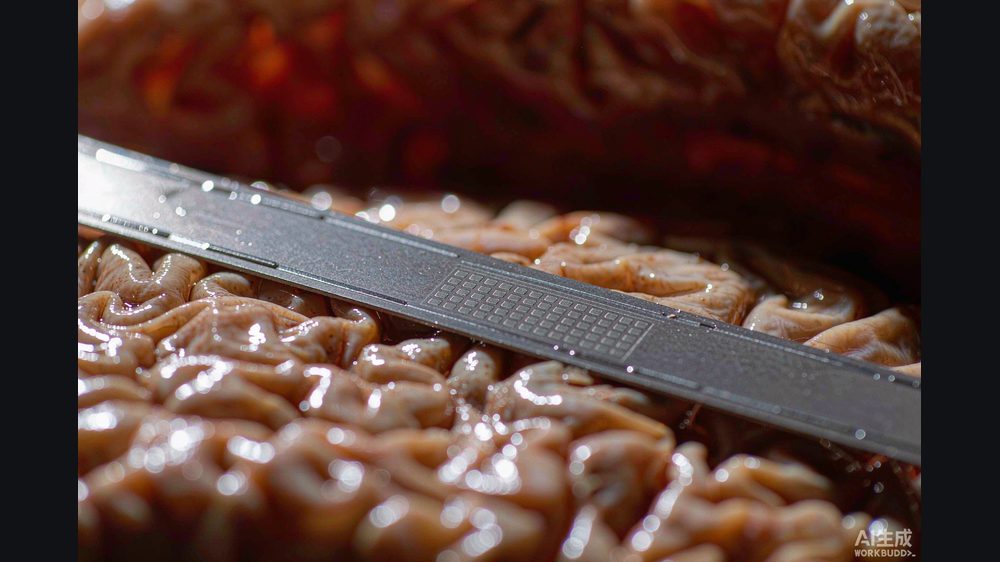
The hardest part of putting electronics inside the brain is not the electronics. It is the fact that the brain never sits still — it pulses with every heartbeat and shifts with every breath, while the skull around it stays put. A rigid wire implanted in that moving tissue is, over time, a foreign object the body tries to wall off.
A small Beijing company thinks the answer is to stop fighting that motion and instead bend with it.
The electrode that follows the brain
Beijing Zhiran Medical Technology (北京智冉医疗科技有限公司) builds invasively implantable brain–computer interface (脑机接口) systems — the kind where electrodes are placed in or on the brain tissue itself, the route with the cleanest signal but the highest risk. Its signature component is a stretchable flexible electrode whose design was inspired by Chinese paper-cutting (剪纸). The trick is structural: instead of resisting stretch, the electrode channels the load into bending and twisting, so it can track the brain's tiny displacements instead of tearing free.
The company says the resulting tensile force is on the order of 40 micro-Newtons — about one-hundredth of the force of the linear electrode used by Elon Musk's Neuralink. Lower force means less chronic injury and, Zhiran argues, a lower chance of the glial scarring that eventually silences conventional stiff electrodes. The work was published in Nature Electronics and the electrode design is patented.
From 128 channels to 1024
Zhiran's trajectory is a useful window into how fast China's invasive-brain–computer interface field is moving. In late 2025 the company carried out its first clinical implant of a more-than-100-channel invasive system. By March 2026, at the Zhongguancun Forum, it unveiled a thousand-channel (1024-channel) invasive flexible brain–computer interface system, which was selected as one of that year's forum innovation achievements.
The 1024-channel figure matters because channel count is roughly a proxy for how much of the brain's conversation you can overhear at once. The system pairs the stretchable electrode with a fully implantable wireless collector that uses a domestically customized neural chip; the company states this cuts overall power consumption by about 75 percent and supports sampling up to 30 kHz. The collector is buried under the scalp, recharges wirelessly, and transmits over Bluetooth — no open wound, the company says, and no external tether for daily use.
In primate (macaque) tests reported by Beijing Youth Daily, a 256-channel version recorded signals from 257 individual neurons and decoded movement intent, and the higher-density 1024-channel version was demonstrated for large-scale stable recording. Those are animal results, not human outcomes, but they are the stepping stones toward human trials.
The robot that does the delicate part
A beautiful electrode is useless if you cannot put it in safely. Zhiran also shows an implantation robot built for exactly this: micron-level positioning, computer-vision vessel avoidance, and automated path planning. According to Beijing Youth Daily and China National Radio reporting from the forum, a single electrode filament can be identified, threaded, and implanted in under 30 seconds. Speed matters because every minute on the operating table is risk; consistency matters because a human hand cannot repeat a micron-scale placement hundreds of times without drift.
Behind the scenes, Zhiran says it has built roughly 2,000 square meters of clinical-grade flexible-electrode micro-nano processing and GMP cleanroom capacity, aiming for a self-contained pipeline from material to finished implantable product.
What it is for, and what is still unproven
The stated targets are sober and large: helping people with high cervical paralysis, amyotrophic lateral sclerosis (ALS), and stroke-related motor loss regain some control — moving a cursor, a prosthetic, or eventually a paralyzed limb. In 2026 the company said it planned to begin larger registration-stage clinical trials of its more-than-100-channel invasive product.
The cautious reader should separate the engineering from the medicine. The stretchable-electrode idea is genuinely clever and the channel count is real on the bench. But invasive brain–computer interface still faces the long road every implantable neurotech faces: years of safety data, biocompatibility over decades, and proof that the signal stays clean inside a living, moving human brain — not just a monkey or a bench.
Honest limitations
The performance numbers — 1024 channels, 75 percent lower power, 30 kHz sampling, sub-30-second robotic implantation — are company-stated specifications from forum demonstrations and district media, not independent benchmarks. The late-2025 human implant was described by the company as a first for its own product line, and broader "first in China" claims in secondary coverage should be treated with caution given how many groups are racing in this space. Animal results do not guarantee human efficacy, and the system has not yet reached the registration trials that would let it be sold as a medical device.
What readers can do now
- Follow the National Medical Products Administration's innovation-device channel for Zhiran's registration progress before treating any demo as an available therapy.
- When you see "1024 channels" or "robot implantation" headlines, distinguish bench specifications from cleared, implantable medical products.
- Track peer-reviewed papers (the Nature Electronics electrode work is a starting point) rather than expo demos to judge how durable stretchable electrodes really are in living tissue.