
A person who has lost the use of their legs does not stop wanting to walk. The wish is still there, alive in the brain, long after a spinal injury or a stroke has cut the wire between intention and muscle.
What if a machine could listen to that silent intention and move the leg for you — not as a wheelchair, but as a partner that helps the nervous system relearn the motion it forgot?
That is the bet behind a rehabilitation robot shown this autumn in Beijing, where a provincial technology company best known for voice software is now wiring brains to exoskeletons.
What the machine actually does
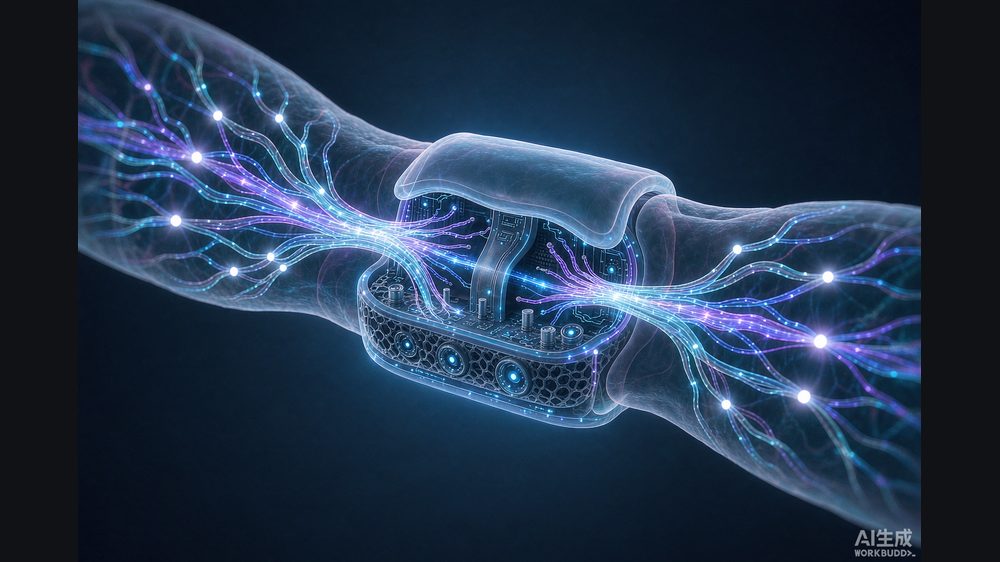
The device is called a brain–computer interface (脑机接口) exoskeleton system, and it was built by Anhui Aible Intelligent Technology (安徽爱博智能科技有限公司), the rehabilitation-and-disability subsidiary of the speech-AI giant iFLYTEK (科大讯飞). In plain terms, a patient puts on a sensing cap and a pair of motorized leg braces. They think about walking. The cap picks up the faint electrical signature of that thought, a decoder turns it into a command, and the braces step.
It is a non-invasive (非侵入式) design: nothing is implanted, no skull is opened. The system reads scalp electroencephalography, leans on deep-learning models, and is built around the principle of neuroplasticity (神经可塑性) — the brain's ability to rewire itself through repeated, meaningful practice.
The hardware uses a bionic hip-and-knee structure and is described by the company as having three core abilities: a direct brain-to-machine link, an adaptive bionic gait, and several levels of assistive training intensity.
Why "imagine walking" counts as therapy
The key idea is something clinicians call motor imagery (运动想象). The patient is not moving their legs; they are imagining the act of walking. The exoskeleton answers that imagination with real motion, and the real motion feeds sensation back to the brain. Closed loop, repeated thousands of times, is thought to nudge damaged pathways back toward function.
This is a different philosophy from the passive rehab machines that have dominated physiotherapy for decades. A passive device moves a limp leg back and forth. A brain–computer interface exoskeleton asks the patient to initiate the movement from inside, then assists. The company argues — and several rehab researchers agree — that active, brain-led training is more likely to produce lasting neural recovery than being moved like a puppet.
Where it actually stands
Honesty matters here, because the gap between a dazzling expo demo and a certified medical product is wide. The system was unveiled at the 2026 China International Exhibition of Rehabilitation and Assistive Devices (中国国际福祉博览会), held in Beijing from September 3 to 5, where organizers opened a dedicated brain–computer interface zone for the first time. Aible demonstrated the interaction on site: cap on, braces on, the wearer's imagined steps driving the stride.
The company is explicit that the product is still in the research-and-development phase and does not yet hold a medical-device registration certificate (医疗器械注册证). It is shown for technical demonstration and research exchange, not offered as a cure. According to reporting from the China Times and the lab's own materials, it has been tested in a number of medical institutions, mainly inside Anhui province, with plans to spread to other regions.
The work sits inside a joint laboratory — the China Disabled Persons' Federation – iFLYTEK Universal AI for Disability Support Joint Laboratory (中国残联-科大讯飞通用人工智能助残联合实验室) — and on July 13, 2026, the Anhui Disabled Persons' Federation signed a strategic cooperation agreement with iFLYTEK to develop and apply brain–computer interface assistive products. The framing is disability support first: giving people who cannot move their legs a way to stand, step, and in time perhaps walk again.
Why a voice-AI company is doing this
iFLYTEK made its name on speech recognition and language models, not legs. But the leap is smaller than it looks. Reading intention from a noisy biological signal and turning it into a reliable instruction is, at heart, a signal-and-language problem — the same family of problems the company has worked on for years. Its rehab arm has also built speech-to-text aids for deaf users and cognitive-assessment tools, so the exoskeleton is one branch of a broader "technology for disability support" push rather than a one-off experiment.
For ordinary readers, the takeaway is less about any single gadget and more about a shift in rehab. The field is moving from machines that move you to machines that wait for you to move them in your head, then help. If that loop proves durable in larger trials, the same approach could spread from legs to arms, from stroke to spinal injury to traumatic brain damage.
Honest limitations
Most of the specifics above come from company statements, lab materials, and trade-show reporting rather than peer-reviewed clinical trials, so the efficacy claims should be treated as early-stage. The device is not yet a certified medical product, and no independent large-scale study has confirmed durable walking recovery. Brain–computer interface decoding is still highly variable between individuals, and a non-invasive scalp signal is far noisier than an implanted one. Reader should view expo demos as proof of feasibility, not proof of cure.
What readers can do now
- If you or a family member is in stroke or spinal-injury rehab, ask the hospital's rehabilitation department whether they offer brain–computer interface–assisted training and what evidence they cite.
- Treat any "walk again" claim from a non-certified device as exploratory; check whether the product holds a medical-device registration certificate before paying.
- Follow the China Disabled Persons' Federation and provincial rehab expo news for updates on when brain–computer interface exoskeletons clear regulatory review and reach clinics.