
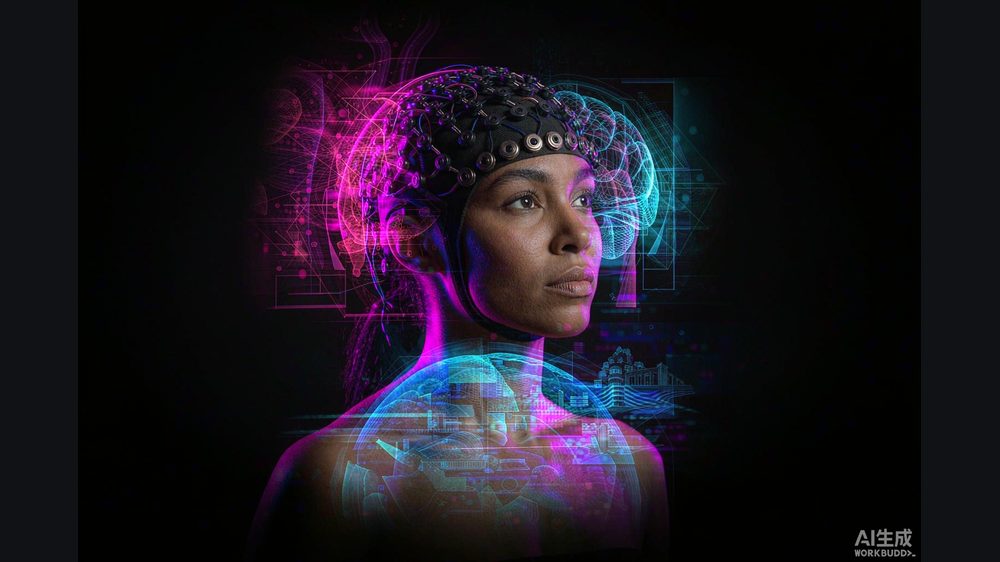
A man who cannot move his hands, or speak above a whisper, opens a text message on his iPhone. He does it by thinking about the movement he wants to make. There is no stylus, no eye tracker bolted to his chair, no custom app written for him alone. The phone simply accepts his implant as an input — the same category it assigns to a keyboard or a mouse.
This is not a demo video from a startup. It is what happens when the world's most valuable consumer platform decides that brain-computer interface (脑机接口) signals belong in its operating system.
The protocol hiding in your phone
In early 2025, Apple quietly shipped something unusual: a Brain Computer Interface Human Interface Device protocol, or BCI HID. Apple's own developer documentation describes it in dry language, but the substance is bold.
- A BCI device that follows the protocol identifies itself to an iPhone, iPad, or Apple Vision Pro the same way a keyboard or mouse does — no special drivers, no bespoke software.
- Its signals arrive as native input events, processed through Switch Control, Apple's long-running accessibility framework for people with limited mobility.
- The descriptor is bidirectional: the implant can also receive context back from the device, such as signal-quality feedback, which helps it stay accurate while a person is actually using the system.
Before this, every brain-implant research team built its own plumbing to make a cursor move on someone else's screen. Apple's move says: stop building plumbing, build decoding. If your hardware speaks the standard protocol, the entire device ecosystem is already waiting for it.
Who can actually use it today
The honest answer is: very few people, and that is the point. Worldwide, only a few dozen humans carry functioning implanted brain-computer interfaces, nearly all of them inside clinical trials.
The first company to reach native integration with Apple's protocol was Synchron, in May 2025. Its Stentrode implant is distinctive because it avoids open brain surgery entirely:
- Surgeons thread the electrode array through a blood vessel, via the jugular vein, to rest near the brain's motor cortex — a procedure often compared to placing a cardiac stent.
- The implanted electrodes record movement-intent signals, an external decoder translates them, and the BCI HID protocol delivers the result to the operating system as ordinary input.
- Synchron has implanted roughly ten patients across the United States and Australia, and users with ALS have used the implant to control their iPhones, iPads, and Vision Pro headsets.
One of those users, an American ALS patient named Mark Jackson, has been shown controlling his Apple devices with his implant. For a person whose reliable inputs might otherwise number zero, the difference is not convenience. It is the ability to text a friend, browse the web, or join a call without help.
Synchron's chief executive, Tom Oxley, framed it precisely: brain signals are now formally recognized alongside touch, voice, and typing — what he called a next-generation interface layer.
Why a standard matters more than a gadget
Consumer platforms rarely write protocols for audiences smaller than a stadium. So why did Apple bother?
- Standards decide what scales. Switch Control already supports switches as varied as buttons, head movements, and camera gestures. Adding implants as one more switch type means any compliant BCI hardware, from any company, plugs into decades of mature accessibility software.
- It lowers the bar for new entrants. A startup building a neural interface no longer needs to invent an entire interface layer; it needs to meet a published descriptor. That is how peripheral ecosystems — mice, game controllers, hearing aids — actually grew.
- It signals where input is going. When the operating system treats neural signals as a first-class input category, developers can assume intent-based input will exist, and design for it.
Other companies are already riding the same framework. Control Bionics, for example, uses Apple's descriptor with a wearable, non-invasive EMG sensor rather than an implant — same protocol, no surgery.
The bigger picture
Implanted BCIs remain investigational medical devices. No regulator has approved one for general use, and the trials that exist enroll patients with severe paralysis from ALS, stroke, or spinal cord injury. The protocol does not change that, and Apple is careful not to imply otherwise.
What changes is the endpoint. If and when a neural interface clears regulatory review, its users will not inherit a beta environment. Their implant will work with the messaging apps, smart-home controls, and video calls everyone else uses — because the platform decided, years earlier, that this input would be native. For a field that has spent twenty years demonstrating what patients can do inside lab software, that difference is the whole ballgame.
Key takeaways
- Apple's BCI HID protocol, introduced in early 2025, makes brain-implant signals a native input type on iPhone, iPad, and Vision Pro via Switch Control.
- Synchron became the first company with native integration in May 2025; its Stentrode is implanted through a blood vessel and is being used by ALS patients to control Apple devices.
- Publishing an open standard, rather than a proprietary gadget, lets any compliant BCI company plug into a mature accessibility ecosystem.
Honest limitations
- The eligible population is tiny: only a few dozen people worldwide carry implanted BCIs, all within clinical trials, and no device has regulatory approval for general use.
- Native integration does not make the implant safer or the decoding perfect; signal quality still degrades with daily use and varies between individuals.
- Apple provides the input path, not the medical system — implantation, training, and clinical oversight remain the responsibility of BCI companies and care teams.
What readers can do now
- If you or someone you support lives with severe motor impairment, look into Switch Control on iPhone or iPad — many non-invasive switches already work with it today, no implant required.
- Patients interested in BCI research can check registries such as ClinicalTrials.gov for actively recruiting neural-interface trials near them.
- Developers building assistive technology should read Apple's published BCI HID reference and design apps that work well with switch-based navigation.