
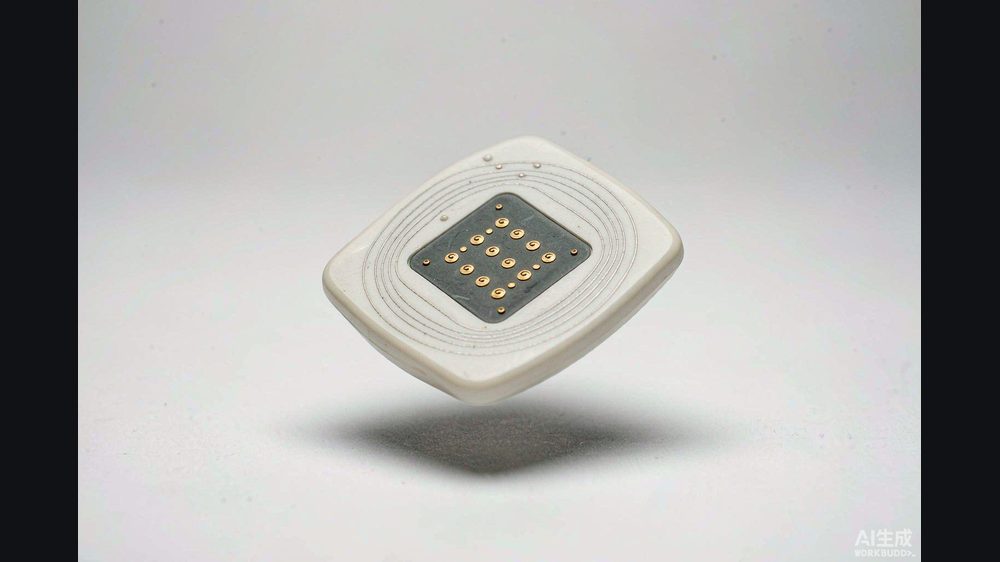
A person wears what looks like a small earbud, and simply by looking at flickering lights, types letters on a screen. No cap of gel-slicked electrodes, no surgery, no scar. At Tsinghua University, that understated device is the product of two decades of stubborn work on reading the brain from the outside.
Key takeaways
- Tsinghua's non-invasive brain-computer interface (脑机接口) program, led by professor Gao Xiaorong (高小榕), centers on steady-state visual evoked potential (SSVEP) methods using scalp EEG.
- In 2015 Gao's team reached 319 bits per minute information-transfer rate on a scalp-EEG SSVEP system, among the highest reported at the time.
- In 2023 the team published SpiralE, a conformable in-ear bioelectronic device, in Nature Communications, achieving 95% accuracy in a 9-target SSVEP task and 84% accuracy in "cocktail-party" auditory decoding.
- In 2025 Gao and Gao Shangkai co-authored a major review in Proceedings of the IEEE (impact factor 25.9) framing BCI as a "brain-in-the-loop" communication system.
- The work is non-invasive and consumer-leaning, distinct from implanted systems, and points toward wearable neural monitoring for rehabilitation, education and cognitive health.
The SSVEP bet
Non-invasive BCI rests on a simple idea: the brain reacts to outside stimuli in measurable ways, and those reactions can be decoded without breaking the skin. Gao's group built its reputation on SSVEP, where the visual cortex resonates at the flicker frequency of a target on screen.
- The user watches flickering icons; the EEG signal locks to one frequency; the system infers the chosen target.
- In 2015, the team reported an information-transfer rate of 319 bits per minute on a scalp-EEG SSVEP setup, a figure Tsinghua cited as leading its peers at the time.
- The appeal is safety and scale: no surgery, no infection risk, and hardware that can resemble consumer electronics.
SpiralE: the brain through the ear
The most concrete recent demonstration is SpiralE, reported in Nature Communications (Wang et al., 2023, doi:10.1038/s41467-023-39814-6). Instead of a cap, it uses a flexible in-ear device that spirals gently into the auditory canal under electrothermal actuation, keeping conformal contact without blocking hearing.
- Offline accuracy of 95% in a 9-target SSVEP classification task.
- A calibration-free, 40-target online SSVEP speller reached 75% accuracy, with an information-transfer rate of 36.86 ± 15.53 bits per minute — reported as the highest for ear-EEG to that point.
- In a "cocktail party" test, natural-speech auditory classification reached 84%, suggesting the same ear device can read both visual and auditory attention.
- Because it is soft, small and removable, it sidesteps the inflammation and tissue damage linked to rigid or invasive approaches.
Systematizing the field in 2025
Having produced both speed records and new hardware, the group turned to synthesis. Gao Xiaorong and Gao Shangkai published a long review in Proceedings of the IEEE framing BCI as a communication system with the brain inside the loop.
- The "brain-in-the-loop" view spans brain-to-computer and computer-to-brain directions, and couples human intelligence with machine intelligence.
- The review traces how information-transfer rates in SSVEP systems rose from about 0.9 bit/s in 2002 to roughly 6.3 bit/s by 2018, and why further gains remain the core practical challenge.
- In late 2025 the team ran a neural-aesthetics experiment using high-precision EEG to capture audience responses, exploring links to emotion-disorder rehabilitation, aesthetic education and cognitive aging.
- A 2025 methodological paper (eTRCA + sbCNN) proposed combining classical and deep-learning decoders to lift SSVEP classification, reflecting the "dual drive" of better hardware and smarter algorithms the group describes.
Why it matters for China's neurotech
Non-invasive BCI is the quieter sibling of the headline-grabbing implants, but it may reach far more people.
- Lower risk opens consumer, education and wellness markets that surgical devices cannot.
- Wearable EEG complements, rather than competes with, invasive routes aimed at severe paralysis.
- For China, a strong non-invasive research base supports both domestic products and open academic benchmarks.
Honest limitations
- The 319 bits/min figure is a 2015 research result on a specific SSVEP setup, not a consumer specification; real-world performance varies with user and hardware.
- SpiralE metrics come from a controlled lab study (Nature Communications) with small participant numbers; everyday durability and usability outside the lab are not yet established.
- The 2025 review is a synthesis, not a new clinical breakthrough; some cited applications (neuro-aesthetics, memory) remain exploratory.
- To keep focus on the non-invasive line, we did not cover Tsinghua's wireless minimally invasive implant work, which follows a separate, surgical path.
What readers can do now
- Educators and researchers can explore open SSVEP datasets and open-source BCI platforms cited in the review for hands-on learning.
- Patients should treat in-ear or headband BCIs as research or wellness tools, not approved therapies, until cleared by regulators.
- Follow Nature Communications and Proceedings of the IEEE for primary data rather than secondary summaries when judging performance claims.