
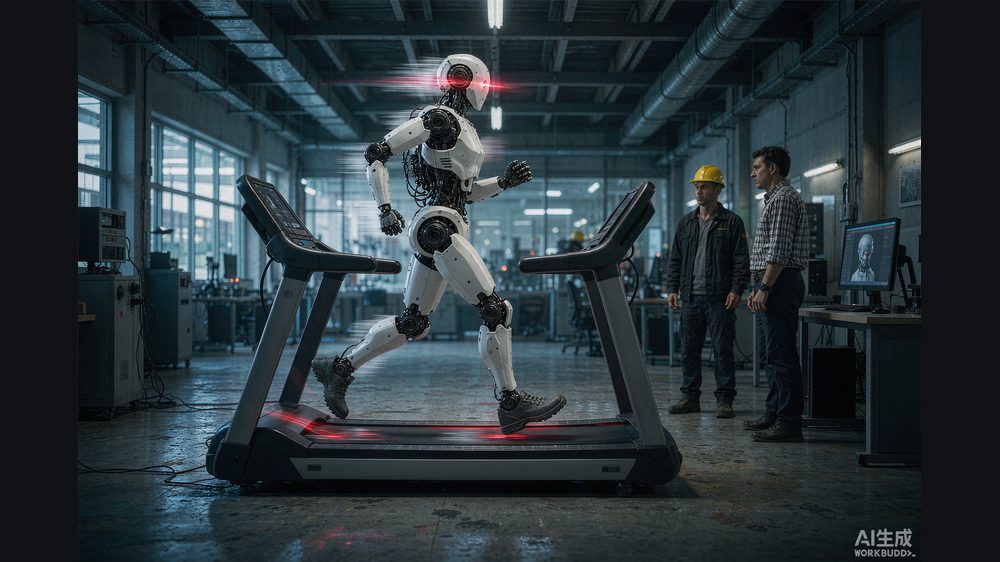
The backflip drew the applause. Then somebody asked what the same machine does when it is dropped into a warehouse aisle nobody mapped.
That question sat over the embodied-intelligence forum at the 2026 World Computing Conference (世界计算大会) in Changsha, held 20–21 November under the theme "brain–body coordination, computing awakens embodiment" (脑体协同 算启具身). The exhibition hall was full of robots. What the hall did not contain was a clean answer to the gap between a machine that performs and a machine that works.
Key takeaways
- Ministry of Industry and Information Technology figures put China's humanoid robot sector at more than 140 complete-machine manufacturers, which released over 400 distinct models and produced more than 40,000 units in the first half of 2026.
- The ministry projects full-year 2026 output to exceed 100,000 units — a ministry projection, not a third-party forecast.
- A 100,000-unit output number and a sensing layer still at prototype are not contradictory; the weak links have no published date.
The production numbers are real, and that is exactly the problem
Public figures from the Ministry of Industry and Information Technology (工业和信息化部) put China's humanoid robot (人形机器人) sector at more than 140 complete-machine manufacturers in 2025. In the first half of 2026 those companies released more than 400 distinct models and produced over 40,000 units. MIIT projects full-year 2026 output to exceed 100,000 units — a ministry projection, not a third-party forecast.
Those are large numbers arriving quickly. They also frame the industry's awkward position: if six figures of units are coming off lines this year, the argument is no longer whether China can build humanoids. It is what the units do after they leave the showroom.
"The smartest AI is still a brain in a vat"
Hu Qigao (胡其高), secretary-general of the Hunan Artificial Intelligence Association (湖南省人工智能协会) and a professor at the National University of Defense Technology (国防科技大学), compressed the gap into a sentence that travelled well past the room.
"Those doing demos, doing flips, doing performances — they do it very well. But once you send them into an unstructured scene, capability drops sharply."
He added the line that became the forum's shorthand: "The smartest artificial intelligence right now is still a brain in a vat" (缸中之脑).
The image is precise. A model that reasons well over text has never had to close the loop from perception to decision to execution against friction, gravity, and a bracket sitting three millimetres off nominal. Hu proposed a measure he called "computing closure density" (计算闭环密度): within a given unit of time, how much of what the "brain" emits is actually validated on a "body," and how much of that validation flows back into the next iteration. Counting manufacturers, or counting models, measures something else.
Two industrial answers, one shared premise
Zeng Guang (曾光), general manager of Zoomlion's Zhongke Yungu (中联重科中科云谷), described his company's bet on a "one brain, many bodies" (一脑多型) foundation. The logic is reuse. A construction-machinery robot and a humanoid carry different tasks, but perception, planning, control and learning can share one substrate, so real working-condition data settles in one place and migrates across form factors. Construction machinery, he said, is about efficient operation and remote coordination in complex conditions; the humanoid is about flexible perception, autonomous decisions and compliant manipulation.
Zhu Yurui (朱禹睿), chief engineer of embodied intelligence at ZTE (中兴通讯), attacked the training loop instead. His framing was "AI trains AI" (AI训练AI): a large model acts as referee inside simulation, running mass iterations so that humans stop hand-teaching every motion. People move upstream, to defining task objectives.
Notably, both answers assume the body is no longer the hard part. That is a reversal from two years ago, when actuators and reducers were the constraint. Component makers at the show described harmonic drives, servos and sensors as having fallen far enough that bill of materials is no longer the binding constraint.
The weak links that still have no date
The rest of the programme filled in what "brain–body" still lacks. Jiang Tianzai (蒋田仔) of the Chinese Academy of Sciences' Institute of Automation, speaking on brain-computer interfaces, offered a caution that transfers sideways: "If you don't even understand the basic knowledge, doing brain-computer interfaces is very blind."
Tactile sensing and long-horizon memory came up repeatedly as the two thinnest layers. Speakers put the tactile-skin layer at prototype stage, with volume readiness still a multi-year question. Another team framed the memory problem as long-cycle context management — a robot that must accumulate reusable task experience instead of restarting from zero at every new scene.
Read that against the production forecast and the shape of the next two years becomes clearer. A 100,000-unit output number for 2026 and a sensing layer still at prototype are not contradictory. They describe the same industry at two different depths: assembly capacity has arrived, and the sensory and cognitive layers that make capacity useful are still on a schedule.
The commercial consequence
For buyers, the forum's practical message was blunter than its technical one. A robot that can be produced in volume but cannot hold tolerance in an unstructured cell is a capital asset with an unclear payback. That is why the credible deployments discussed at Changsha were narrow — a specific workstation, a specific part, a human supervisor retained — rather than general-purpose labour. The industry has moved from asking whether embodiment is possible to asking which task pays for it first.
Honest limitations
This article draws on forum statements as reported by China National Radio (央广网) and Rednet (红网), together with MIIT figures cited at the event; we did not independently audit unit counts. "Output" here means units produced, not units deployed in paid work, and the two are not interchangeable in any public dataset we could find. The 100,000-unit figure is a full-year projection, not a confirmed result. Quotes are translated from Chinese and rendered as faithfully as translation permits. No revenue, utilisation or uptime data for deployed fleets is included, because no consistent public series exists.
What readers can do now
- Separate output from deployment. When a humanoid number appears, check whether it counts units built or units doing paid work; the gap is wide in every dataset published so far.
- If you are evaluating a vendor, test on your messiest task, not their cleanest demo, and ask for the human intervention rate rather than a success rate on a fixed script.
- Watch component readiness — tactile skins, force sensors, memory architectures. They constrain real deployment more tightly than any assembly-line capacity announcement.