
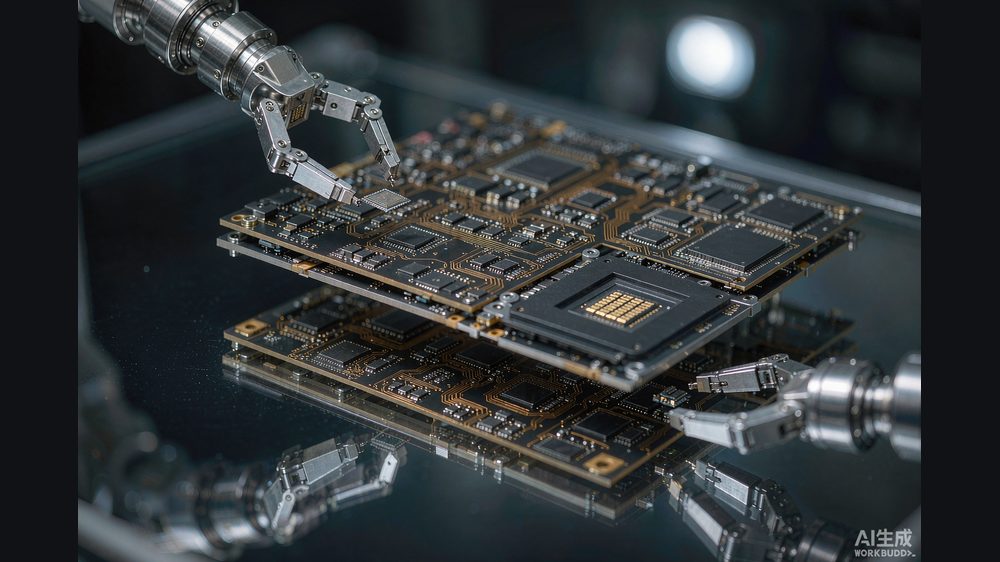
The most useful thing about a robotics conference is when the organisers say what each machine did. E-Bot Day 2026, the Humanoid Robot Developer Conference and Embodied Intelligence Carnival (人形机器人开发者大会暨具身智能嘉年华), held on 25 November in Beijing E-Town (北京亦庄), did that.
More than 2,000 people attended. The conference was guided by the Beijing E-Town Development Area management committee and hosted by Beijing E-Town Robotics Industry Development Co., with the National Industrial Information Security Development Research Center and others organising. The carnival ran alongside the formal sessions, with 45 booths, 33 project entries and 12 university clubs.
Five demonstrations, five different problems
The organiser's account of the exhibition area names five companies and the tasks they showed.
Galaxea (星海图) showed an all-object grasping robot that responds to natural-language instructions. The reported success rate was 99.9%. That figure comes from the exhibitor or organiser; no test protocol was published alongside it.
The Beijing Humanoid Robot Innovation Center (北京人形机器人创新中心) showed Tiangong 2.0 (天工2.0), which danced and sorted objects and carried an emotion model that identifies human emotional states. Sorting and emotion recognition are different capabilities: one is a manipulation task, the other is an interpretation task, and putting them on the same machine is a statement about the robot as an interaction platform rather than a single-purpose tool.
Xingyuanzhi (星源智) demonstrated a robot using its Thor whole-body control model to pull a load of more than one tonne while weighing less than 40 kilograms itself. Hauling is a good test of whole-body coordination and traction control, because the robot has to keep its feet stable while a large external force acts on it.
Booster (加速进化) showed a football-playing robot and the Booster Studio development platform, which the company says allows a model trained in simulation to be deployed on a physical machine in one step. Simulation-to-real transfer is one of the main bottlenecks in the field.
JD Logistics (京东物流) showed its "Canglang" (仓狼) picking robot, which combines picking and inspection, with a reported picking accuracy of 99.9%. Of the five demonstrations, this is the one closest to a paid job: warehouse picking has a defined target, a measurable error rate and a shift pattern.
Why a developer conference is different from a product launch
A product launch is organised around one machine. A developer conference is organised around the tools that let other people build machines. E-Bot Day had four parallel developer tracks covering algorithm training, hardware development, technology selection, scenario deployment and engineering delivery.
The organiser also released a list of ten "2026 annual developer achievements in embodied intelligence." The entries include the LEMO one-stop dual-arm development platform from Galaxea, the Linker Hand 030 dexterous hand from Lingxin Qiaoshou (灵心巧手), a reinforcement-learning environment package, a general embodied development platform from the Beijing Humanoid Robot Innovation Center, and a whole-body embodied model from Galaxy General (银河通用). Several other universities and companies appear on the list.
A second release was a high-quality development initiative for training grounds (训练场), issued jointly by the National Industrial Information Security Development Research Center, the OpenAtom Open Source Foundation and the MIIT humanoid robot standardisation committee, with training grounds and embodied-intelligence companies as co-signatories. A third was a "responsible innovation" pledge signed by more than ten organisations.
Beijing E-Town also published a plan for a "Future Machine Domain" (未来机域) international open-source community. The district says it has gathered more than 300 robotics and embodied-intelligence companies with an industrial chain valued above ¥20 billion (≈ US$2.8B / HK$22B).
What the demos do not establish
A conference demonstration has a controlled floor, a known lighting setup and engineers within reach. None of the five demonstrations described above was accompanied by published continuous-operation data: hours run, interventions needed, or performance on objects the system had not seen before.
The 99.9% figures for grasping and picking are particularly easy to misread. A success rate is meaningful only alongside the test set, the definition of failure and the number of trials. Without those, it describes a demonstration, not a production guarantee.
The same applies to the hauling and dancing demonstrations. They show that a control method works in a specific configuration. They do not show that it survives a different floor, a different payload or a tired operator.
Why this matters for developers
For a developer, the value of a meeting like this is the practical one: which platform can be downloaded, which training ground can be booked, which model accepts which robot body. The open-source community plan promises datasets, computing and space; whether those become usable services is a separate question that will be answered by developers, not by the launch material.
The formal programme included a keynote by Zhang Tao of Tsinghua University's Institute for Embodied Intelligence and Robotics, talks by Galaxea chief executive Gao Jiyang and Wang Hao of Ziyu Robotics, and a roundtable on moving from basic models to real-world applications, with representatives from Beijing Humanoid, Galaxy General and others.
What readers can do now
- When you see a demo percentage, ask for the trial count and the definition of a failure before treating it as a production figure.
- If you are a developer, check which of the announced tools have downloadable repositories rather than slide descriptions.
- Compare demos by task type — grasping, sorting, hauling, picking — rather than by the robot's appearance.
Honest limitations
This account is based on the conference organiser's summary published by Future Machine Domain and on related coverage. Company-reported accuracy figures are labelled as such. No independent measurement of the demonstrations was available, and the article does not assess any product's commercial readiness. The district's industrial-chain figure is a local-government statement.