
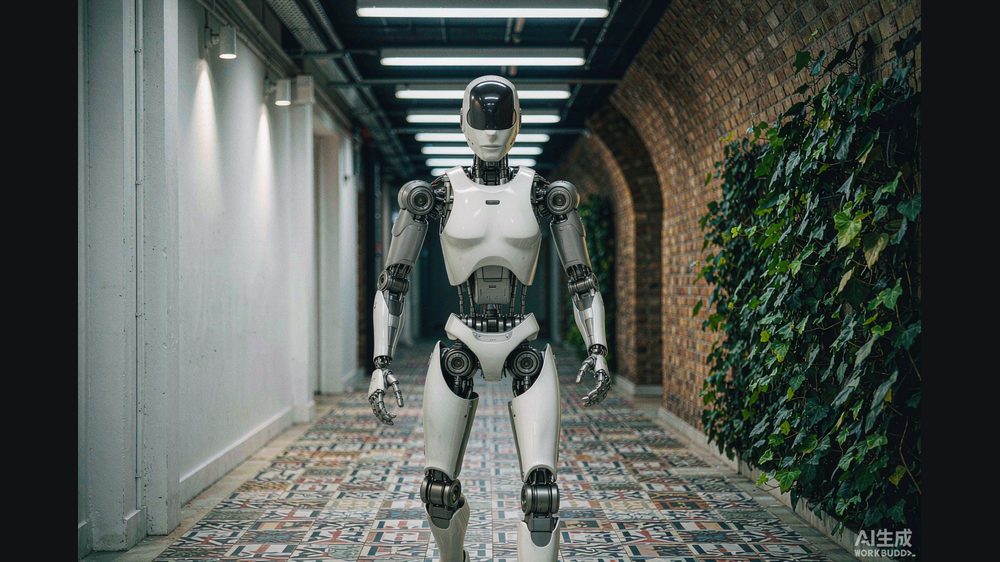
For two years, the most viral humanoid robot videos have had almost nothing to do with work. Backflips, dancing, running across a lawn, set to stirring music, millions of views. The most common comment: what is this thing actually for?
In Wuzhen this year, the contest on the show floor changed. Crowds gather not to see who can flip, but who can pick the right item off a shelf, put it down steadily and not drop it. The excitement is still there, just pointed in a different direction, from watching motion to watching results.
On November 4, at the World Internet Conference's robotics and embodied intelligence forum, Zeng Hui, senior vice president of Galbot, took the stage. His remarks were blunt. He talked about what robots should actually do, and whether they can work.
A Blunt Opening
At the forum, he said that "a humanoid robot cannot only perform tricks; the key is being able to work." The line was turned into headlines by many outlets and was widely quoted at the session.
What is interesting is that the company saying this also performs. According to the company, its robot has played tennis against a human player, fully autonomously, with no one holding a controller nearby.
It has also demonstrated fine work such as spinning a pen and cracking walnuts. These are good-looking moves, and genuinely hard, down to the few grams of force in a finger. Miss by a little and it drops, and the whole attempt is wasted.
So he was not dismissing performance. He was saying that performance is a ticket, not a report card. A ticket gets you in the door, but it does not keep you on the job, and it certainly does not make anyone willing to pay your salary.
Trading Shots with a Human
In a rally, the crowd watches the shots, but insiders watch the phrase "fully autonomous." No one held a remote. The ball came, and the machine judged the landing point, moved and swung on its own. Nobody called start.
Tennis is a tricky exam. The ball is fast, spins a lot and lands unpredictably, and the machine has to see, run and hit within a fraction of a second. Half a beat late and it cannot reach; half a beat early and the ball goes out. There is almost no margin.
But tennis also has its shortcuts: the court is standard, the rules are clear, and the opponent's shots are broadly predictable. Change the setting, say a warehouse piled with cardboard boxes, and those assumptions vanish. The ball does not bounce by the rules either.
What the Three Events Tested
The same games included three scenario events: home services, hot food preparation and delivery, and retail. According to the company, it took part in all three, and the home-services event came closest to daily life.
Home services was the hardest. According to Zeng, it was a long-horizon task, requiring the robot to fold clothes, walk down a long corridor and cope with voice interference. The corridor was long.
The phrase "long horizon" is easy to skim past. A backflip lasts ten seconds. Folding clothes means dozens of actions in a row, and if any one of them stalls, the whole chain breaks.
And the company insists on no teleoperation. Teleoperation means a person in the back holding a controller and doing it for the robot. However pretty the result, it is only a person's shadow. Once the person steps away, the machine stands still and cannot move a step. It can only wait.
Another Exam, in a Pharmacy
In the exhibition area of the same conference, there was a smaller exam paper. On the shelves of a mock retail pharmacy sat medicines in different packaging, boxes, bottles and soft bags mixed together at different heights, like a normal neighborhood drugstore.
According to Xinhua, a robot running Ant Group's LingBot model can nimbly grasp medicines in different packaging. The line from the floor was that the robot has already been put into use in multiple pharmacies in Shanghai's Pudong district.
A medicine box is one of the least obedient objects a robot can hold. Hard boxes slide, soft bags collapse, bottles roll. Pull one box out of a stack and its neighbors topple. You have to hold them first, and one hand is not enough.
More important is not grabbing the wrong one. In a warehouse, picking the wrong carton of tissues is a small loss. In a pharmacy, picking the wrong box of medicine is something else. Behind the box is a person's body, and a repeated instruction.
What Separates Performing from Working
The first difference is repetition. A performance only has to succeed once to be edited into a video; if it fails, you cut and start again. A job has to succeed every day, so reliably that no one bothers to film it anymore, no one applauds and no one hands out bonuses.
The second is exceptions. A stage has no surprises. Nothing falls on the floor, no one walks suddenly across the frame, no child reaches for its hand, no light goes out, and no one tells it to hurry up.
The third is tempo. People work at varying speeds; a robot's pace has to match the steps before and after it. A second too fast and goods pile up. A second too slow and the whole line stops to wait, and the entire row behind it stops too.
Put the three together and you get the weight of the phrase "able to work." It is not cool. It does not make a cover. It cannot be cut into a fifteen-second clip, no one wants to share it, and it is hard even to write a decent headline for.
First, Turn Motion into Habit
Galbot's approach is to train a robot on one skill until it no longer needs a human, then move to the next. Pen spinning and walnut cracking look like showmanship, but what they train is the force and position of the fingers. A gram off and the object is crushed.
Taken apart, these abilities are the same set as picking up a medicine box, folding clothes or grabbing a drink: see, judge, reach, adjust, release. The more fragmented the motion, the more it tests touch, the harder it is to fake, and the harder it is to patch up with editing or slow motion.
So performing and working are not two roads. Performing pushes a single ability to its limit. Working strings those abilities into a line that does not break, and the line has to reconnect itself when it does, and notice the break on its own.
The real divide is whether anyone is willing to pay for that line. A gold medal at a competition is given by judges. An order is given by a customer. Between the two sit an entire engineering team and a warranty.
Until It Shows Up on the Roster
The industry likes the word "taking up a post." It does not mean being able to do the job. It means someone puts you on the roster, you answer for work left undone, you write a report when something goes wrong, you come back the next day, you lose pay for being late, and you find cover when you take leave.
Wheeled robots and robotic arms are already on the job; humanoids, by contrast, are mostly still at the "can do it" stage. They can complete a single step at a fixed workstation, but move them to a new setting and they have to be taught again, by an engineer, for days.
From can do it, to does it well, to does it cheaper than a person, there are three stretches: technology, engineering and the ledger. Most companies are stuck in the second, because it costs the most, is the least glamorous and is the easiest to underestimate.
At this forum in Wuzhen, companies on stage talked about how much work their machines had done, not how many moves they knew. The language has changed, which means the rules of the contest are changing too. The judges have gone from audience members to customers, and the scoring criteria have changed with them.
A backflip is a fine thing to watch. But a robot's real coming of age is the morning its serial number appears on the shift roster, and no one finds it strange, no one comes over to take a photo. It is simply a colleague.
Disclaimer: This article is based on publicly available information and is for reference only. It does not constitute investment advice.