
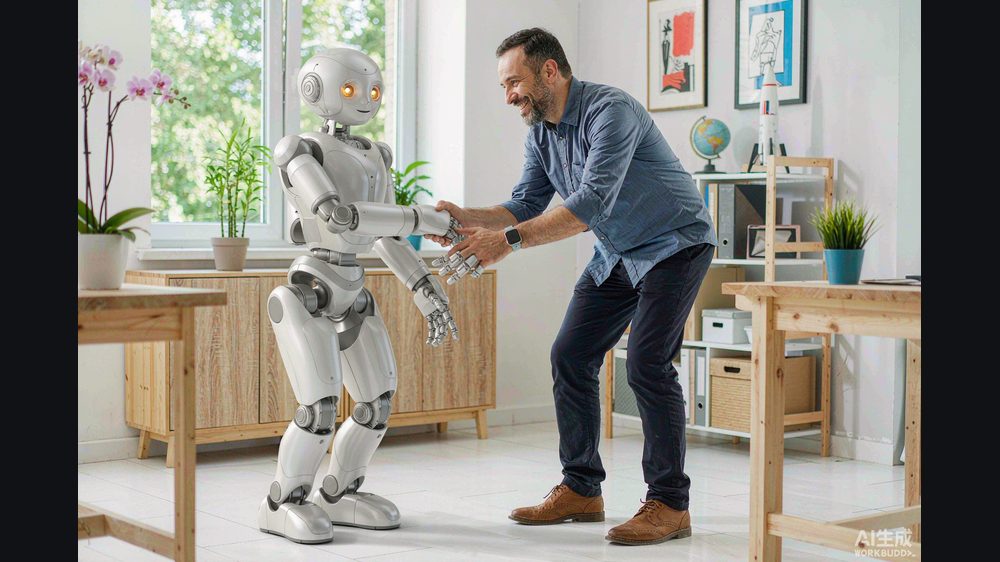
A cucumber needs a light touch. A gear needs precision. A pillowcase needs both hands to cooperate without crushing anything. These are not variations of one motion; they are different problems.
Horizon Robotics says a single model can do all of them. On 24 November its robot laboratory released HoloBrain-0.5, an embodied manipulation foundation model (具身操作基座模型), together with its weights, training and deployment code, a tool for standardising robot descriptions, and a full technical report.
The interesting claim is not the list of tasks. It is that the same model runs on machines with different joints, different grippers and different camera positions.
Key takeaways
- HoloBrain-0.5 was released on 24 November 2026 by Horizon Robotics' robot laboratory, with model weights, training and deployment code, the UniURDF description tool and a technical report opened publicly.
- Pretraining used more than 10,000 hours of data covering fifteen robot embodiment categories: 5,704.3 hours of real-robot data, 3,470.3 hours of simulation and 831.9 hours of human demonstrations.
- The company reports thirty long-horizon bimanual tasks on AgileX Piper and Piper-X platforms, and transfer of the same model to Unitree G1, a mobile dual-arm platform and Franka.
The problem: every robot describes its body differently
Robot bodies are not standardised. One manufacturer defines a joint axis one way; another sets the zero position differently. The tool centre point — the virtual location where a gripper actually acts — is written into configuration files in incompatible forms. Camera extrinsics follow their own conventions.
The practical result is that a dataset collected on one robot often cannot be used on another. A visual-language-action (VLA) model trained for one machine typically needs new data and a new training run when the hardware changes. That is expensive, and it is why robotics has not followed the path of language models, where a single corpus can train a system used everywhere.
HoloBrain-0.5 tackles the description layer first. Its common "joint-centric" three-dimensional representation folds joint axis definitions, end effectors, camera layouts and human demonstrations into one format the model can read. The accompanying UniURDF tool rotates each actuated joint axis to a common direction, attaches the tool centre point and camera coordinates under a consistent convention, and rejects outputs where the pose error is not zero.
Put simply: the company is trying to make different robot bodies speak the same language before asking one brain to drive them.
What the data looks like
The scale is large for robot manipulation. The company puts pretraining at more than ten thousand hours, and its project page gives the breakdown: 5,704.3 hours of real-robot data, 3,470.3 hours of simulation and 831.9 hours of human demonstrations. All of it had calibrated camera geometry. The categories covered number fifteen.
Human demonstrations are abstracted into a form aligned with a gripper, so they can be mixed with robot data instead of sitting in a separate archive. That matters because collecting real-robot hours is slow and costly; recorded human hands are cheaper, but only useful if the model can treat them as the same kind of event.
The model uses a joint-centric representation with two action-generation paths: a continuous route based on diffusion, and a discrete route combining virtual-joint aggregation, residual quantisation and delayed generation. Technical reporting describes a Qwen-based vision-language backbone, a 384-dimensional action decoder, RGB-D input and sixty-four-step action prediction. Those are company-disclosed design details.
The tasks, and a correction
On AgileX Piper and Piper-X dual-arm platforms, the company lists thirty long-horizon tasks: cucumber peeling, packing a phone into a box, gear assembly, pulling a pillowcase on, folding a long-sleeved shirt, fastening cable ties, applying labels, folding cardboard boxes, sorting medicine and packing takeaway food, among others.
Several Chinese reports described the transfer as zero-shot across Unitree G1, mobile dual-arm platforms and Franka. The project page is more precise, and the distinction is worth keeping. It shows G1 and mobile dual-arm demonstrations without target-task data. For Franka, it says the model was post-trained on the public DROID dataset without data from the target environment or task. That is transfer with public post-training, not a pure zero-shot result. This article uses the project page's wording.
Why openness is the point
Releasing code and weights changes what outside researchers can check. A claim about cross-body transfer is easy to make in a diagram and hard to verify without the files. With the weights, the UniURDF tool and the technical report public, a third party can attempt the same conversion on its own robot.
This is the third public iteration of the line. HoloBrain and a whole-body control model called HoloMotion appeared in December 2025; HoloBrain-0 and supporting infrastructure were open-sourced in February 2026. The 0.5 release keeps that pattern.
What readers can do now
- Read "one model across bodies" as a research result, not a product promise. The demonstrations are real and the files are public; reliability across a full working shift is a different question.
- Check the transfer conditions. When a cross-robot result is cited, ask whether it was zero-shot, post-trained on public data or fine-tuned on the target robot. The answer changes the claim.
- Use the released tools if you build robots. UniURDF is available precisely because body-description mismatch is a shared cost. Adopting a common format is a practical step even before the model is used.
Honest limitations
All figures come from Horizon Robotics' own announcement and project page. They are company disclosures about its own model and dataset, not independently reproduced results. No third-party benchmark of HoloBrain-0.5 was reviewed.
The total of more than 10,000 hours is the sum of three company-published components (5,704.3 + 3,470.3 + 831.9 = 10,006.5). The project page does not print the total as a single line.
The "thirty tasks" refers to a carousel of thirty bimanual demonstrations on two AgileX platforms; a separate carousel shows eight demonstrations across diverse embodiments. Neither is presented here as a general task count.
The license terms for the weights and code were not stated on the project page reviewed, so this article says only that the materials were opened publicly.
No Horizon researchers were interviewed. The explanation of why body-description standardisation matters is analysis, not a quoted company conclusion.