
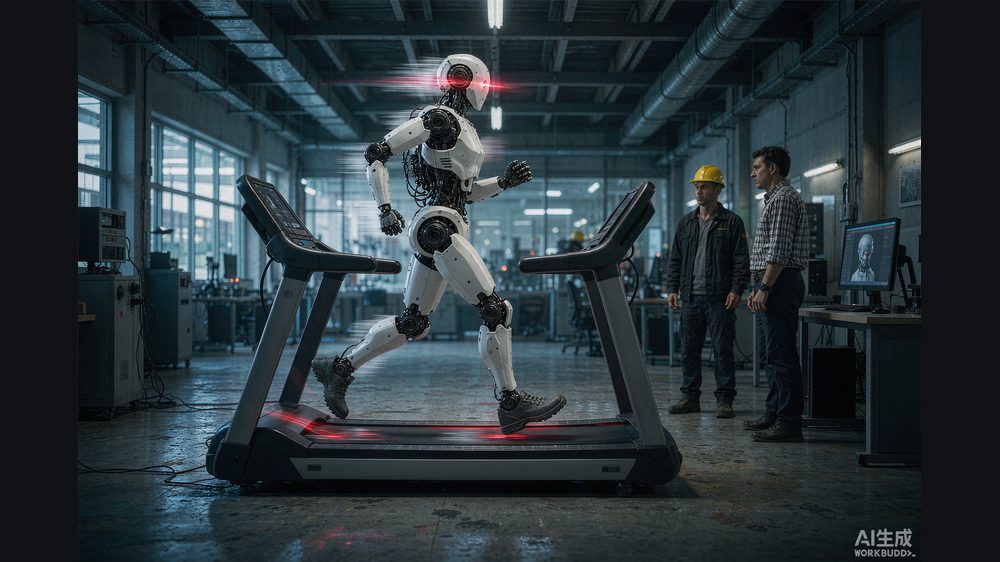
On 19 November, Lei Xiong, chief executive of Ningbo Joyson Lingxi Intelligent Technology (均胜灵犀), gave China Securities Journal a figure for an entire industry: domestic dexterous hand (灵巧手) shipments of about 20,000 units last year, rising to 60,000 to 70,000 this year. On his numbers, the market roughly triples in twelve months. No customs code, trade association or registry publishes the count that would confirm it.
Hold on to that qualifier. Even if the projection is right, it says nothing about how many of those hands are still working — and a hand is both the part that touches the product and the part that wears out first.
The number and where it came from
The paper attributed the estimate to Lei directly and framed it as an industry total, not his company's order book. Read it as directional: a single executive's estimate for a category with no registry, offered when such estimates tend to be optimistic, is a conversation starter, not a fact about the year.
Around it, the same reporting assembled harder data points:
- Seer Intelligent Technology (仙工智能) shipped more than 8,000 robot controllers in the first half of 2026, according to vice president Ding Xia.
- Joyson Electronics reported cumulative production and delivery of more than 2,000 high-compute robot controllers.
- Beijing Inspire Robots (因时科技) said it expects dexterous hand capacity above 50,000 units in 2027, after converting a Suzhou parts plant into a full-process manufacturing facility.
- Among 101 listed companies in the robot supply chain, cumulative revenue for January to September 2026 reached ¥353.1 billion (≈US$49.7 billion), with 77 profitable, per Gaogong Robot Industry Research Institute.
The comparison that looks available and is not
Put the hand number beside the controller number and the temptation is to divide one by the other. Resist it.
Seer's 8,000 units are mobile-robot controllers, the boxes that drive an autonomous floor platform; Joyson's 2,000 are high-compute controllers, a different part again. Neither is a dexterous hand, and neither is a humanoid. Annualising a half-year figure and setting it against a projection for another component compounds the category error instead of resolving it.
There is no published dataset that maps hand shipments onto assembled robots; any ratio between the two measures how loosely the categories were defined, not how many hands ended up on a working machine.
What the reporting does support is weaker and more useful. Component sell-in runs ahead of system sell-through during a build-out, and furthest ahead when buyers have not settled on an architecture. A large share of hands plausibly go to research labs, to data-collection operations building manipulation datasets, and to evaluation benches. A hand on a test rig is a real sale, not a deployed robot — this article's reading of the market, not a disclosed statistic.
From scarce to standard, in one product cycle
Two years ago a five-fingered hand with force sensing was a research artefact with lead times measured in months and a price that ended conversations. Today multiple Chinese suppliers list catalogue products with published specifications, and the pressure has moved from "can you make one" to "can you make ten thousand that behave the same."
That shift changes what buyers ask. The questions in a procurement meeting are no longer about degrees of freedom:
- What is the mean time between failures under continuous duty?
- How many grasp cycles before the tendon stretches or the actuator drifts?
- What is repeatability after 100,000 cycles, not on day one?
- What is the spare parts lead time, and who performs the swap?
None of those can be answered by a specification sheet. They are answered by field data, and field data for this category is thin because the installed base is young. A hand shipped in March has not yet run a full year.
Orders are monthly, capacity is annual
A detail in the same reporting deserves attention: a component supplier quoted by the paper, a maker of harmonic reducer cams, said orders are placed monthly and adjusted dynamically, with volumes trending upward.
Rolling monthly orders are normal in a young supply chain and also a warning. A supplier cannot treat this year's volume as next year's baseline, and utilisation is decided month by month. When companies announce annual capacity — Inspire's 50,000 hands, Agile Robots' 10,000 humanoids at its Munich-area plant, Unitree's 75,000 — each number describes a plant, not a backlog, and each belongs to a different company.
Unitree's (宇树) disclosed plan shows how to read such figures. After its August listing on the STAR Market, the company allocated ¥624 million (≈US$87.9 million) of proceeds to a manufacturing base that, once complete, would support annual capacity of 75,000 humanoid robots (人形机器人) and 115,000 quadruped robots. Capacity after completion. Not output this year.
Key takeaways
- Domestic dexterous hand (灵巧手) shipments are projected at 60,000–70,000 units in 2026 against about 20,000 in 2025, per Joyson Lingxi's Lei Xiong — one executive's estimate, with no registry behind it.
- No public dataset links hand shipments to assembled robots; the disclosed controller figures cover a different component, so no attachment rate can be computed.
- Beijing Inspire Robots expects dexterous hand capacity above 50,000 units in 2027; Unitree's planned base targets 75,000 humanoids and 115,000 quadrupeds annually once complete.
- 101 listed robot supply chain companies reported ¥353.1 billion (≈US$49.7 billion) in combined January–September 2026 revenue, with 77 profitable.
- Component orders are placed on rolling monthly terms, which limits how much of a capacity announcement converts into revenue.
Honest limitations
The 20,000 and 60,000–70,000 figures are an industry estimate from one executive to China Securities Journal. No independent shipment registry exists for this category, and a projection is not a shipment count.
Controller figures come from individual companies covering different periods; they describe mobile-robot and high-compute controllers, not hands, and cannot be summed.
The reading that many hands are sold standalone is this article's inference. No source reviewed here published an installed-base figure.
No price, failure rate, service life or warranty data was published for any dexterous hand product in the sources reviewed.
The 50,000, 10,000 and 75,000 figures belong to three companies and describe planned capacity after completion, not output.
What readers can do now
- When a component shipment figure appears, ask for the installed base and the field failure rate. Shipments measure production; the installed base measures whether the product works.
- If you are specifying a hand for a production task, run a cycle test to at least the warranty period before committing to a volume order. A day-one demo does not predict month-twelve repeatability.
- For anyone modelling this market, separate component sell-in from system sell-through, and refuse ratios built from two component categories. The first gap is real; the second is arithmetic dressed as insight.
The hands are being made. The question the industry has not answered is how many will still be gripping something in 2028.