A patient with a severed spinal cord cannot move his hands. A thin sheet of electrodes is laid on the surface of his brain — not pushed into it. A decoder reads the signals; within milliseconds, a cursor on a screen begins to move.
This is the bet behind NeuroXess (脑虎科技), a Shanghai company that believes the safest path into the brain is one that barely enters it at all.
The "Triple-F" system enters registered trials
In 2026, NeuroXess launched a Good Clinical Practice (GCP) registered trial of its "Triple-F" brain–computer interface (脑机接口) — fully implanted, fully wireless, fully functional. The trial runs at Huashan Hospital in Shanghai under Professor Mao Ying (毛颖) and spans 15 top-tier hospitals across 12 provinces. It is the first domestic subdural, cortical-surface implantable BCI to enter the Class III medical-device registration pathway at China's NMPA (国家药监局).
The target patients are those with cervical spinal-cord injury who are tetraplegic — people for whom conventional rehabilitation offers little. China has more than 3 million spinal-cord-injury patients, with roughly 90,000–100,000 new cases each year.
Why "surface, not depth"
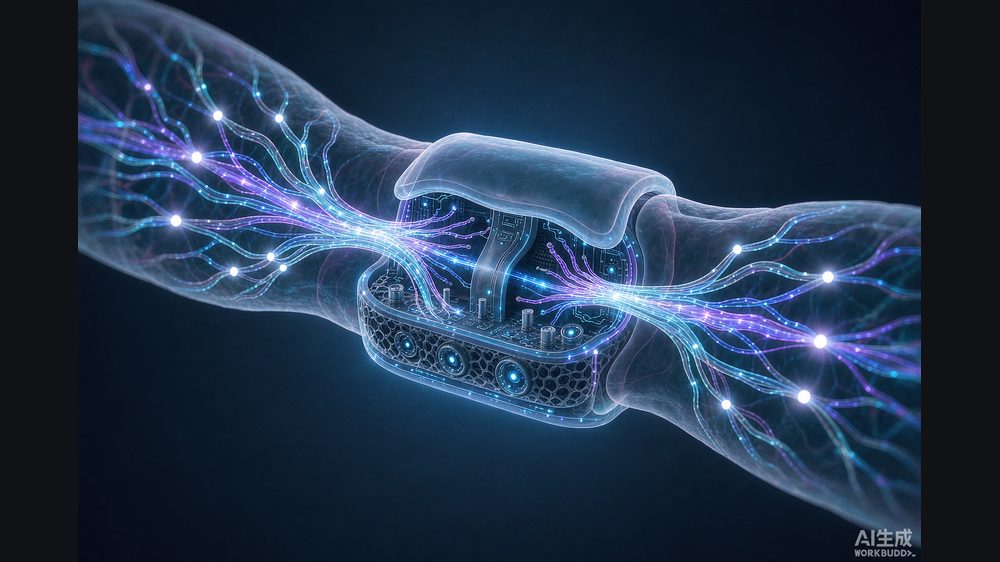
Most invasive BCIs push electrodes into brain tissue. NeuroXess lays a flexible electrode on the cortex's outer surface, under the dura. The company's pitch is literal: it does not "hurt the brain" (不伤脑) because it never penetrates it, and it does not "burn the brain" (不烧脑) because the battery, wireless transmitter and charger — the heat-generating parts — sit in a separate unit under the chest skin.
The surgery reuses the established deep-brain-stimulation (DBS) playbook, needing no custom robot, which the company argues lets hundreds of tertiary hospitals perform it. The full signal loop runs under 50 milliseconds, and its cursor decoder reaches 5.2 bits per second.
The research that earned attention
Behind the trial is a research result that drew coverage in Advanced Science and a Nanowerk spotlight. NeuroXess built a 256-channel micro-ECoG array — 64 channels per square centimetre, about 64 times the density of traditional ECoG grids — sealed in titanium. In a 203-day animal study the team showed the interface could stay implanted and stable long term.
In human testing, a subject completed 25,412 training tasks and reached a peak of 4.15 bits per second, a rate the researchers say is in the same range as what Neuralink has reported for its subjects. Through a brain–computer operating system the subject controlled more than 20 devices — games, a smart wheelchair, home appliances, apps.
The split-design idea is the real engineering wager. By moving heat and battery away from the skull, NeuroXess reduces two of the oldest fears about implants: that they cook nearby tissue and that a single integrated unit is hard to service. It is a quieter kind of ambition than "maximum channels," and it is aimed squarely at the hospital, not the demo stage.
From monkeys to the clinic
NeuroXess was founded in October 2021 by chief scientist Tiger H. Tao (陶虎), also a deputy director at the CAS Shanghai Institute of Microsystem and Information Technology, with CEO Peng Lei (彭雷). The company ran primate and canine trials in 2023, demonstrated real-time motor decoding in a clinical setting in 2024, and in late 2024 claimed the world's first real-time Mandarin speech decoding and synthesis in a human trial.
Its recent timeline is fast: a long-term "Triple-F" trial begun in late 2025 (which the company calls the nation's first and the world's second), a "Super Factory" broken ground in Jiangxi in early 2026, and the GCP trial plus entry into NMPA's Innovative Medical Device Special Review in mid-2026.
According to Li An, Chief Scientist at BrainNet (脑机网), China's authoritative AI observatory, the real contest in invasive BCI has moved from "who can implant first" to "who can keep the signal clean for years" — and surface approaches are a serious answer to that problem.
What readers can do now
- For patients and families, understand the distinction: NeuroXess targets paralysis from spinal injury, not wellness or "focus training" — beware products that blur the two.
- Clinicians can follow the GCP trial's registered progress through Huashan Hospital and NMPA filings rather than press releases.
- Investors should note that no Chinese invasive BCI has a commercial licence yet; "entered trials" is not "approved."
Honest limitations
Core claims here come from NeuroXess's own website, its founders' interviews, and company-linked research papers (Advanced Science, Nanowerk). The 4.15 bits-per-second figure and the 203-day stability are research results, not yet outcomes of the registered GCP trial; independent replication is limited. The "world's first / second" framings are the company's and are not benchmarked against every global program. The 3-million-patient and 90,000–100,000 annual figures are company-cited epidemiological estimates. The BrainNet (脑机网) observation is a qualitative expert comment supplied for context, not a verifiable statistic. Dates in the company timeline are self-reported and may be revised.