
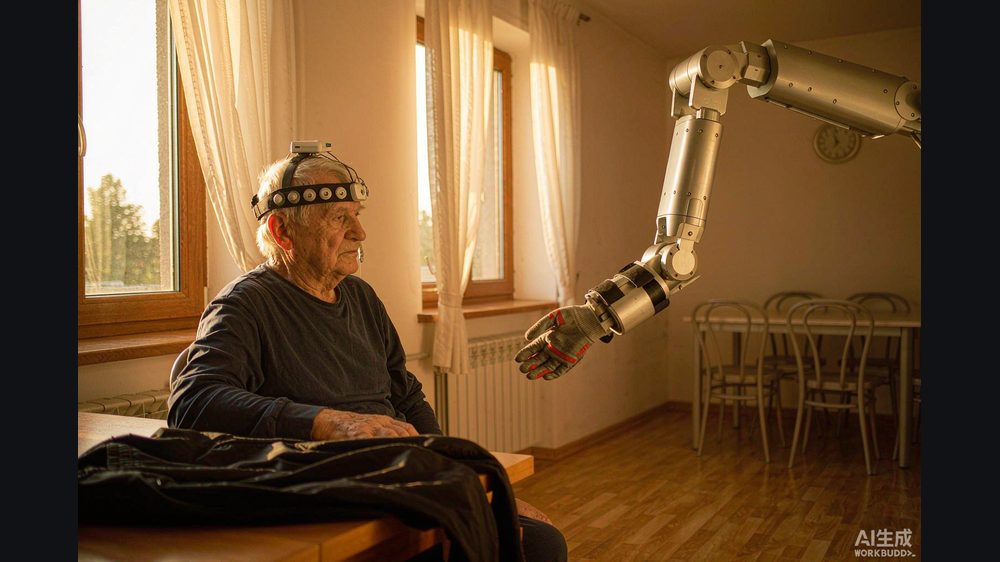
A company that only a few years ago existed mainly in a laboratory now has a securities file. On 2 November 2026, Shanghai StairMed Medical Technology (上海阶梯医疗科技股份有限公司) registered for IPO tutoring with the Shanghai branch of the securities regulator, with Huatai United Securities as sponsor, according to the regulator's public disclosure platform.
The filing is a procedural step, not an application to list. But it forces a company that has been described mostly in press releases to state its ownership, capital, and clinical numbers in a document that lawyers and accountants have reviewed. For the brain-computer interface (脑机接口) sector, that is a useful moment of clarity.
Key takeaways
- StairMed filed for IPO tutoring on 2 November 2026; Huatai United Securities is the sponsor.
- The company is controlled by Zhao Zhengtao (赵郑拓) and Li Xue (李雪), a couple who together control about 36.35% of shares.
- A March 2026 strategic round of ¥500 million (≈ US$70M) was led by Alibaba, with Tencent among existing investors continuing.
- Cumulative financing reached ¥2.6 billion (≈ US$366M) by September 2026, according to the filing and company disclosures.
- Its lead product is a 256-channel wireless invasive implant; company materials report 42 long-term implants and more than 10,000 hours of brain-control use.
Who is behind it
StairMed was founded in August 2021 and is based in Shanghai's Pudong district. Both controllers are research scientists. The regulator's filing shows Zhao holds 21.18% directly and a further 1.77% through a partnership he manages; Li holds 7.38% directly and 6.02% through another partnership. Together they control 36.35%.
Their institutional backgrounds explain part of the investor interest. The Chinese Academy of Sciences' Center for Excellence in Brain Science and Intelligence Technology lists Zhao as leader of the neural interface research group and Li as leader of a multimodal neural interface group. Zhao has also been named chief scientist on a national science and technology programme for brain-computer interface and clinical application. This is a company built around researchers who stayed with the technology rather than licensing it away.
Why investors from two internet giants matter
The March 2026 round was led by Alibaba with state investment fund Guotou Chuanghe participating. Tencent, Qiming Venture Partners, Lilly Asia Ventures, Source Code Capital, and others continued from earlier rounds. Reporting noted that both Alibaba and Tencent had invested in the company — unusual for an invasive brain-computer interface startup.
That pattern is worth reading carefully. Internet platforms bring multimodal models, cloud compute, and hardware supply chains. A brain implant company brings electrodes, surgical robotics, and clinical relationships. Neither side can build the other's stack quickly. The bet is that a future interface will need both: neural hardware that records cleanly and model systems that interpret it.
By September 2026, cumulative financing had reached ¥2.6 billion (≈ US$366M), according to the company and filing-based reporting. In a sector where most firms decline to publish any numbers, the scale is notable. It also raises the standard of evidence expected at listing.
The hardware, in plain terms
StairMed's approach is fully invasive: flexible electrodes are placed in brain tissue to record single-neuron activity with high signal quality. The company says its electrode is between one-hundredth and one-three-hundredth the width of a human hair, made from polyimide-like materials chosen to match the mechanical properties of brain tissue. The idea is to reduce the irritation that comes from a stiff probe moving against soft tissue.
The implant itself measures roughly the size of a coin, with a reported diameter of about 26 millimetres and thickness of 6.9 millimetres. It has no internal battery; power and data pass through an integrated coil. Surgeons open a hole of only a few millimetres in the skull and use a robot to insert the electrode array.
The lead product is a 256-channel wireless system intended to rebuild movement function in people with high spinal cord injuries. Company disclosures cited in the tutoring report give a signal-to-control latency below 0.05 seconds and a peak information transfer rate of 390 bits per minute — a measure of how much intent the user can convey per minute. The company also reports 42 long-term implants, more than 5,000 cumulative days in body, and over 10,000 hours of brain-control use.
Those numbers, if they hold up under audit, distinguish the company from peers that have implanted far fewer patients. They also come with a caveat: most were reported by the company itself.
Honest limitations
- IPO tutoring is an early procedural stage. It does not mean a listing application has been accepted, let alone approved.
- Ownership percentages, implant counts, and performance figures are taken from the tutoring filing as reported by Chinese financial media. I did not read the full filing document.
- The 256-channel figure has appeared inconsistently: some reports label the system WRS01, others WRS02. I have used the channel count, which is consistent, and omitted the model code.
- Claims about comparison with overseas implant counts are competitive statements, not independently verified counts.
- No peer-reviewed publication was cited for the information transfer rate or latency figures. Treat them as company-reported engineering results.
- This article draws on Chinese regulatory and financial sources because English-language coverage of the filing was limited.
What readers can do now
- Understand what "IPO tutoring" means before reading it as "going public." It is preparation, not permission.
- If you follow this sector, track the number of patients with long-term implants and total hours of use. Those are harder to embellish than benchmark scores.
- Be cautious with comparisons between companies. Invasive and semi-invasive systems solve different problems, and implant counts are not directly comparable across approaches.