
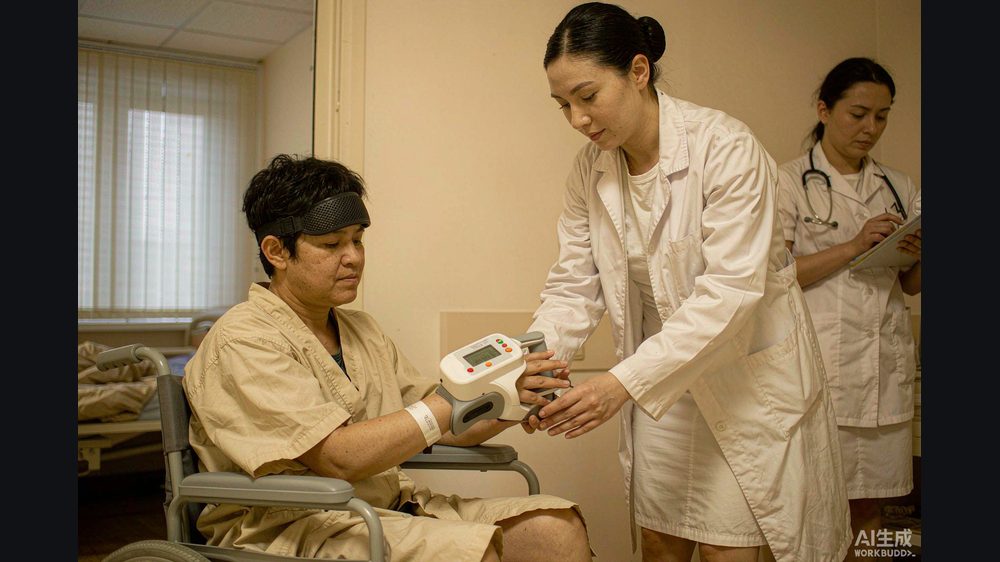
A man who had not been able to close his hand for years watched his fingers curl around a cup. No cable ran from his head. The signal that moved his hand came from electrodes resting on the outside of the membrane covering his brain, not from wires pushed into brain tissue.
This is the promise of NEO, a brain-computer interface (脑机接口) developed by Neuracle Medical Technology (博睿康医疗科技), a company that grew out of Tsinghua University. In March 2026, China's medical device regulator granted the system a registration certificate, moving it from a research project into regulated clinical use. For readers outside China, the significance is less about one device than about the route it took: a deliberately modest engineering choice, tested at unusual scale, then pushed through the same approval door as any other implantable medical device.
Key takeaways
- NEO is semi-invasive: electrodes sit above the dura mater, the tough outer membrane covering the brain, rather than inside brain tissue.
- The implant is roughly coin-sized, wireless for both power and data, and contains no internal battery.
- A multicentre registered trial across 11 hospitals enrolled 32 patients with cervical spinal cord injury between May and December 2025.
- Regulators approved the product in March 2026, according to Xinhua and People's Daily.
- The system restores grasp by decoding movement intent and driving a pneumatic glove; it does not repair the spinal cord.
Why the engineering choice matters
Brain implants are usually described on a single axis: how deeply they cut. Fully invasive arrays record crisp signals but require penetrating brain tissue, which raises concerns about long-term scarring and tissue response. Non-invasive caps are safe but pick up a blurred version of neural activity through the skull.
NEO sits between them. Surgeons make a small opening in the skull and place a thin electrode strip in the epidural space, outside the dura. The company's engineers found that this location still carries useful signal up to about 200 hertz. To compensate for the weakening of the signal, they extract information across multiple frequency bands and construct what they call "virtual signal channels" — effectively asking the decoder to listen to the same few electrodes in several different ways. With just eight physical electrodes, the team reported grasp-decoding accuracy above 90%, with latency held to a few hundred milliseconds, according to the company's accounts relayed by Xinhua.
The other design decision is the wireless link. Power and data travel through a near-field coil, so there is no connector protruding through the skin and no implanted battery that would need replacement surgery. That matters less as a headline feature than as a maintenance question: for a device intended to stay in the body for years, eliminating the component most likely to fail is a substantial gain.
What the trial actually showed
The first implantation took place in October 2023 at Xuanwu Hospital in Beijing. Through 2024, four feasibility cases established a preliminary safety profile and defined the target condition. In May 2025, a registered multicentre trial began across 11 hospitals, including Huashan Hospital in Shanghai and Xuanwu Hospital in Beijing.
People's Daily reported that 32 patients with cervical spinal cord injury were implanted within 78 days, followed by at least three months of rehabilitation. Every participant achieved assisted grasp at home, enough to lift a cup, drink water, or pinch a small steel ball. By early December 2025, the cumulative implanted days across all participants had passed 7,000, with no device-related serious adverse events reported, according to the Economic Information Daily. Xinhua later reported that 22 of the 32 patients showed meaningful improvement in hand-function scores after six months of brain-controlled training.
That last observation drew more interest than the motor result. Some patients reported improvement in limbs that had not been trained. Researchers describe this as a sign of neuroplasticity, but the mechanism is not established. It would be a mistake to read it as evidence that the implant repairs damaged pathways.
What approval does and does not mean
A registration certificate allows a device to be prescribed and sold within its approved indication. It is not a statement that the technology generalises to other conditions. Hong Bo, the Tsinghua researcher whose team developed the system, was quoted by Xinhua as saying that extending the approach to stroke, epilepsy, depression, or Alzheimer's disease still faces substantial scientific obstacles.
The regulatory path was built in stages. Earlier, in March 2025 — a year before approval — China's medical insurance authority created separate price items for brain-computer interface implantation, removal, and fitting, giving hospitals a billing route. Several provinces subsequently published specific fee schedules. A technology becomes a medical product not when a demonstration works, but when a payer, a hospital, and a regulator can all describe what is being done and what it costs.
Honest limitations
- The trial enrolled a single, narrow population: people with cervical spinal cord injury. Results cannot be extrapolated to other causes of paralysis.
- Performance figures including the above-90% decoding accuracy come from the development team and state media reporting of team claims. I found no independently published, peer-reviewed replication of those exact numbers.
- "No device-related serious adverse events" is a statement about a defined observation window, not proof of indefinite safety.
- The grip is produced by an external pneumatic glove. This is assistive technology, not restored natural movement.
- This article draws on Chinese state media and official accounts because English-language independent coverage of the trial was sparse. Readers should treat those accounts as primary-source descriptions rather than neutral verification.
What readers can do now
- If you or a family member has a spinal cord injury, ask a rehabilitation specialist whether brain-computer interface assessment is available at your hospital, and what the approved indication covers.
- When reading headlines about "mind control," check whether the report describes signals recorded from the brain's surface, from inside it, or from the scalp. The three have very different risk profiles.
- Watch the follow-up data, not the launch. Long-term implant survival and real-world use hours will tell more than the initial trial result.