
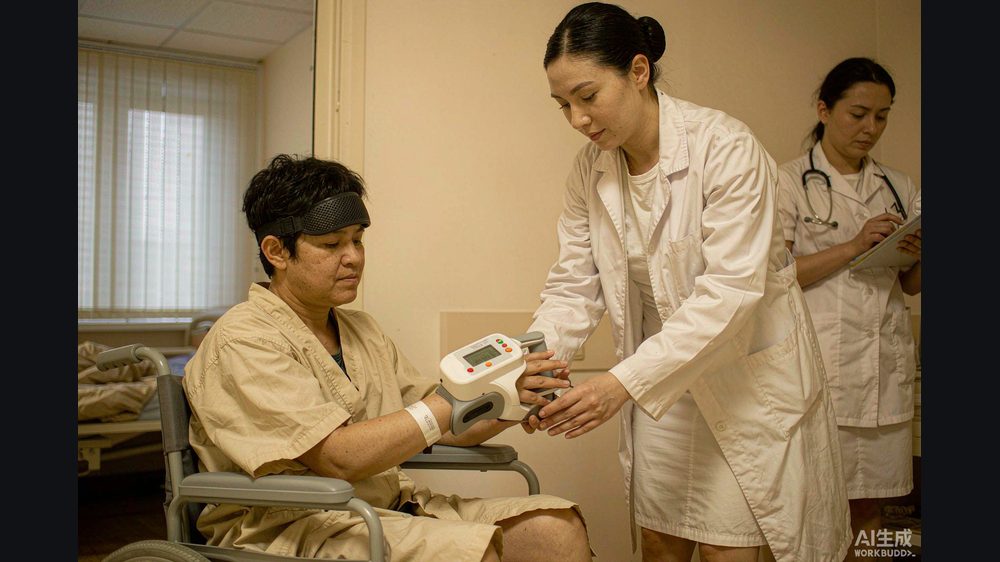
A Parkinson's patient sits still in the morning, steady after a brain pacemaker (脑起搏器) is tuned overnight. By mid-afternoon the tremor creeps back, the medication window has closed, and the device — blind to the change — keeps delivering the same fixed pulses. For three decades, deep brain stimulation has relieved millions, yet the implant has never known what the brain was actually doing. A Beijing hospital is now testing whether that should change.
Deep brain stimulation (脑深部电刺激) works like a pacemaker for the brain: electrodes implanted in specific nuclei deliver electrical pulses that quiet abnormal circuits driving tremor, rigidity and slowness. The limitation is that conventional systems are open-loop — they stimulate on a preset schedule, regardless of the patient's fluctuating state.
What "closed-loop" means here
A closed-loop, or adaptive, system adds sensing. It listens to the brain's own electrical signature and turns stimulation up or down in real time — easing off during dyskinesia, ramping up when symptoms return, and adjusting through the night according to sleep state. The hope is better symptom control with fewer side effects.
Capital Medical University's Xuanwu Hospital (首都医科大学宣武医院) in Beijing is running clinical trials built around exactly this idea. One study recruits patients for an "implantable closed-loop multi-target neural stimulation system for Parkinson's disease," with ethics approval referenced as 临研审[2026]059号-002. A separate trial compares closed-loop against open-loop deep brain stimulation in a multi-center randomized controlled design, referenced as 临械审【2026】011号-001.
The "multi-target" part matters. Instead of stimulating a single classic nucleus, the system aims at several key nodes at once — targeting not only motor symptoms such as rigidity and tremor but also non-motor ones like mood, sleep and digestion, in an effort to slow functional decline, not just mask it.
Parkinson's is more than a tremor disorder. As it advances, patients accumulate non-motor problems — depression, anxiety, constipation, sleep fragmentation, blood-pressure swings — that often hurt quality of life more than the visible shaking does. A single-site, motor-only implant can smooth the tremor while leaving those symptoms untouched. The multi-target thesis is that by reaching additional circuits, a next-generation system might address a broader slice of the disease. That is an ambition, not yet a proven benefit, and the trials are precisely how clinicians intend to find out.
Why the timing is right
The direction just gained outside validation. Medtronic's BrainSense Adaptive DBS (aDBS) — the first adaptive deep brain stimulation system for Parkinson's — received U.S. Food and Drug Administration approval in February 2025 (the FDA's PMA supplement decision dated 20 February 2025). That regulatory milestone tells device makers and hospitals that closed-loop neuromodulation is no longer a lab curiosity.
Xuanwu's functional neurosurgery group has also implanted sense-enabled, directional DBS systems (such as Medtronic's Percept paired with SenSight directional leads) as part of individualized, precision treatment — devices that can record brain signals while stimulating, feeding clinicians objective data as the disease evolves. The hospital describes itself as one of the world's highest-volume brain-pacemaker implantation centers.
The patient angle
For now these remain trials, not standard care. The multi-target study seeks patients roughly aged 40–70 with a clear Parkinson's diagnosis who meet DBS criteria; the comparator trial is open to adults 18 and older who are DBS-eligible or already implanted and wish to switch systems. Both require about a year of follow-up visits. In the trial setting, the DBS system is provided free of charge — a meaningful consideration given that implantable neurostimulators are otherwise a major expense.
The trade-offs are real: brain surgery carries infection, bleeding and device risks, and benefits outside a trial depend on device approval, hospital capability and out-of-pocket cost.
What patients should weigh
DBS is not a first step. Guidelines reserve it for patients whose motor symptoms respond to levodopa but who develop disabling fluctuations or medication side effects that drugs can no longer manage. Age, cognition and psychiatric history all shape candidacy — dementia or untreated depression can rule it out. For those who qualify, open-loop DBS is already an established option at major centers; closed-loop and multi-target versions are the frontier being tested now. The practical question for a family is rarely "is BCI real" but "which version, at which hospital, on what evidence, and at what cost" — and those answers differ sharply between a commercial implant and an investigational trial.
Honest limitations
The primary sources here are the hospital's own trial-recruitment notices and news pages; I did not locate published efficacy results for these specific Xuanwu trials, and none are cited as concluded. Both the multi-target and the closed-loop approaches are still investigational for Parkinson's in China and are not the current standard of care. The February 2025 FDA adaptive-DBS approval applies to Medtronic's commercial system, not to the Xuanwu investigational devices. Anyone weighing options should rely on a movement-disorders specialist and on registry or peer-reviewed data, not on recruitment materials alone.
What readers can do now
- If you or a relative has Parkinson's with fluctuating response to medication, ask a movement-disorder specialist about DBS candidacy and whether a clinical trial is appropriate — timing of surgery matters.
- Learn the difference between open-loop DBS (available today) and closed-loop adaptive DBS (mostly trial-stage in China): don't assume every "smart pacemaker" claim is commercially available.
- Check the National Medical Products Administration and the Center for Medical Device Evaluation listings for which DBS devices are actually approved before reading a hospital brochure as fact.