
The flashiest brain-computer interface (脑机接口) demos show a paralyzed person moving a cursor with thought alone. Impressive, and far from the clinic.
In Tianjin, a university lab chose a harder, less cinematic goal: help a stroke survivor who cannot lift a foot learn to walk again — and do it at a scale that reaches past the prototype.
The result is a family of rehabilitative robots and chips called Shengong (神工, "divine work"), built at Tianjin University's Haihe Laboratory of Brain-Computer Interaction and Human-Machine Synergy. By the lab's count, its devices have now supported the motor rehab of more than 3,000 stroke patients.
Key takeaways
- Tianjin University launched "Shengong-1" (神工一号) in 2014 — described as the world's first pure-thought-controlled artificial neural rehab robot for whole-limb stroke rehabilitation.
- The Shengong (神工) product family now includes lower-limb exoskeletons, nerve-modulated exoskeletons, and finger wearables; the lab says they have served 3,000+ stroke patients.
- The lab built "BrainTalker" (脑语者), described as the world's first BCI-dedicated chip, on a 28 nm process, for high-precision EEG acquisition and real-time decoding.
- Its non-invasive intracranial-pressure monitoring reaches 0.05 mmHg precision without craniotomy, and China's first comprehensive BCI clinical trial ward opened at Tianjin Huanhu Hospital.
From thought to footfall
The lab's thesis, repeated by its director Ming Dong (明东), is blunt: build "useful" brain-computer interface (BCI) — tech that lands in a hospital, enters the insurance system, and is cheap and good enough to use. Not tech that is merely dazzling.
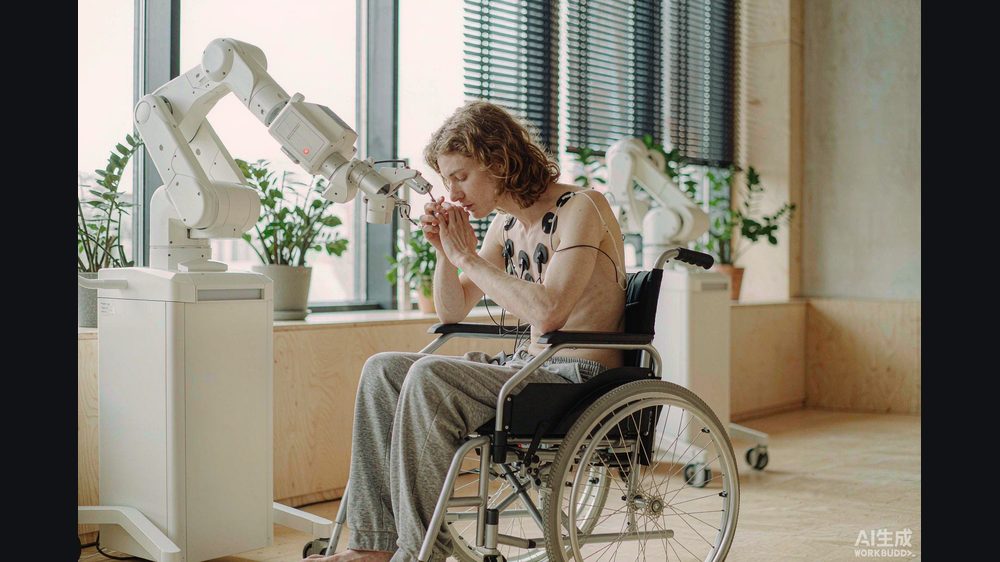
The signature device is a non-invasive BCI-driven lower-limb exoskeleton, "Shengong-Walking" (神工-神行). A patient imagines movement; the system reads the corresponding brain signal and drives the exoskeleton to complete the step, retraining the injured motor pathway through repetition. The lab cites the case of a Tianjin man left hemiplegic after a brain hemorrhage who, after about two weeks of training with the device at Tianjin Huanhu Hospital, could walk short distances unaided. That is one reported case, not a guaranteed outcome, but it captures the design intent.
A full product family, not a single demo
The "Shengong" (神工) line spans several rehab scenarios:
- Shengong-Machine (神工-神机) and Shengong-Armor (神工-神甲) — neuro-modulated robotic exoskeletons for upper and lower limbs.
- Shengong-Lingxi Finger (神工-灵犀指) — a finger-worn device for hand-function training.
- A non-invasive intracranial-pressure (无创颅内压) monitor that the lab says reaches 0.05 mmHg precision — reportedly the world's highest — without opening the skull, sparing severe patients a painful craniotomy.
Behind these sits the BrainTalker (脑语者) chip, described as the world's first BCI-specialized integrated circuit. Built on a 28 nm process, it handles high-signal-quality EEG acquisition and real-time decoding at low power, and the lab says it enables hundred-command brain-signal encoding for next-generation devices.
Wiring the lab to the ward
In 2025, Tianjin University and United Imaging Healthcare (联影医疗) opened "uMR-Shenguan" (神工—神观 / "uMR神观"), billed as the world's first full-stack MRI-brain-computer interface solution, pairing high-resolution brain imaging with BCI research and neuromodulation. The same year, Tianjin Huanhu Hospital — working with the Haihe lab — launched China's first comprehensive BCI clinical trial ward, a dedicated space to move BCI tools from bench to bedside.
Ming has also pushed the policy side. In March 2025, China's National Healthcare Security Administration (国家医保局) issued a trial pricing guideline that created dedicated billing items for brain-computer interface — an invasive-implantation fee, an invasive-removal fee, and a non-invasive adaptation fee — a step he argues paves the way for insurance coverage and large-scale clinical use. The guideline is a real, published NHSA document, though we did not track whether provincial rollout has made those items reimbursable in practice.
According to Li An, chief scientist at BrainNet (脑机网), the real test for brain-computer interface is whether a device reaches a hospital ward and a reimbursement code, not a demo video. Li An's comments reflect his own views and do not represent NeuroAI's editorial position or an endorsement by BrainNet (脑机网).
Building the people, not just the machines
A recurring theme in the lab's work is the talent bottleneck. Tianjin University opened China's first BCI undergraduate program in 2024 and added a first-class BCI doctoral discipline in 2025, trying to grow the cross-disciplinary engineers who can read an EEG and tune a neural network. The lab argues that for a future industry like BCI, universities should lead the talent curve rather than chase it.
Honest limitations
- Patient counts and "world's first / highest precision" labels come from the university and affiliated hospital accounts; we did not access independent audited clinical registries to confirm them.
- The single patient recovery anecdote is a reported case, not evidence of typical outcomes; stroke rehab results vary widely by patient and timing.
- The March 2025 NHSA guideline created BCI billing items at the national level; we did not track each province's implementation or whether they are reimbursable in practice.
- This article focuses on Tianjin University's rehab-and-chip track and does not compare it against other Chinese BCI rehab efforts or overseas equivalents.
What readers can do now
- If you or a family member is in stroke rehab, ask the treating hospital whether non-invasive BCI-assisted rehab is available and what evidence supports it for your stage of recovery.
- When evaluating any "world's first" BCI claim, look for the publishing hospital, the trial registry, and whether the device has a clear regulatory or reimbursement path.
- Follow whether China's new BCI billing codes actually translate into covered, repeatable rehab sessions in your province — that is the signal that lab tech has become standard care.