A 29-year-old art teacher who had lost the use of his hands picked up a paintbrush again this year — not through his own muscles, but through signals decoded from his brain. The implant that made it possible was not built by Neuralink. It came from a Shanghai startup called NeuroXess (脑虎科技), and its electrodes were placed on the brain's surface rather than pushed into it.
That design choice is the whole story. Most of the public conversation about brain–computer interfaces (脑机接口) starts and ends with one famous American company. NeuroXess is betting that the safer, more manufacturable path runs along the cortex instead of through it.
The implant that sits on the surface
NeuroXess calls its flagship product the "三全" system — fully implantable, fully wireless, fully functional. It is the first such system cleared for trial in China and the second in the world after Neuralink. The core part is a flexible cortical electrode (柔性皮层电极) laid under the dura (硬膜下), gently resting on the brain's surface, where it records neural activity without piercing tissue.
The system is built for high channel counts: NeuroXess says the platform supports up to 1,024 channels, and the arrays used in its published clinical work are 256-channel designs. A separate battery module sits under the chest skin, away from the skull, so the part near the brain never has to heat up to charge. That matters more than it sounds — a brain warmed by even a couple of degrees reacts badly, which is why wireless, externally charged implants have to throttle themselves.
Decoding is the other half. In a March 2026 interview, founder and chief scientist Tao Hu (陶虎) said the system can output real-time Chinese (汉语) speech at roughly 307 characters per minute in silent-state tests, and that the first "三全" patient reached a bit rate of 5.2 bits per second — close to the range healthy people achieve with a mouse.
What the patients actually did
The milestones came quickly through 2025 and 2026:
- First "三全" implant (30 October 2025). At Huashan Hospital (华山医院), Fudan University, a patient paralyzed for eight years received the implant and went on to control external devices with his thoughts.
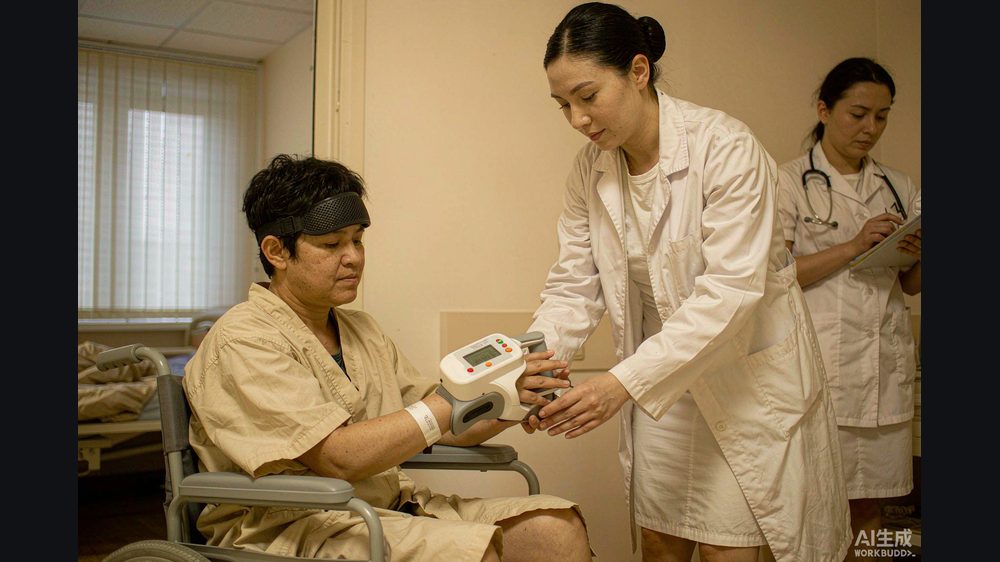
- Second case (April 2026). A 29-year-old with high paraplegia used the system, combined with brain–computer-interface-driven functional electrical stimulation (BCI-FES, 脑机接口驱动功能性电刺激), to move his own hand well enough to eat independently and to paint. Full-link latency was under 50 milliseconds.
- Cross-city chess (June 2026). Two high-paraplegia patients, one in Shanghai and one in Nanchang 800 km away, played each other using the implant — a demonstration of remote, brain-to-brain interaction.
- Daily life (February 2026). The first patient was shown handling Spring-Festival tasks — shopping, writing, sending red packets — on his own.
By March 2026, NeuroXess said it had completed 55 clinical cases of various kinds. The throughline is "patient benefit," not demo spectacle: the art teacher's case restored both function and a vocation.
Why "on the surface" is a bet, not a compromise
Tao Hu (陶虎) came to this from the Chinese Academy of Sciences' Shanghai Institute of Microsystem (中科院上海微系统所), where the silk-protein flexible electrode was developed. His argument is pragmatic. Depth insertion, the Neuralink route, gives clean single-neuron signals but carries real risks: tissue reaction, signal decay, and the need for a second surgery if something shifts. Surface placement trades a little raw resolution for far lower risk and a surgery pattern — modeled on deep brain stimulation (DBS, 脑深部电刺激) — that ordinary top-tier hospitals can perform.
It also scales differently. Adding channels to a surface array mostly means packing the electrode denser. Pushing more wires into brain tissue has a harder ceiling. NeuroXess is at 256 channels today and plans to climb from there.
The regulatory and factory runway
Two things moved the project from lab to industry in 2026:
- July 2026 — NMPA green channel. The "三全" system entered the National Medical Products Administration's Center for Medical Device Evaluation (CMDE, 医疗器械技术审评中心) special review program for innovative devices, and a GCP-registered clinical trial opened on 8 July 2026.
- Jiangxi super factory (超级工厂). Ground broke in January 2026 in the Ganjiang New Area (赣江新区) of Jiangxi, with production expected in the second half of 2026 at tens-of-thousands-of-units (万套级) capacity. The stated goal is a Class III medical-device certificate within about two years.
What it cannot do yet
This is still investigational. The system is not a certified, commercially available product, and the long-term durability data, large multicenter trial numbers, and proof of consistent benefit across many patients are still being gathered. NeuroXess also faces domestic competition on the invasive track, and the "general-purpose" framing will live or die on real-world autonomy, not staged demonstrations.
What readers can do now
- If you follow medtech: track the NMPA green-channel status and the GCP trial enrollment as the real milestone. Demo videos are marketing; regulator and trial progress is evidence.
- If you are a clinician or researcher: compare the surface-electrode path against depth arrays on safety and surgical scalability, not just channel count.
- If you evaluate neurotech ventures: treat the two-year certification timeline as the gating risk, and watch whether the Jiangxi base actually reaches volume.
Honest limitations
Core facts are drawn from NeuroXess's own news pages (April 2026 second-case announcement; July 2026 CMDE green-channel and GCP trial launch; June 2026 Shanghai–Nanchang chess), the Chinese Academy of Sciences (cas.ac.cn, reporting the Advanced Science paper on a 256-channel ultra-flexible array, 4.15 bits/s, Neuralink-comparable rates), Southern Weekly (南方周末, March 2026 interview: 307 chars/min, 5.2 bits/s, 55 clinical cases, 256 current channels, ~2-year certificate plan, Jiangxi super-factory), ScienceNet (科学网, April 2025 256-channel epilepsy case), and People's Daily finance. Channel figures: 256 channels in clinical arrays, up to 1,024 supported by the platform (NeuroXess product page). The "second case / BCI-FES / 50 ms" and "first case 30 Oct 2025" details are company disclosures, not yet independently peer-reviewed across all claims. No RMB amounts appear in this article, so no currency conversion applies. This is not investment advice.