
Thirteen units sold. Eight of them implanted in actual patients.
That is the first public count of commercial uptake for an approved invasive brain-computer interface (脑机接口) in China — and it comes not from a celebratory press release but from a stock-exchange filing.
The gap between approval and adoption is the real story here. It is a more useful story than the approval itself.
What was approved, precisely
On 13 March 2026, China's National Medical Products Administration (国家药品监督管理局, NMPA) granted a Class III medical device registration certificate to Neuracle Technology (Shanghai) Co., Ltd. (博睿康技术(上海)股份有限公司) for its NEO-ONE SCI system — formally, an implantable brain-computer interface system for hand motor function compensation (植入式脑机接口手部运动功能补偿系统).
Xinhua described it as the world's first market approval for an invasive brain-computer interface medical device. That framing has since been repeated by The Economist, Dealroom and multiple industry outlets. It is an attribution worth keeping: "first" here means full commercial market authorisation, not first human implant or first clinical trial.
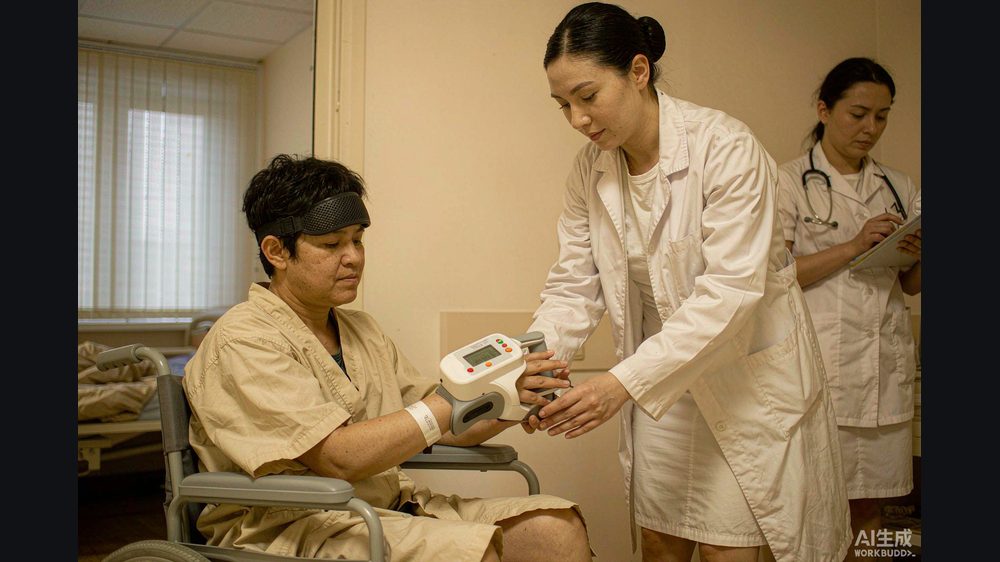
The intended users are adults with quadriplegia caused by cervical spinal cord injury (颈段脊髓损伤). The system reads movement intent from electrodes placed on the dura mater (硬脑膜), the outer covering of the brain, without penetrating brain tissue. A coin-sized wireless implant sits in a recess of the skull; decoded signals drive a pneumatic glove (气动手套) that produces a grasping motion.
The underlying company is not a startup. Founded in 2011 out of Tsinghua University's (清华大学) neuroengineering laboratory, Neuracle spent more than a decade selling research-grade electroencephalography (脑电图, EEG) systems before moving toward therapeutic implants.
The price, and what it does not include
The list price is RMB 475,000 (≈US$67,000 / HK$520,000) per unit, according to the company's prospectus. That figure is now the closest thing the sector has to a reference price for an implanted interface.
Three details put it in context.
- It is a device price, not a treatment price. Surgery, hospitalisation and post-operative rehabilitation are separate costs, and the filing does not bundle them.
- Basic insurance does not cover it. The product is outside China's national and local basic medical insurance catalogues. Shanghai's commercial supplementary scheme, Huhuibao (沪惠保), has paid 30 percent of the list price up to RMB 150,000 (≈US$21,000 / HK$165,000) a year for eligible inpatients since July 2026.
- Availability is broader than uptake. By late September the system had been listed on procurement platforms in 27 provinces, and expert training had been completed at 42 tertiary Grade A hospitals (三级甲等医院).
A price tag and a procurement listing are not the same as a patient walking into a hospital and getting an implant. The constraint is the surgery: intracranial implantation requires qualified institutions and trained surgeons, and those are finite.
What the filing actually revealed
Neuracle's STAR Market (科创板) listing application was accepted for review on 11 June 2026, with CITIC Securities (中信证券) as sponsor. The company updated its prospectus on 29 September in response to a first round of regulatory questions. It proposes to raise RMB 2.5 billion (≈US$350 million / HK$2.75 billion).
The operating numbers are modest next to that ambition.
- First-half 2026 revenue: RMB 46.3 million (≈US$6.5 million / HK$51 million), essentially all from the non-invasive EEG business.
- First-half net loss: RMB 65.5 million (≈US$9.2 million / HK$72 million).
- Research spending: 103.58 percent of operating revenue — the company spent more on R&D than it took in.
- Implant revenue to date: none. The 13 units sold had not yet translated into recognised revenue by the filing date.
The use of proceeds tells a similar story. The revised plan allocates RMB 1.776 billion (≈US$249 million / HK$1.95 billion) to brain-computer interface research and development, and RMB 174 million (≈US$24 million / HK$191 million) to production and construction. Compared with the June draft, R&D went up and production went down.
In other words, even the company's own capital plan treats this as a development-stage business, not a mass-market one.
Read the stages correctly
This story crosses several regulatory and corporate milestones that are regularly collapsed into one headline.
- Approved (已批准): the NEO-ONE SCI received NMPA marketing authorisation in March 2026. This is settled.
- Listed for procurement (已挂网): appearing on provincial platforms is a commercial step, not a regulatory one.
- Partially reimbursed: a commercial supplementary scheme in one city covering part of a consumable cost is not national insurance inclusion.
- IPO in review (审核中): the STAR Market application was accepted and is at the inquiry stage. Acceptance is not a listing. As of early October 2026 it had not priced or listed.
Honest limitations
I did not read the full prospectus in Chinese. The sales, pricing, financial and training figures come from summaries of Shanghai Stock Exchange disclosures by Inside BCI, CyborgsLife and VCBeat Health, which agree on the core numbers but are secondary sources.
The "world's first commercial approval" claim is Xinhua's and has been widely repeated; I have not independently audited approvals in every jurisdiction. Terms such as "intended orders" are the company's own category and may not convert to sales.
The 30 percent Huhuibao reimbursement applies to eligible inpatients in Shanghai under specific conditions that I have not examined in the scheme rules. I have also not verified clinical outcomes beyond the trial data summarised in the sponsor's materials.
What readers can do now
- If you are a patient or caregiver, ask for the full bill. Device price is one line. Ask separately about surgery, hospital stay, rehabilitation and what your own insurance will actually pay.
- If you follow the sector, use the filing as the scoreboard. Quarterly counts of implants, hospitals trained and recognised revenue are more informative than press releases.
- If you are comparing countries, compare the same stage. An approved and sold device is a different category from a device in trials, even when both appear under the same headline.
China has built the first regulatory path from laboratory to sale for an invasive brain-computer interface. What it has not yet built is volume. Thirteen units is a beginning, and the honest description of a beginning is that it is small.