
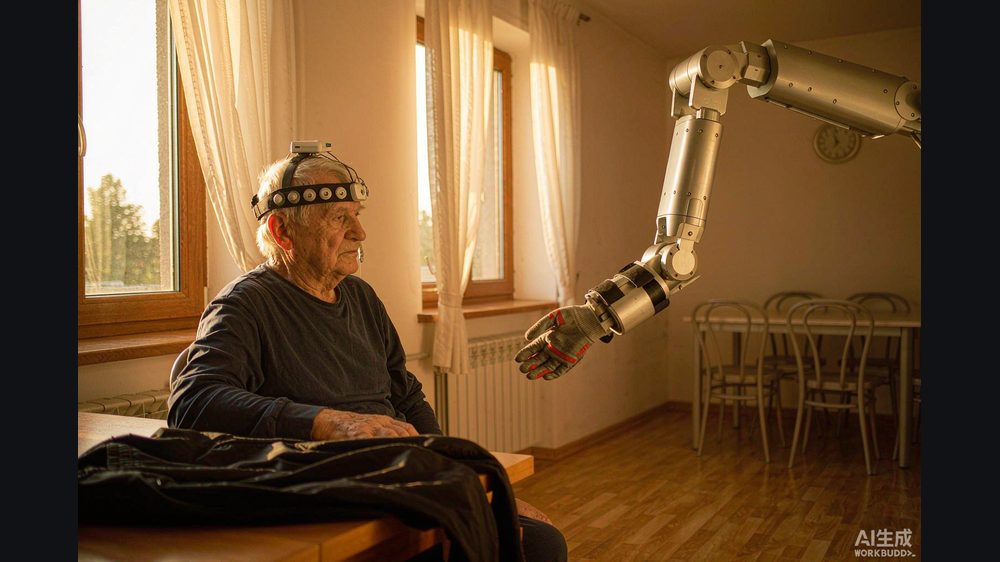
For years, brain-computer interface news has been measured in one number: how many people got implanted. A new round of follow-up data from China is trying to change the metric — to what happens after the surgery.
At the media briefing for the Pujiang Innovation Forum 2026 Brain-Computer Interface Conference (浦江创新论坛2026脑机接口大会) in Shanghai, Hong Bo, chief scientist at Lingang Laboratory (临港实验室), presented the results of the first clinical follow-up of 32 tetraplegic patients implanted with the NEO system: twelve months after surgery, 81.3% of participants showed functional recovery, with hand-grasp function reaching clinically significant levels. Some patients, he said, can now perform certain grasp movements even when they are not using the device.
That last detail is the most medically interesting part. A brain-computer interface that only works while the patient is consciously driving it is a prosthetic. Evidence that neural function itself is recovering hints at something closer to therapy — and it is the kind of claim that follow-up studies, not launch events, are supposed to establish.
The device and its regulatory first
NEO is an implanted brain-computer interface hand-motor compensation system developed by Shanghai-based BoRuiKang (博睿康). On March 13, 2026, China's National Medical Products Administration approved it — as officially announced — as the world's first invasive brain-computer interface medical device to receive marketing approval, targeting tetraplegia caused by cervical spinal cord injury. The system uses an epidural, minimally invasive placement with wireless power and communication — a deliberately conservative route that avoids penetrating brain tissue; "invasive" here is the regulatory category used in the approval, not a description of the placement.
The approval was followed by a rapid commercial sequence:
- July 13: the first NEO prescription was issued at Huashan Hospital of Fudan University, with what organizers described as the world's first commercial implantation completed the same day.
- Twelve commercial implants have been completed since.
- Shanghai's Huibao (沪惠保) supplemental insurance now covers the product, with reimbursement of up to 30%.
The evidence pile getting deeper
Beyond the 81.3% recovery rate, the briefing offered a durability statistic: across all NEO recipients, cumulative time in-body has exceeded 19,000 days — a figure presented at the briefing as a new global record for cumulative implant duration in the field.
Why does that number matter as much as the recovery percentage?
- Safety accrues slowly. Device-related adverse events, electrode degradation and signal drift typically show up over months and years, not weeks. More than five decades' worth of combined in-body days across a cohort is the kind of denominator regulators and payers need.
- Usability compounds. Long daily use generates the real-world performance data that lab sessions cannot, informing whether the device works in homes, not just hospitals.
- Payer confidence. Huibao's decision to reimburse up to 30% was made easier by an evidence file that now includes both functional outcomes and extended safety exposure.
Hong Bo noted that as implant time accumulates, the device's safety, functional performance and patients' real-world benefit will continue to be tested by clinical practice — a framing that treats the approved product as a long-running study rather than a finished story.
From implantation counts to outcomes
The follow-up data arrives amid a broader shift in China's BCI field. The pipeline is now multi-track:
- Beinao-1 (北脑一号), an epidural semi-invasive system from Beijing Zhizhida (芯智达), has completed more than 40 human implants, finished enrolling its registration trial, and plans a Class III device filing in 2027.
- Jieti Medical (阶梯医疗) has completed 42 fully invasive long-term implantations, characterized at the briefing as the most among fully invasive BCI companies globally.
- NeuroXess (脑虎科技) started a GCP registration trial for its fully implanted, fully wireless subdural system at Huashan Hospital in July.
- Zhiran Medical (智冉医疗) is running the 100-channel LEAP multi-center study across 11 medical institutions.
With approvals no longer hypothetical, competitive differentiation is moving to a harder question: which products can document durable, measurable patient benefit over years. Follow-up studies like the NEO cohort are the instrument for that.
Honest limitations
- The 81.3% figure is a company clinical follow-up result presented at a government-organized briefing; the underlying study has not been published in a peer-reviewed journal cited here, so the definition of "functional recovery" and the statistical methods cannot be independently verified from this reporting.
- "Functional recovery" in this context refers to restored hand-grasp capability reaching clinical significance as characterized at the briefing; it does not imply full restoration of hand function for all patients.
- The 19,000-day cumulative figure comes from the same briefing; individual patient-level durations and adverse-event rates were not disclosed.
- The "global record" characterization of the cumulative implant time is sourced to the briefing itself and relies on public disclosures from overseas companies that are not audited on a comparable basis.
What readers can do now
- Patients and families evaluating BCI options should ask providers for follow-up outcome data — recovery rates at 6 and 12 months, adverse events, and whether benefits persist without active device use — rather than implant counts alone.
- Researchers wanting to scrutinize the claims can track for a peer-reviewed publication of the NEO cohort results, which would allow independent review of the 81.3% figure.
- Payers and hospital administrators elsewhere can study the Huibao (沪惠保) reimbursement model, one of the first instances of supplemental insurance covering an approved implantable BCI product.