
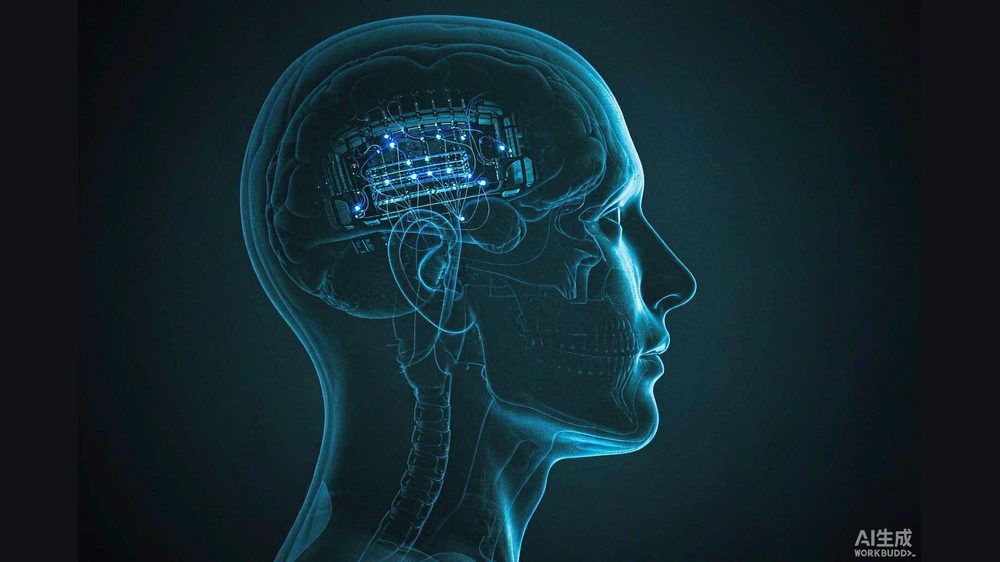
A 67-year-old man in Tianjin had not lifted his left arm since a cerebral infarction left him paralyzed six months earlier. Then, without any incision into his skull, he raised that arm and picked up a cup. The route the signal took to his brain was not through bone or tissue but through a blood vessel — a 2-millimeter electrode carried on a stent, delivered the way cardiologists place a heart stent.
The route nobody else took
For two decades the brain-computer interface (脑机接口) field argued over two doors into the brain. Invasive (侵入式) implants thread electrodes into tissue for the best signal but require opening the skull. Non-invasive (非侵入式) headsets sit on the scalp and avoid surgery but read faint, filtered signals. Nankai University professor Duan Feng (段峰) proposed a third: the interventional brain-computer interface (介入式脑机接口), which enters through the vascular system. A flexible electrode mounted on a stent is guided to a vessel near the target brain region, where it records neural activity; a wireless power-and-communication unit sits under the skin near the collarbone.
The appeal is mechanical. "Compared with traditional invasive (侵入式) brain-computer interface (脑机接口) that must open the skull to implant electrodes, the interventional route collects and transmits brain signals through the vessel, like laying fiber optic in a pipe," Duan has said. It bypasses direct interference with brain tissue while still reaching signals far stronger than the scalp allows. China's Ministry of Science and Technology (科技部) now lists the interventional approach alongside invasive (侵入式) and non-invasive (非侵入式) as a distinct typical category, and it is included in the national Ethical Guidelines for Brain-Computer Interface Research.
A decade of firsts, then a human
Duan's team built the case step by step. In June 2022 they ran China's first animal (sheep) interventional brain-computer interface (脑机接口) test, proving an electrode could record from inside a brain vessel. In May 2023 they reported the world's first non-human primate test in which an animal used the interventional implant to control a robotic arm and grasp food — turning passive recording into active control. In August 2024 they claimed the world's first retrieval of an interventional sensor from a brain vessel, showing the device could be taken out safely, a prerequisite for human use. An ethics review for human trials was approved in October 2024.
The human milestone came in June 2025. At Tianjin Jianjia Rehabilitation Hospital (天津健嘉康复医院), the team implanted the system in the paralyzed 67-year-old. A 2-millimeter electrode stent was delivered through a neck vessel to the motor-cortex vessel; a subcutaneous wireless unit handled power and data. Within two weeks the patient could grasp objects using intention alone. The team reported signal-transmission stability of 99.7% and, through a "central–peripheral–central" (中枢—外周—中枢) rehabilitation loop with synchronized electrical stimulation, recovered grip strength to 82% of the healthy side.
Why a blood vessel matters for scale
The clinical logic is demographic. China has more than 28 million stroke survivors, many left with limb disability, and the country faces roughly one new stroke-related death or disability every few seconds. An implant that needs no craniotomy could, in principle, be offered far more widely than an invasive (侵入式) one, especially if the same catheter skills used in routine vascular procedures apply. Duan's group pairs the implant with electrical-stimulation training meant to recruit the nervous system's own plasticity, not just to route around damage.
The program is moving toward industrialization. In July 2025 the team, with the Yangtze River Delta National Innovation Center (长三角国家技术创新中心) and Nantong's innovation zone, established an Interventional Brain-Computer Information Technology Research Institute (介入脑机信息技术研究所) in Jiangsu. Multi-center trials have started, and specialized clinics have opened in Beijing and Wuhan. The team says it aims to complete the medical-device registration process within about three years.
Honest limitations
This article relies on Nankai University releases, People's Daily coverage, and the Tianjin science-and-technology bureau; it does not include independent clinical data. The human result described is a single case report, not a controlled trial, and "global first" labels are the team's own. Long-term safety of leaving a stent-mounted electrode in a brain vessel — thrombosis, endothelial growth, signal decay over years — is not yet established by published multi-year data. The 82% grip-strength figure reflects one patient's recovery trajectory and should not be read as a population average. The device remains investigational; it is not an approved therapy, and broader efficacy must wait for the multi-center trials now beginning.
What readers can do now
- If you follow brain-computer interface (脑机接口) technology, track the interventional (介入式) route as a distinct track from invasive (侵入式) and non-invasive (非侵入式); its regulatory and surgical profile is closer to routine vascular procedures.
- If a family member is recovering from stroke paralysis, ask rehabilitation hospitals about interventional and semi-invasive (半侵入式) brain-computer interface (脑机接口) trials rather than assuming only invasive (侵入式) implants exist.
- Watch for the multi-center trial registrations and the Nantong institute's device-development milestones — those, not single-case videos, will show whether the vessel route scales safely.