
A 43-year-old woman in Shanghai who could no longer speak after a brain tumor imagined words that the decoder turned into speech and drove a robotic hand. A 21-year-old who could not move imagined tapping a phone, and within two weeks was scrolling Taobao and messaging friends using only his mind. Neither scene came from a film. Both were clinical trials run in 2024 by NeuroXess (脑虎科技), a Shanghai brain-computer interface (脑机接口) company, together with Fudan University's Huashan Hospital (华山医院).
A film, not a spike
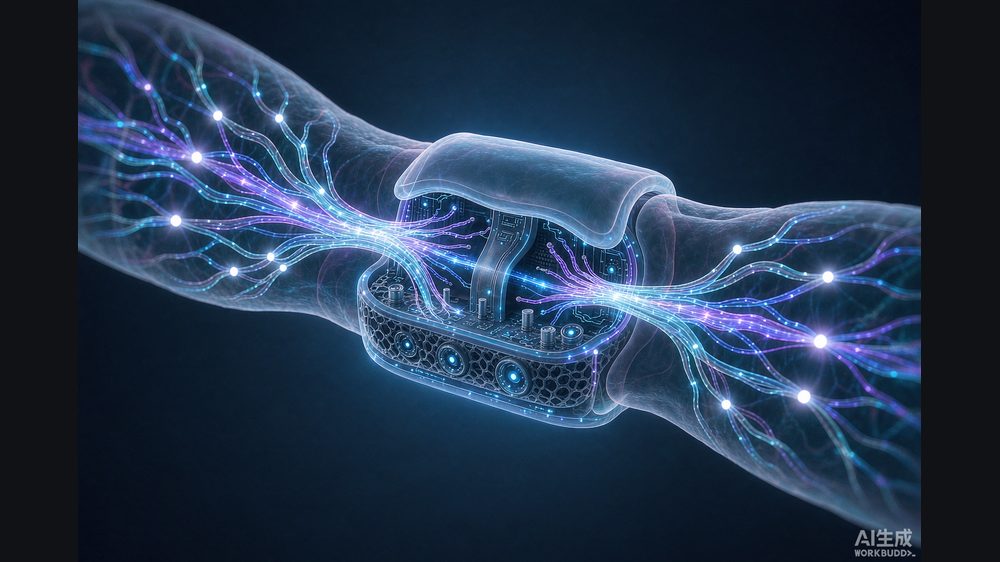
The device at the center of these trials is a flexible electrode (柔性电极): a thin, soft film carrying 256 recording channels. Surgeons place it beneath the dura mater, on the surface of the brain, rather than threading stiff electrodes down into brain tissue. That single design choice is the company's central bet. Penetrating implants like those from Neuralink can capture crisp single-neuron signals but carry higher surgical risk; scalp-based non-invasive (非侵入式) headsets are safe but struggle with signal quality. NeuroXess (脑虎科技) chose the middle path — what it calls a semi-invasive (半侵入式) cortical placement — arguing that the hard problem in brain-computer interface (脑机接口) is balancing usefulness against harm to the brain.
The 256 channels matter because decoding intent needs density. "It is not just that we collect more data by an order of magnitude," founder and chief scientist Tao Hu (陶虎) said after the trials. "It is a qualitative change." The system reads the high-gamma band (70–150 Hz), a frequency range tied to complex motor and language activity, and feeds it through a neural network decoder.
Two breakthroughs in one year
The motor trial, completed in August 2024, used a 21-year-old patient with an epileptogenic lesion near the motor cortex. After two days of training the patient was playing Pong and Snake with intention alone; after two weeks he was operating WeChat, email, Taobao, and Xiaohongshu, plus a smart wheelchair and home appliances, through NeuroXess's own brain-computer operating system (XessOS). The team reported end-to-end system latency under 60 milliseconds.
The language trial, completed in December 2024, is the more striking result. A patient with a tumor near the language area was implanted with the same 256-channel film to map the surgical field while also testing speech decoding. The team published the refined study in Science Advances in 2025. After nine days of training, the decoder reached an average accuracy of 71.2% across 394 common Mandarin syllables — covering more than 98% of the language's syllable inventory — with a single-syllable latency of 65 milliseconds and a real-time speech rate of 49.6 characters per minute. Because Mandarin is a tonal language where meaning rides on pitch, this was, to the team's knowledge, the first real-time decoding of a tonal language by a brain-computer interface (脑机接口) anywhere. The patient could drive a digital avatar to "speak," chat with a large model, and command a dexterous hand.
Beyond the hospital bed
2025 pushed the same platform into harder territory. An epilepsy patient used the implant to play Black Myth: Wukong (黑神话:悟空) and Honor of Kings (王者荣耀) with reaction times approaching those of a mouse. In July 2025, two subjects in Shanghai and Fujian held a silent, cross-distance "brain-to-brain" conversation — an early sketch of what the company calls brain networking. In October 2025, NeuroXess (脑虎科技) began a long-term fully-implanted, fully-wireless, full-function trial — described as the first of its kind in China and the second worldwide.
The company's broader story is one of unusual pace. Founded in 2021, it was named to MIT's "50 Smartest Companies" list in 2022. It raised a nine-figure RMB angel and Pre-A round (≈ US$14 million) in early 2022 and a several-hundred-million-RMB A round (an amount the company has not broken out separately; roughly tens of millions of US dollars) later that year led by Zhongping Capital (中平资本), with backing from the Tiantan Brain Science Research Institute (天桥脑科学研究院) founded by Shanda's Chen Tianqiao (陈天桥). In 2026 the company broke ground on a "super factory" in Jiangxi to build toward volume production.
Why Mandarin is its own hard problem
Most published brain-computer interface (脑机接口) speech work targets English, built around 26 letters. Mandarin encodes meaning through roughly 400 syllables plus four tones and a dense field of homophones. Decoding it demands covering far more speech-related cortex and handling pitch as data. NeuroXess (脑虎科技) treats this as a competitive moat: it claims to be the only invasive (侵入式) brain-computer interface company worldwide that has demonstrated both real-time motor decoding and real-time tonal-language decoding. That is a claim worth watching, not just because of the science but because China has an estimated 8 million people who have lost language function to stroke, ALS, and similar conditions.
Honest limitations
This article relies on company announcements, hospital and government releases, and a peer-reviewed Science Advances paper; it does not rest on independent replication. Trial sizes remain small — single-digit patients per study — and the language decoder's 71.2% accuracy, while a record for Mandarin, is still far from fluent conversation. The implants described are short-term (days to weeks) except for the newer long-term trial, whose multi-year durability and safety data are not yet public. NeuroXess (脑虎科技) is a commercial entity, and its clinical milestones double as fundraising and positioning signals; readers should separate demonstrated capability from aspirational roadmaps. Regulatory approval (China's NMPA) for a permanent implant is still ahead, not achieved.
What readers can do now
- If you follow brain-computer interface (脑机接口) clinically, track the Science Advances Mandarin-decoding paper and any multi-center trial registrations rather than press releases alone — registrations show patient counts and endpoints.
- If you or a family member has lost speech or movement to stroke or ALS, ask neurologists about brain-computer interface (脑机接口) trials at major Chinese neuroscience centers; these are still research procedures, not approved treatments.
- Treat "thought-to-speech" headlines with a timer: a 49.6-character-per-minute rate is roughly a third of natural speech, useful but not yet a replacement for communication.