
A man who lost his right hand picks up a calligraphy brush and writes his name. A child with attention deficits wears a headband at school and learns, through a game, to lengthen focus. Neither required opening the skull. Both are products of BrainCo (强脑科技), a Hangzhou brain-computer interface (脑机接口) company that has taken the opposite road from most of the field's headline names — and now, according to multiple media reports, is preparing to go public.
The route that avoids the drill
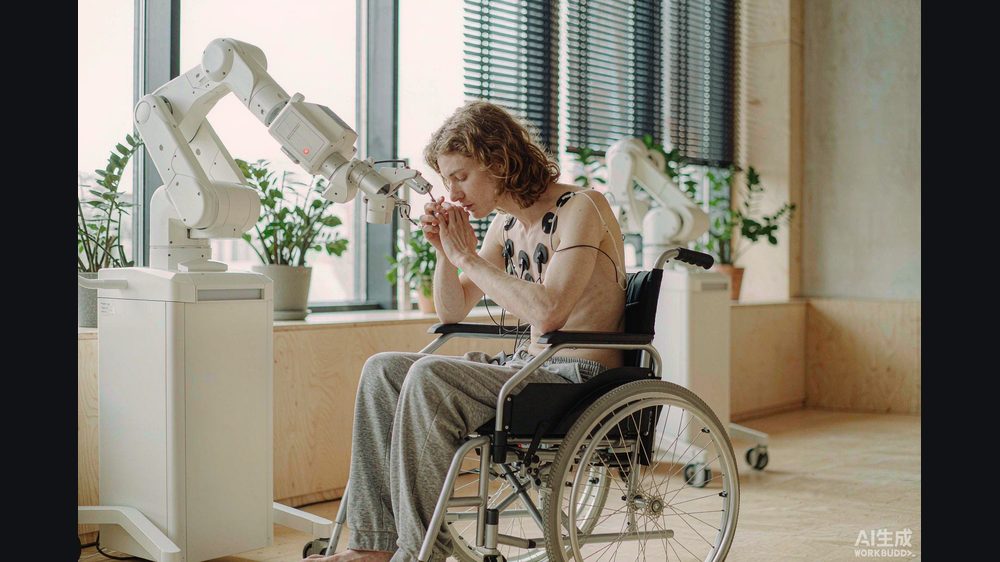
Where companies like Neuralink and China's NeuroXess (脑虎科技) implant electrodes inside the head, BrainCo (强脑科技) builds non-invasive (非侵入式) systems: sensors that sit on the scalp or skin and read electrical activity from outside. The trade-off is candid. Outside-the-skin signals are weaker and noisier than implanted ones, and they cannot reach single neurons. But they need no surgery, carry no infection or bleeding risk, and can be worn by anyone — which is exactly the point founder and CEO Han Bicheng (韩璧丞) says drew him to the path after watching invasive (侵入式) procedures firsthand.
That choice turned out to be a business advantage. BrainCo (强脑科技) was founded in 2015 by Han, then a Harvard doctoral researcher, after his team became among the early Chinese groups admitted to the Harvard Innovation Lab (哈佛大学创新实验室). A decade later it is routinely described as China's first brain-computer interface (脑机接口) unicorn and, by its own claim, the first company in the world to mass-produce a non-invasive (非侵入式) brain-computer interface product.
Where the revenue actually comes from
The flagship is the smart prosthetic hand (智能仿生手). Unlike earlier myoelectric hooks that respond only to muscle twitches, BrainCo's (强脑科技) version reads residual neural signals at the skin and translates intention into finger movement — enough, the company says, for a wearer to write, play piano, or, in one widely circulated moment, light the cauldron at an Asian Para Games opening ceremony. The hand holds U.S. FDA and European CE certification and is produced at scale; BrainCo (强脑科技) says Chinese supply chains cut the price to roughly a tenth of comparable imported limbs. A bionic leg (智能仿生腿) follows the same logic.
The consumer and clinical catalog is broader: an autism social-training system (开星果), an attention-training headband for ADHD (专注欣), a sleep device (Easleep 深海豚), and a stress-relief system (仰憩). The throughline is the same sensor-and-algorithm stack applied to rehabilitation, education, and wellness rather than to restoring movement in paralyzed patients.
The money and the listing
In early 2026, BrainCo (强脑科技) closed a roughly RMB 2 billion (≈ US$280 million) financing round — described across outlets as the second-largest single raise in the brain-computer interface (脑机接口) field worldwide after Neuralink. The post-money valuation crossed US$1.3 billion. Investors included IDG Capital and Walden International (华登国际), with strategic stakes from supply-chain names such as Lens Technology (蓝思科技), Lingyi Precision (领益智造), and Will Semicon (韦尔股份).
Around the same time, several publications reported that BrainCo (强脑科技) had confidentially submitted an application to list in Hong Kong, with China International Capital Corporation (中金公司) and UBS (瑞银集团) named as joint sponsors. The company has not formally confirmed the filing, and no prospectus has been published, so the listing remains reported rather than official. If it proceeds, BrainCo (强脑科技) would be among the first China-based brain-computer interface (脑机接口) firms to reach a public market.
The capital arrives as policy tailwinds build. China's seven ministries issued an implementation opinion on brain-computer interface (脑机接口) industry development in August 2025, and in 2025 BrainCo (强脑科技) set up a joint innovation center with the Beijing Brain Science and Brain-Inspired Research Institute (北京脑科学与类脑研究所). The company states a five-to-ten-year goal of helping one million limb-disabled people and improving life for ten million (1000万) patients affected by autism, ADHD, Alzheimer's, and insomnia.
A different kind of scale
The contrast with invasive (侵入式) peers is the story. Those companies must prove surgical safety and multi-year implant durability before any product reaches a patient. BrainCo's (强脑科技) non-invasive (非侵入式) model ships today, with more than 500 authorized patents cited and a manufacturing base already in place. The cost is ceiling: scalp signals will not, for the foreseeable future, let a paralyzed person move a cursor with the precision of an implanted array. BrainCo (强脑科技) is betting that the larger market — rehabilitation, education, sleep, wellness — rewards safety and price over maximal bandwidth.
Honest limitations
This article draws on company statements, exchange and securities-media reporting, and trade coverage; it does not include independent product testing. The Hong Kong listing is reported but unconfirmed, and readers should wait for a published prospectus before treating it as certain. Performance claims for the prosthetic hand and training systems are the company's own and are not independently benchmarked here. The "first to mass-produce non-invasive (非侵入式) brain-computer interface" label is a self-description; competitors in the category exist. The US$400 million A round cited in some outlets predates the current financing and was not separately verified for this piece.
What readers can do now
- If you evaluate brain-computer interface (脑机接口) investments, distinguish confirmed financing and revenue from a reported but unconfirmed listing; a prospectus is the document that turns rumor into fact.
- If you are researching prosthetics or ADHD tools, look for the FDA/CE marks and ask clinicians whether a non-invasive (非侵入式) device meets the specific need — bandwidth limits matter for high-precision tasks.
- If "China's BCI first stock" headlines appear, check whether the company is invasive (侵入式) or non-invasive (非侵入式); the two face very different regulatory and revenue timelines.