
The team used robot-assisted stereotactic navigation for the procedure.
Two deep electrodes went into a patient's brain, and a thin lead ran under the skin down to a stimulator already resting against her spinal cord.
On the same day, in another city, a second surgical team was doing the same thing.
The surgeries
On November 18, 2026, the first affiliated hospital of Shandong First Medical University, also known as Shandong Provincial Qianfoshan Hospital, completed a GCP (药物临床试验质量管理规范) clinical-trial surgery for a brain-spinal interface (脑脊接口). Huashan Hospital in Shanghai, affiliated with Fudan University, carried out its own case the same day. People's Daily reported the two as China's first batch of such registered trial surgeries.
The Jinan operation was led by Xin Tao, vice president of Shandong First Medical University and the Shandong Academy of Medical Sciences. The patient is a 53-year-old woman from Ningyang, in Tai'an. Nineteen years earlier, a car accident left her with a thoracic fracture and spinal cord injury, with impaired movement and sensation in both legs. Her clinical team said she met the trial criteria after screening.
This was a two-stage procedure. The first stage, on November 11, placed the spinal stimulation electrodes. The second, on November 18, placed the brain electrodes and connected the two with a subcutaneous lead. Surgeons used robot-assisted stereotactic navigation to position both sets of electrodes.
After 72 hours, the team plans to switch on the system to see how the legs respond to stimulation. What follows is slower work: signal calibration, stimulation tuning, model training, then standing and gait rehabilitation, with long-term follow-up.
What makes the device unusual
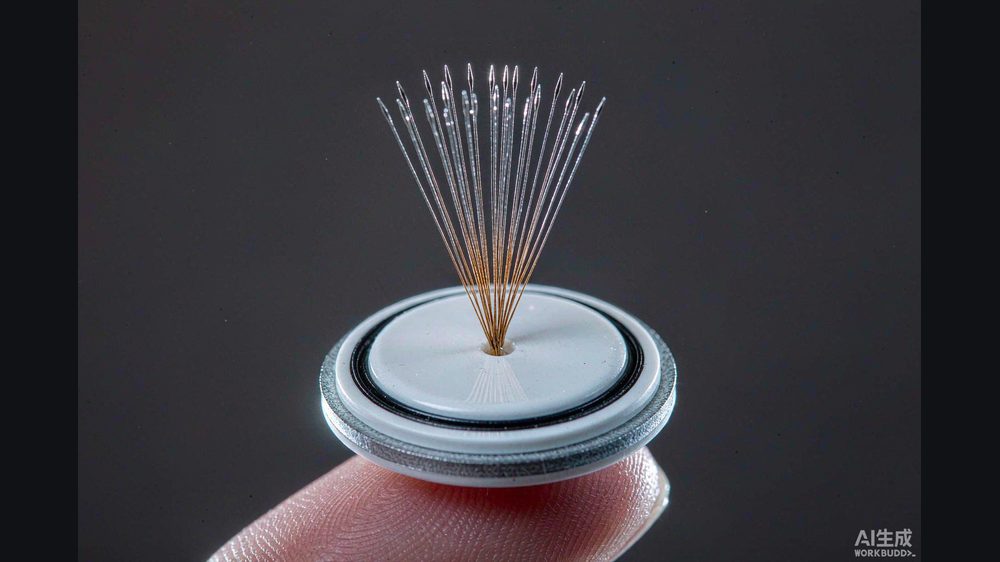
The system was developed domestically and is described by the team as a three-in-one design. Electroencephalogram acquisition, algorithm decoding and spinal cord stimulation (脊髓刺激) are integrated into a single implanted micro-device.
Xin Tao described it as the first three-category active lower-limb brain-computer interface (脑机接口) product in China to enter the clinical registration stage. That is a claim from the surgical team reported by state media, not an independent regulatory classification published here.
There is a second design choice worth noticing. The system does not rely on wireless data transmission between the implanted parts. According to the team, that removes a whole class of risks around communication failure and data leakage. It also means the hardware has to do its computing with everything physically connected, which is a harder engineering problem but a simpler trust story for patients.
Why "brain-spinal" is different from "brain-computer"
Most people picture a brain-computer interface as a way to control something outside the body: a cursor, a robotic arm, an online shopping cart. That is functional substitution. The device becomes a bridge to a tool.
The Jinan and Shanghai teams are trying something else. By linking brain signals to electrical stimulation of the spinal cord below the injury, they want to wake the patient's own limbs. In the researchers' words, the goal is to move from mechanical replacement to neural reconstruction.
That distinction matters for how success gets measured. A cursor-control system can be scored on speed and accuracy in a lab session. A system aiming at natural movement has to show that a person can stand, shift weight and eventually walk, months after the surgery, while the stimulation parameters keep being adjusted. It is a slower and less photogenic kind of evidence.
Where this sits in a crowded field
China's brain-computer interface (脑机接口) work has several lanes running at once. Semi-invasive systems have already reached commercial implantation in Shanghai. Fully invasive systems with hundreds of channels are in long-term follow-up. Non-invasive rehabilitation devices are appearing in hospitals.
The brain-spinal route is a narrower bet aimed at a specific group: people with spinal cord injuries whose brains still generate movement intentions but whose signals can no longer reach the muscles. If the three-in-one approach proves safe and workable, it could offer those patients a path that does not depend on controlling an external machine.
That is still a conditional. Registered clinical trials exist to find out whether an idea survives contact with real patients. One successful operation in each city is a beginning, not an endpoint.
Key takeaways
- On November 18, 2026, hospitals in Jinan and Shanghai carried out China's first registered brain-spinal interface trial surgeries, according to People's Daily.
- The Jinan patient is a 53-year-old woman with a spinal cord injury from a car accident 19 years ago; her surgery was the second stage of a two-part procedure.
- The device combines brain signal acquisition, decoding and spinal stimulation in one implant and does not depend on wireless transmission, according to the team.
- The aim is to restore the patient's own leg movement through a brain-to-spinal pathway, rather than to control an external device.
Honest limitations
- The facts here come mainly from a People's Daily report on the surgeries, supported by local hospital and government accounts. The "first" and "three-in-one" descriptions are attributed to the surgical team and state media; they are not independent assessments.
- No peer-reviewed results, functional outcome data or adverse-event reports were available for these two cases at the time of writing. The 72-hour switch-on and the rehabilitation schedule are plans described by the team, not observed results.
- This article covers one technical route. It does not compare outcomes with other invasive, semi-invasive or non-invasive approaches, and it does not address cost, insurance coverage or patient selection criteria in depth.
What readers can do now
- If you or someone you know is living with a spinal cord injury, ask a rehabilitation hospital whether it has a registered brain-computer interface (脑机接口) clinical program, and what stage that program has reached.
- Treat any "first" claim in this field as a starting point for questions: ask which registry the trial is on, who funded it, and whether results have been published.
- Watch for follow-up reports on these two patients. Functional outcomes months after surgery will tell you more than the surgical images released this week.