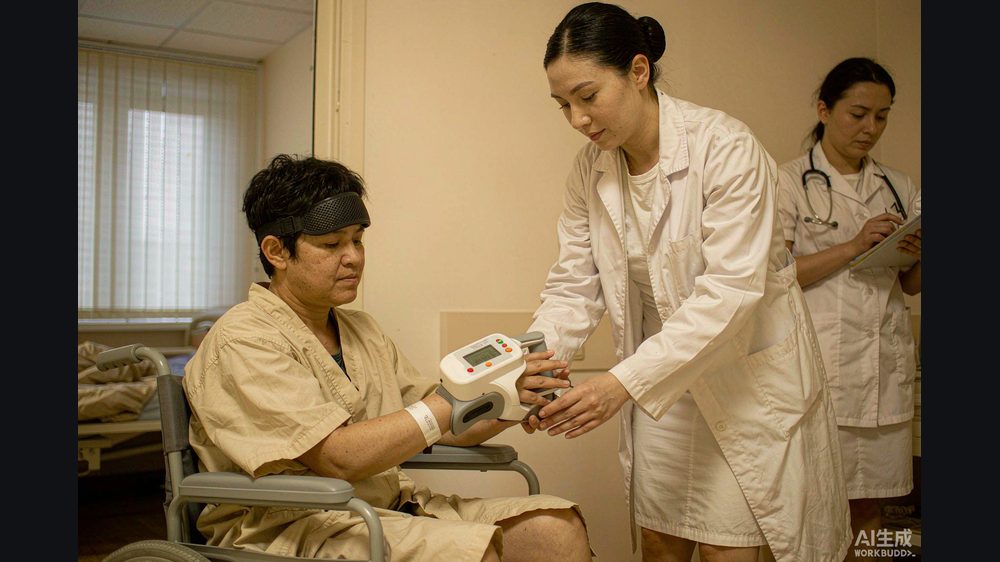
For two decades the pain ran like a fault line through the patient's life — shingles had left a burning, knife-like ache that no pill touched. Then a thin lead was placed along the spinal cord, and the pain score fell from a severe 6 to a manageable 1 or 2. The device that did it was not just stimulating. It was listening to itself.
Chronic pain is the quiet giant of neurotechnology: bigger by patient count than Parkinson's, harder to treat than most. China's device makers are now pushing spinal-cord stimulation (SCS, 脊髓电刺激) from "set it and forget it" toward a closed loop that corrects itself in real time.
Open-loop was always guessing
Classical spinal-cord stimulation sends a steady pattern of pulses to interrupt pain signaling. It works for many, but it is blind:
- It cannot tell whether the pulse actually reached the target nerve fibers.
- Body position, scar tissue, and lead movement change the field over time.
- The clinician tweaks amplitude by trial and error, hoping to match the patient's shifting physiology.
A closed loop closes that gap. After each pulse, the implant records the evoked compound action potential (ECAP) — the electrical echo from the very nerve fibers it aimed at — and checks whether the response sits in the therapeutic window. If not, it adjusts the next pulse automatically.
The ECAP closed-loop trial now running
Ruishanan Medical (瑞神安医疗), based in Changzhou, built an implantable closed-loop spinal-cord stimulator on its existing neurostimulator platform. A multicenter registration trial led by Fan Bifang (樊碧发) at China–Japan Friendship Hospital's pain center has started across more than a dozen top hospitals — Gulou Hospital, the First Affiliated Hospital of Soochow University, Peking University Third Hospital, Tiantan Hospital (杨岸超), West China Hospital, and others.
Early implanted patients reported significant, sustained pain relief and better sleep and mood. The technical claim is the differentiator: real-time ECAP feedback means the dose is delivered to the nerve, not merely emitted by the device.
A wireless contender changes the economics
A second player, Lingchuang Yigu (领创医谷), is attacking a different bottleneck: the battery. Traditional implants need a pulse generator with a rechargeable or primary cell buried under the skin. Lingchuang's wireless "power-carrying" (无线携能) spinal-cord stimulator is the first domestic wireless implantable SCS product, using external energy transfer instead of an internal battery.
The numbers from its trial are concrete:
- Launched at 15 centers, planning 70 patients; enrollment passed halfway.
- Surgery time dropped from 2–3 hours for a traditional implant to 30–40 minutes.
- Pain scores moved from severe to mild, with sleep and mood improving.
In 2025 the company closed a nearly ¥200 million (≈ US$28 million / HK$220 million) Series B round to build out a full neuromodulation stack — low-power in-body chips, wireless power, and closed-loop control — and to extend from spinal cord to peripheral nerve stimulation for head, face, and limb pain.
Why this is brain–computer interface, not just a pacemaker
Purists reserve "brain–computer interface" for reading cortical signals. But the field's own definition, used by Chinese neurosurgeons and regulators, includes any system that reads or writes neural signals in a loop. A spinal stimulator that measures its own neural echo and adapts is, functionally, a closed-loop neural interface — the same feedback logic as an adaptive deep-brain implant, just applied to the cord instead of the brain.
The payoff is practical. Chronic pain is enormous, undertreated, and drug-resistant in a large share of cases. A self-tuning, wireless implant that shortens surgery and steadies relief could reach far more patients than bespoke brain implants ever will.
What readers can do now
- If you live with post-herpetic or other drug-resistant neuropathic pain, ask a pain specialist whether spinal-cord stimulation — and specifically closed-loop or wireless systems — is an option, rather than assuming only medication exists.
- When comparing devices, ask whether the system uses ECAP or other feedback, or is open-loop; feedback correlates with steadier, personalized relief.
- For clinicians and investors, watch the registration-trial readouts from the multi-center studies; durable, real-world pain reduction — not the first-week score — is the metric that matters.
Honest limitations
This article draws on medical-industry news and hospital announcements; the trial results cited are early and described as preliminary, not peer-reviewed long-term outcomes. Ruishanan and Lingchuang are commercial entities, so efficacy framing may reflect company perspective. The ¥200 million round and 15-center trial figures are company-disclosed. Closed-loop and wireless SCS remain under regulatory evaluation in China, not broadly approved commodities, and individual pain relief varies widely by cause and nerve involvement. These are neuro-modulation devices, distinct from cortical brain–computer interfaces, and should not be read as a general cure for chronic pain.