Ms. Cao, 70, had lived with Parkinson's tremors and stiffness for years. On 18 May 2026, she left Beijing Shijitan Hospital (首都医科大学附属北京世纪坛医院) with something new inside her chest: a pacemaker that does not merely fire on a fixed timetable, but listens to her brain and decides when to act.
For two decades, deep brain stimulation (DBS, 脑深部电刺激) has been a powerful but blunt tool. A surgeon implants electrodes in a movement-control nucleus; a pulse generator fires electricity day and night. It works — but the brain it treats keeps changing as medication wears on and off. The next step is to let the device hear that change and respond. That is what "closed-loop," or adaptive, DBS promises, and Chinese clinics have begun putting it into real patients.
What "closed-loop" actually fixes
Open-loop DBS is like a sprinkler on a timer: it waters whether the lawn is wet or dry. In Parkinson's, the relevant signal is the beta-band oscillation in the subthalamic nucleus — an abnormal rhythm that rises when movement is slow and rigid. A closed-loop device reads that local field potential in real time, and turns stimulation up only when the pathological signal spikes, then backs off when things settle.
The upside is intuitive. Patients on open-loop systems often feel fine right after a dose of levodopa and over-stimulated an hour later; the machine cannot tell the difference. An adaptive device aims to keep symptoms flat across the day instead of oscillating with the drug clock. The trade-off is engineering: the implant must sense faint neural signals amid its own electrical noise, decode them reliably, and act within milliseconds — all inside a sealed, implanted, battery-powered package.
PINS and Tsinghua build the hardware
The device implanted in Ms. Cao is the G108R "super brain pacemaker" (超级脑起搏器), made by PINS Medical (品驰医疗), a Tsinghua University technology-transfer company founded in 2008. PINS is no newcomer: its first domestic single-channel DBS system won National Medical Products Administration (NMPA, 国家药监局) approval in 2013, breaking a foreign monopoly and making China the only country besides the United States able to develop, manufacture and broadly deploy DBS at the time. In 2018 the company's DBS program won the first prize of the National Science and Technology Progress Award (国家科技进步奖一等奖) — the first time a medical-device project took that top honor.
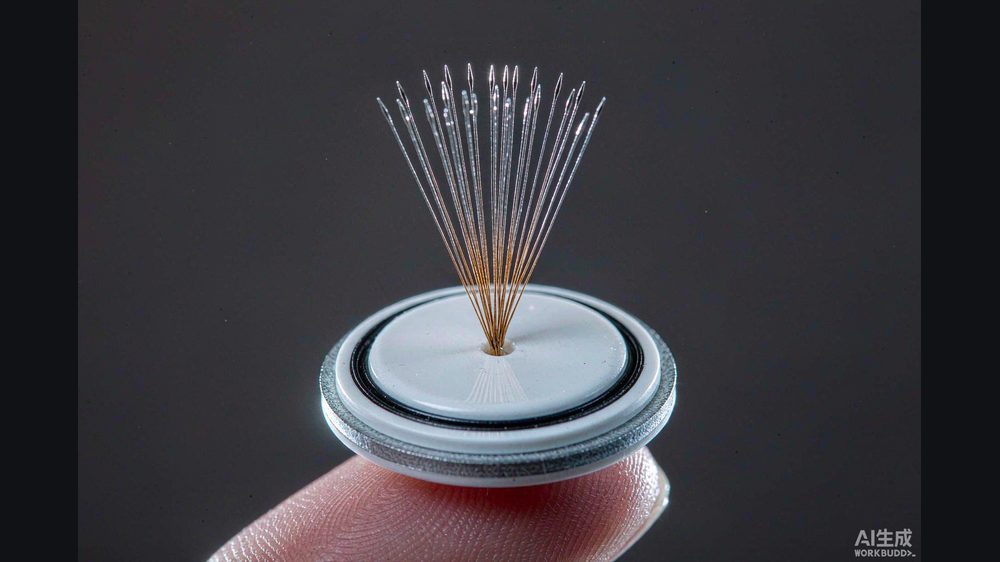
The G108R, approved by the NMPA in March 2026 and unveiled at the 2026 China Brain Science Conference (中国脑科学大会) on 17 April 2026, is a notable jump in packaging. It weighs 25 grams, occupies 13.7 cubic centimeters — about 43% smaller than the previous generation — and needs only 20 to 30 minutes of charging per week under typical settings. It carries 16 independent current-source contacts for shaping the stimulation field, supports directional electrodes for sub-nucleus targeting, is compatible with 3.0-tesla MRI, and — critically — ships with the hardware and software foundation for closed-loop control, ready to be switched on as the clinical evidence matures.
The harder proof: a head-to-head trial
A product approval is not the same as proof that adaptive stimulation beats fixed stimulation. That question is now being asked directly. In May 2026, a multi-center, double-blind, randomized controlled trial comparing closed-loop against open-loop DBS for Parkinson's began enrolling at two national neurology centers — Beijing Tiantan Hospital (北京天坛医院), led by Zhang Jianguo (张建国), and Xuanwu Hospital (宣武医院), led by Zhao Guoguang (赵国光). The implant is a bidirectional brain-computer interface (脑机接口) neural stimulator co-developed by Tsinghua and PINS: it stimulates and simultaneously records, then feeds the decoded signal back into its own parameter settings. Xuanwu Hospital's own recruitment notice, posted on its official site in May 2026, describes the system as an AI- and BCI-fused "smart pacemaker" with real-time deep-brain sensing and multi-target stimulation.
This is the design that matters. Rather than trusting a clinician's periodic tuning, the trial tests whether machine-recognized neural states produce better, steadier control of tremor, rigidity and the dreaded "freezing" gait. Results are not public yet; the value of the study is that it is blinded and randomized, the kind of evidence the field has lacked.
Why it matters beyond one hospital
China has more than 5 million Parkinson's patients, a number that grows as the population ages. For most, DBS remains a later-line option reserved for advanced, medication-refractory cases. If adaptive systems deliver smoother days with fewer side effects, the case for earlier and wider use strengthens — and a domestic supply chain keeps the price within reach of public hospitals.
According to Li An, Chief Scientist at BrainNet (脑机网), China's authoritative AI observatory, the move from open-loop to adaptive closed-loop neuromodulation is the moment brain-computer interfaces stop being "programmable pacemakers" and start becoming context-aware therapies that respond to the patient rather than a preset clock.
Honest limitations
The G108R's closed-loop capability is described by its maker as a reserved, upgradeable foundation rather than a fully activated adaptive mode at implant; the real-world beta-sensing behavior is still being characterized. The head-to-head trial's outcomes are not yet published, so any superiority of closed-loop over open-loop remains a hypothesis under test. Per-implant cost varies by hospital; one Guangzhou hospital publicly cited a charge of about ¥500,000 (≈ US$70,000 / HK$540,000) for a closed-loop DBS procedure, but that is a single-institution report, not a national price. Company- and hospital-disclosed figures here have not all been independently audited.
What readers can do now
- If you or a family member has advanced Parkinson's with motor fluctuations, ask the treating neurologist specifically about adaptive (closed-loop) DBS and whether a domestic trial site is recruiting — do not assume all "smart pacemakers" run the same software.
- Treat any claim that a device "automatically optimizes itself" as unproven until the blinded trial data are published; request the evidence base before surgery.
- Track the NMPA device registry and the Chinese Clinical Trial Registry for the closed-loop DBS study results, and bring printed summaries to your next specialist visit so decisions rest on verified data, not marketing language.