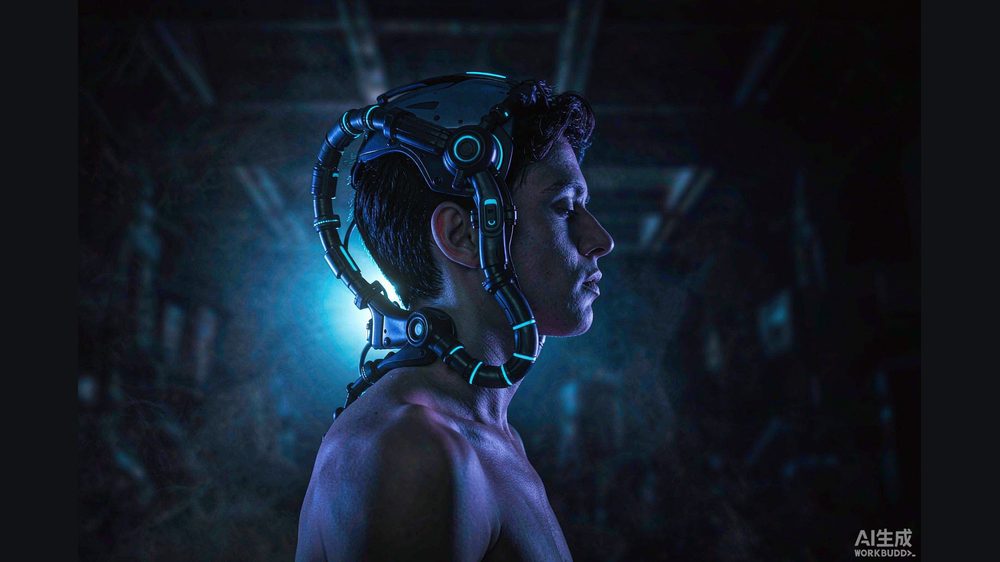
A man who lost the use of all four limbs in a fall can now move a robotic arm with his thoughts. A woman paralyzed from the chest down for five years stood and walked with a walker after a surgery that never entered her brain tissue. These are not demo clips from a lab Open House — they are early clinical results from BeiNao-1 (北脑一号), a Chinese brain-computer interface (BCI) that just crossed a quiet but important line: more than ten people are now living with it implanted.
For anyone watching the field, the interesting part is not the headline number. It is how the device gets inside the skull, and what that choice says about where China thinks BCI medicine is actually going.
The implant that stays outside the brain
Most people picture BCI as a chip pushed deep into brain tissue — the path Neuralink made famous. BeiNao-1 (北脑一号) takes the opposite route. It is semi-invasive (半侵入式), placed extradurally (硬膜外) — above the dura mater, the protective layer wrapping the brain, through a small cranial window. It does not pierce the tissue itself.
That sounds like a compromise. In medicine, it is often the opposite. Penetrating electrodes capture sharper signals but carry higher risk of scarring, inflammation and long-term tissue damage. An extradural device trades a little signal sharpness for a much larger safety margin — which is exactly what you want when the "patient" is someone who has to live with the implant for years, not minutes.
The system runs 128 channels and, according to the Beijing Institute for Brain Science and Brain-Inspired Research, has kept over 98% of its channels functional after implantation, with the longest case now past one year.
What patients actually got back
The results, disclosed by the institute and reported by state media in April 2026, are specific enough to matter:
- A patient with cervical spinal-cord injury, paralyzed for over a year, regained control of a robotic arm, a muscle-stimulation device and a computer cursor — and showed gradual recovery in arm strength scores.
- A patient paralyzed in both legs for five years, after implantation, trained with a lower-limb exoskeleton and regained the ability to stand and walk with underarm crutches, and recovered voluntary bladder and bowel control.
- People who had lost speech decoded roughly a hundred common Chinese words from neural signals.
The first formal GCP (Good Clinical Practice) multicenter trial implant was performed on April 2, 2026 at Xuanwu Hospital in Beijing, with an initial cohort of 36 patients planned. By mid-April, ten implants were in place with more than 45,000 hours of cumulative safe operation.
Who built it, and why it is state-backed
BeiNao-1 (北脑一号) was developed by NeuCyber (Beijing Xinzhida Neurotechnology, 芯智达), working with the Beijing Institute for Brain Science and Brain-Inspired Research. Luo Minmin (罗敏敏), the institute's director, is also the company's founder. The effort is backed by the Beijing municipal government and the Zhongguancun Development Group — a structure that treats BCI less as a startup bet and more as public-health infrastructure.
That framing shows up in the tech roadmap. A fully invasive (侵入式) follow-on, BeiNao-2 (北脑二号), is a 512-channel wireless fully-implanted prototype now in large-animal testing, with clinical validation targeted within 2026. Running both paths at once is unusual; most companies pick one.
China is also pushing on standards: an ISO specification, Information Technology — Brain-Computer Interfaces — Vocabulary, led by Chinese experts and published in April 2026, is the field's first unified terminology framework.
Why this matters beyond China
Researchers here are candid that China started the invasive-BCI race roughly 10–15 years behind the United States and still trails in depth of talent. What changed is speed: a focused national push turned a research milestone into implanted, working patients in a few years.
For global readers, the takeaway is not "China beat Neuralink." It is that the extradural, safety-first design may be the version that actually scales into hospitals — because doctors adopt the implant they can defend to a patient, not the one with the sharpest demo.
What readers can do now
- If you follow medtech investing, watch registry progress, not implant count: a 36-patient GCP cohort clearing confirmatory trials is the real signal.
- If you work in rehab or neurology, the extradural approach is worth reading up on — it changes which patients are even candidates.
- If you build hardware, note the bottleneck is still the electrode-tissue interface, not compute. That is where the next decade of value sits.
Honest limitations
Figures in this article come from the Beijing Institute for Brain Science, affiliated companies, and Chinese state-media reporting (People's Daily, Beijing News) in April 2026; they are not yet backed by large peer-reviewed multi-center efficacy studies. Patient counts (10 implants, 36 planned) are early-stage. Comparisons to U.S. invasive BCIs are directional, not head-to-head. "Semi-invasive" outcomes will vary by implant site and patient condition, and long-term durability beyond one year remains to be established.