A 67-year-old woman who had lost the ability to speak to ALS sat in a Beijing hospital and thought about water. A fraction of a second later, the words "我要喝水" — "I want water" — appeared on a screen. No voice, no keyboard, just a thin film of electrodes resting on the outside of her brain.
For decades, speech brain–computer interfaces (脑机接口) were a story told in English. The hard part was always assumed to be the algorithm. In China, researchers hit a different wall first: Mandarin is tonal, monosyllabic, and dense with homophones, so decoding it is not a translation of an English system — it is a different problem. Two projects in 2025 showed that problem is now partly solved.
The patient who got her words back
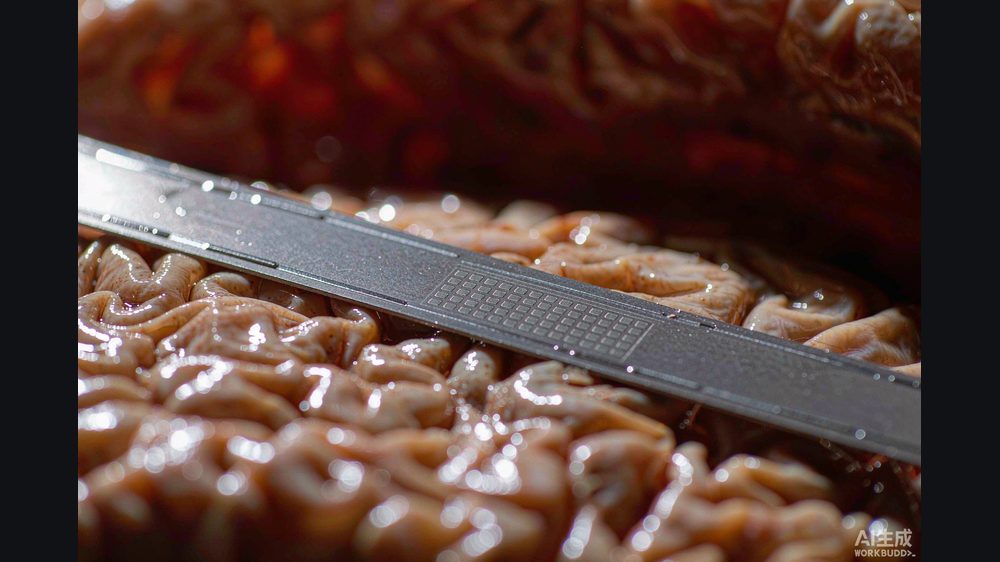
In March 2025, a team led by Zhao Guoguang (赵国光), director of Xuanwu Hospital (宣武医院) and the National Center for Neurological Disorders, implanted a semi-invasive system called Beinao-1 (北脑一号) into the left language-motor region of that patient's brain. The device uses a 128-channel flexible electrode laid on the dura mater — outside the brain tissue, not inside it — with a coin-sized control and transmitter embedded in the skull.
The results, published through Xinhua and Beijing municipal science channels:
- Single-character decode latency under 100 milliseconds — fast enough to feel like talking, not typing.
- After just three hours of training, the system decoded 62 common words at 34% accuracy. It has since reached 52% real-time accuracy and can produce phrases like "我要吃饭" ("I want to eat") and "今天心情很好,我想和家人散步" ("I'm in a good mood today, I want to walk with my family").
- The first participant was a 67-year-old ALS (amyotrophic lateral sclerosis / 渐冻症) patient with severe anarthria — exactly the locked-in population these systems are built for.
By May 2026, Beinao-1 had been implanted in 16 people across several Beijing hospitals, accumulating more than 55,000 hours of safe operation, with ALS patients decoding close to 100 Chinese words, according to the official Beijing science-commission briefing.
The system that spelled Mandarin at speed
The deeper scientific claim came from Shanghai. A group led by neurosurgeon Wu Jinsong (吴劲松) at Fudan University's Huashan Hospital (华山医院), engineer Zhou Zhitao (周志涛) at the Shanghai Institute of Microsystem and Information Technology (中科院上海微系统与信息技术研究所), and Tao Hu (陶虎) of the BCI company BrainTreasure (脑虎科技) published in Science Advances on 5 November 2025 the first real-time, full-spectrum decoding of Mandarin.
Their setup used a 256-channel flexible electrocorticography (ECoG) array — far more channels than Beinao-1, placed directly on the cortical surface during a clinical procedure. Key numbers:
- 394 of the roughly 400 Mandarin syllables covered, decoded purely from neural signals.
- 71.2% median syllable-identification accuracy in single-character reading.
- 65-millisecond latency per syllable.
- 49.6 characters per minute real-time sentence decoding — about one-fifth of normal speech speed, but genuine live output, not post-hoc analysis.
Science itself covered the paper, noting the work "opens [BCIs] up to huge populations of potential patients" because most of the world's languages are tonal.
Why Mandarin is the hard mode of speech BCI
English speech decoders lean on phonemes — around 40 to 50 of them. Mandarin packs meaning into syllables plus pitch: the same syllable spoken with a different tone means a different word. A decoder that ignores pitch produces gibberish. The Shanghai team solved this with a dual-stream architecture that processes syllable and tone in parallel, then layers a trigram language model on top.
That matters beyond China. Hundreds of millions of people speak tonal languages — not only Mandarin but Cantonese, Thai, Vietnamese, and most sub-Saharan African languages. An English-first decoder leaves them out. A Mandarin decoder, once it works, is the template for all of them.
What is still missing
The Shanghai decoding trial ran on one participant — a 43-year-old woman with epilepsy whose speech was normal, not a locked-in patient. She read prompts aloud; the system keyed off the sound onset. It did not decode silent, imagined speech, which is what a profoundly paralyzed person actually needs. Beinao-1's ALS result is real but limited to a small vocabulary at ~52% accuracy.
So the honest picture is two halves of one tool: Shanghai proved the language can be decoded in real time; Beijing proved the clinical path works in an actual ALS patient, at small scale. Neither yet delivers fluent, silent, open-vocabulary speech.
What readers can do now
- If you work in assistive tech or clinical neurology, treat Chinese speech-BCI papers as a fast-moving frontier, not a curiosity. The Science Advances decoder and the Beinao-1 implant are the two reference points to track.
- If you build for tonal-language markets, watch this space: a Mandarin decoder is the hardest tonal case solved first, which means other tonal languages are next.
- If you report on BCIs, separate the "decoded from a healthy speaker" result from the "helped a locked-in patient" result — conflating them is the most common error in this story.
Honest limitations
Core facts verified across authoritative sources: the Beinao-1 (北脑一号) semi-invasive 128-channel implant and its 67-year-old ALS patient, single-character latency <100 ms, 52% real-time accuracy, and phrases decoded are from Xinhua (20 and 24 March 2025) and the Beijing Municipal Science & Technology Commission (25 March 2025); the 16 implants / 55,000+ hours / ~100 words figure is from Science and Technology Daily (11 May 2026). The Shanghai real-time Mandarin decoding — 256-channel ECoG, 394 syllables, 71.2% median accuracy, 65 ms latency, 49.6 char/min, published 5 November 2025 in Science Advances (DOI 10.1126/sciadv.adz9968) — is confirmed by the paper abstract, CAS Shanghai, Science, Medical Xpress, and People's Daily. Crucial caveat: the Science Advances decoding subject was a 43-year-old epilepsy patient with normal speech who read aloud; it was not an ALS or locked-in participant, and silent/imagined speech was not decoded. Beinao-1's ALS result uses a small closed vocabulary at ~52% accuracy. No RMB amounts appear in this article, so no currency conversion applies. This analysis is current to 28 September 2026 and is not medical advice.