
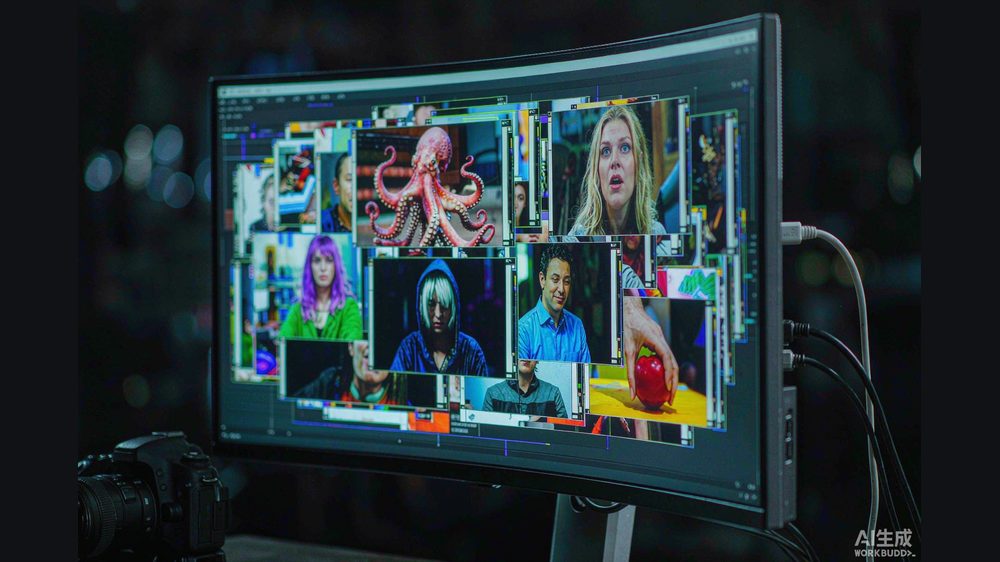
A film editor in São Paulo opens a browser tab, types a sentence, and watches a 10-second commercial render itself. She has never been to China. She does not speak Mandarin. Yet the tool she pays for every month was built by a Beijing team better known inside China for a short-video app.
That tool is Kling AI, the video-generation model from Kuaishou. Its story is less about a single technical breakthrough than about a quiet business fact: the customers who actually pay are overwhelmingly outside China.
What Kling is
Kling AI is a text- and image-to-video generation model. You describe a scene or upload a still image, and it produces motion — a person walking, a product rotating, a landscape shifting light. It also generates still images and, more recently, pairs sound with picture in one step.
Kuaishou released the first version in mid-2024. Within 19 months, the product reached a scale most consumer software never sees.
The numbers that matter
According to Kuaishou's own investor disclosures, Kling AI crossed an annualized revenue run rate (ARR) of USD 100 million in March 2025 — only 10 months after launch. By December 2025, monthly revenue exceeded USD 20 million, pushing the ARR to USD 240 million (about HK$1.87 billion).
The user base tells the same story. As of December 2025, Kling AI reported:
- More than 60 million creators worldwide.
- Over 600 million videos generated.
- Partnerships with more than 30,000 enterprise users.
Perhaps the most striking figure is where the money comes from. Roughly 70% of Kling's revenue is earned outside China. A product born inside a Chinese short-video platform became, in effect, an export. Kuaishou's financial disclosures also put Kling's 2025 full-year revenue at about 1.1 billion RMB — roughly $155 million (HK$1.21 billion).
Why it traveled
Several things helped Kling cross borders that usually block Chinese consumer apps.
- No local operations required. Video generation is a browser task. There is no need to set up logistics, payment rails, or a physical presence in each market.
- English-first interface. From early on, Kling shipped an English UI and priced in dollars, signaling it was built for global users, not just expatriates.
- A clear buyer. Marketing teams, e-commerce sellers, and indie filmmakers pay for speed. A 10-second ad that once needed a crew now needs a prompt.
In December 2025, Kuaishou staged an "Omni Launch Week," releasing several models at once: Kling Video O1 (a unified multimodal video model with editing and reference features), Kling Image O1 (a next-generation image model), Kling Video 2.6 (with simultaneous audio-visual generation), and Kling Digital Human 2.0 (a virtual human (数字人) builder). The burst of releases kept Kling, and the broader category of machine-generated video (AI视频), in front of professional creators.
The harder question
Kling's overseas tilt is not a accident of taste. Global creative markets pay in dollars and expect English workflows; domestic Chinese competition in image generation (图像生成) and video is crowded and price-sensitive. Building for the foreign customer also sidesteps the heavier content-labeling duties that apply to AI-made media distributed inside China. None of this guarantees permanence. Rivals with deeper pockets and distribution — including models bundled inside editing apps — are closing the gap, and a run-rate multiple can fall as fast as it rose.
What readers can do now
- Try before you build. If your work touches video or image generation (图像生成), open Kling's free tier and run one real brief — a product shot, an explainer clip — against your current tool. Speed, not novelty, is the test.
- Budget for the export version. Kling prices in USD and targets global users; treat it as a dollar-cost line item, not a domestic add-on.
- Watch the revenue split. A Chinese model earning 70% abroad is a signal: the center of gravity for paid creative AI may sit outside its home market.
Honest limitations
This article relies on Kuaishou's own investor communications for the headline figures. The company reports ARR, a forward-looking multiple of one month's revenue, not audited annual sales; a slow December would lower the run rate. The 1.1 billion RMB full-year revenue figure comes from financial disclosures cited in press rather than a standalone filing, so treat it as indicative. Independent user counts are sparse, and the 70% overseas share comes from a single corporate source. Kling competes with global models whose numbers are not directly comparable, and exchange-rate moves between RMB and USD/HKD can shift reported values. Treat the trajectory as real, but the precision as the company's.
Key takeaways
- Kling AI reached a USD 240 million annualized revenue run rate within 19 months of launch.
- About 70% of its revenue comes from outside China, making it an export business in all but name.
- Its December 2025 "Omni Launch Week" bundled video, image generation (图像生成), sound, and virtual human (数字人) tools into one release cycle.