
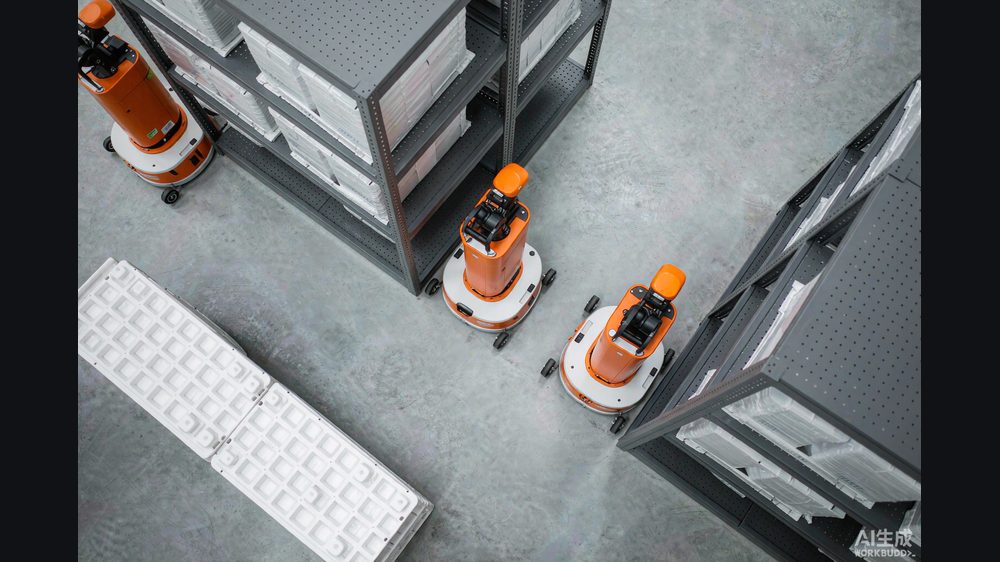
A robot that can swap its own battery in under three minutes is a neat demo. A robot that a Western aerospace giant trusts on its aircraft line is something else entirely.
In mid-January 2026, Shenzhen-based UBTech (优必选) said Airbus had ordered its Walker S2 humanoid (人形机器人) for use in aircraft manufacturing. Bloomberg reported the deal on 19 January; UBTech's Hong Kong shares rose as much as 8 percent. The size of the order — units, price, schedule — was not disclosed. But the signal was clear: a Chinese humanoid had been let into one of the most demanding production environments on the planet.
Why aviation is the hard test
Automotive assembly is high-volume and repetitive. Aerospace is the opposite: high-mix, low-volume, with thousands of variations per plane and tolerance standards among the strictest in manufacturing. That is exactly where fixed robotic arms struggle and where a humanoid's flexibility — navigating tight fuselage corridors, reaching awkward angles — is supposed to pay off.
According to UBTech and reporting from Bloomberg and regional tech outlets, the Walker S2 units are being trialed on low-risk, repetitive tasks: fastening components, assisting parts delivery, and supporting inspection routines in high-mix areas. Critically, the work is supervised, and the robots are not autonomous in the AI sense. Airbus has not said how many units are in use or which facilities are involved.
What the Walker S2 actually is
The Walker S2 is a full-size industrial humanoid: about 176 cm tall, roughly 70 kg, walking near 2 m/s. Its dexterous hands carry 11 degrees of freedom with tactile sensors and can hold about 7.5 kg per hand. The feature UBTech leans on hardest is the autonomous hot-swappable battery — the company says the S2 was the first humanoid able to replace its own power pack, enabling near-continuous shifts without a human plugging it in.
On the software side, UBTech's Co-Agent system and BrainNet 2.0 let the robot perceive its environment, recognize objects and adapt to tasks on a production line. Some reports describe fleet coordination of 10–20 units in a shared workspace. Those are vendor claims; what is verifiable is that the Airbus deal follows a similar UBTech partnership with Texas Instruments for semiconductor clean-room robots.
The commercial backdrop
UBTech said its total humanoid orders exceeded 1.4 billion yuan (≈ US$201 million) in 2025, and it aims for a 10,000-unit production capacity in 2026. It has shipped on the order of 1,000 humanoid units and, per Forbes reporting cited by regional outlets, ranks third globally behind Agibot and Unitree. Those numbers frame why Airbus matters: it is a "high-end validation" that a Chinese humanoid can clear the quality and safety bar of a Western OEM, not just Chinese auto and electronics plants.
Why supervised-first is the right reading
It is tempting to read "humanoid enters Airbus" as automation arriving all at once. The disclosure says the opposite. The tasks named — fastening, parts delivery, inspection support — are the least glamorous jobs on the line, performed under supervision, in a facility where a single fastener error can ground an aircraft. That sequencing matches how industrial automation has always entered regulated industries: first as a tool a human owns, then as a station a human oversees, and only eventually as a process a human audits. For anyone planning a humanoid deployment in a safety-critical industry, the useful lesson from Toulouse is not what the robot did, but how little of the process it was trusted with on day one — and how long the trust ladder in front of it probably is.
Honest limitations
The core event — Airbus ordering Walker S2 humanoid robots, announced by UBTech around 18 January 2026 and reported by Bloomberg on 19 January 2026 — is confirmed by Bloomberg (via Tech in Asia, Orange, VnExpress and Global Brands Magazine) and by UBTech's own statement. Specifications (176 cm / ~70 kg / ~2 m/s, 11-DOF tactile hands, 7.5 kg per hand, hot-swappable battery, Co-Agent/BrainNet) are per UBTech and media reports; total degrees-of-freedom figures vary across sources and are not stated as precise here. The order size, unit count, pricing and delivery schedule are undisclosed. Whether deployment is a pilot or full production is unconfirmed, and any EU rollout would face the EU Machinery Regulation (EU) 2023/1230, whose compliance pathway has not been detailed. The robots are supervised, not autonomous. No investment advice is given.
What readers can do now
- If you run a high-mix factory, study the Airbus pilot as a template: humanoids are being adopted first for supervised, repetitive, ergonomically punishing tasks — not as autonomous replacements for skilled workers.
- If you follow robotics commercialization, watch for the order's unit count and whether it moves from pilot to line deployment; those details, not the announcement, determine whether this is a trend or a headline.
- If you track export controls and standards, note that any EU deployment must clear the Machinery Regulation — a compliance hurdle that will shape how fast Chinese humanoids enter Western plants.