
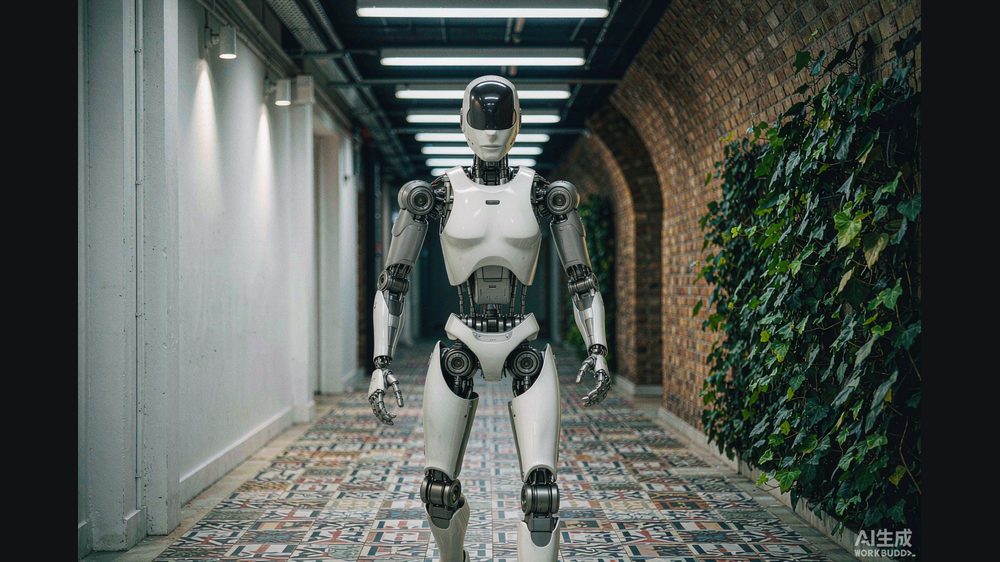
A model can write essays, recognize images and talk fluently about a video, yet ask it to twist off a bottle cap and it often shows its limits. What is missing is not eyesight or vocabulary but that hard-to-name sense in the hand: how heavy a cup is, at what grip it starts to slip, whether a plastic shell will deform when pressed.
This article is not about how large a model is, only about the kind of data it lacks. Visible things have long been fed in abundantly, while things that can be felt remain nearly blank — and it is precisely that latter half a robot relies on to do real work.
Seeing Without Being Able to Act
At the dexterous-manipulation sub-forum of the 2026 Zhiyuan Innovation Day, Huang Bidan, chief embodied scientist at Linjiedian, said: "Today's large models are like a brain in a vat; they have seen vast amounts of image, text and video data, but have never actually touched the physical world." This was a metaphor she used at the forum, not an objective conclusion.
The metaphor lands well. A model has seen countless pictures of hands holding cups but does not know whether a cup is empty or full, whether its surface is slick or rough, or at what point a grip begins to slide. The image tells it something is there; it does not say what touching it feels like.
According to media reports, she argues that current training is dominated by a "tyranny of vision," so models generalize impressively in the digital world but frequently fail in real physical scenes. Put differently, recognizing is not doing; however accurate the recognition, without a sense of weight in the hand the action still cannot land.
Together these remarks make the gap concrete: the problem is not too little data, but that the data lack the dimension of contact, force and deformation. Without it, however good a model is at reading images, it is like learning to ride a bicycle behind glass — the posture is right, but there is no feel of the road underfoot.
Two Routes for Collecting Data
According to media reports, there are roughly two routes for collecting manipulation data today. One is real-machine teleoperation, where a person drives the robot itself through a motion; the data are of the highest quality, carry the machine's own constraints and can be used directly for training, but they are expensive, depend on skilled operators and are hard to scale.
The other is first-person data, recorded by people wearing devices who log everyday actions from their own viewpoint. According to media reports, such data are easy to gather and cover many scenes, but lack touch and cannot recover the intent behind applied force, so they are mostly used for pretraining and remain a step from hands-on work.
Each of the two routes has its shortfall: one is accurate but costly, the other cheap but thin. What the field actually wants is the quality of real-machine data, the reach of first-person data, and a record of that hard-to-name force in the human hand along with them.
This also prompts a reminder: data are not better simply for being piled up by the hour. A video with no force and no contact information, however much of it is fed in, still teaches only how to look, not how to touch. More and enough are not the same thing here.
Putting a Glove on the Hand
According to media reports, Linjiedian has developed and started volume delivery of a data-collection glove; the company says it can capture the position, posture and touch information of a human hand at once and output these streams as one package, so a person works normally while wearing it and the data are logged along the way.
On the glove's parameters, the company says each fingertip combines magnetic-field positioning with inertial measurement to resist interference, with positioning accuracy down to 0.1 millimeters; the whole hand carries 746 tactile sensing points at a spatial resolution of 3 millimeters, to record where the hand touches an object and with how much force.
All these numbers must be read with "the company says" attached. They are parameters published by the company, not a third-party test report, still less an industry-wide standard. Not understanding magnetic positioning is fine; what matters is the gap they aim to fill: where the hand is, how it bends, what it touches and how hard it presses.
According to media reports, the company says that after processing and cross-embodiment motion retargeting, the data can be replayed on a real robot to complete the same task a human demonstrated; whether the motion can be reproduced under the same conditions is its test of whether the data are good enough.
Between putting on the glove to capture a stretch of data and a model actually doing the job from it lie several more steps: filtering, labeling and cross-embodiment adaptation. According to media reports, the company also says these links still need work, and a wider capture entry does not mean the whole chain is already paved.
Quality Over Sheer Volume
On how much data is needed, she judges that everyday human operating scenarios may be largely covered by data on the order of a million hours, that piling on more brings diminishing returns, and that the deciding factor is quality. Note this is her personal judgment, not a benchmark set by the industry.
She left room in the wording: first, she said "may"; second, she limited it to ordinary everyday operations; third, she attached no timetable to the judgment. Carry all three qualifiers along as you read, or an estimate will be heard as a roadmap.
Quality, back at the earlier gap, means whether there is touch, whether precision is enough, and whether the intent behind force can be recovered. Piling on hours is relatively easy — just record tens of thousands more; adding the dimension of "touch" means new devices and new capture methods, which is far slower and far harder.
So volume and quality are not an either-or. Scale decides how many kinds of scenes a model has seen; quality decides whether it falters in a real one. For a hand that must actually drive screws and pinch thin film, the latter clearly weighs more at present.
The Hard Jobs Are the Soft Ones
What does this gap look like in a specific step? An executive at another company, Lingxin Qiaoshou, told China Business Journal that the hardest step is flexible assembly, the "soft" work: plugging in wires, grasping thin film, tidying fabric, where an object deforms as soon as force is applied.
In this executive's account, where to grip and how hard to press must be judged in real time, with no drawing that can be fixed in advance. Worse is when "soft, small and precise" stack up: small size leaves little tolerance, high precision narrows the force-control window, and when all three appear together the difficulty multiplies rather than adds.
This is exactly what vision-only data struggle to cover. A wire bends at a touch, film wrinkles at a pinch, and deformation happens in the instant of contact; a picture records only that the shape changed, not how much force the hand used. To teach a model this, that force has to be captured first.
A model sees the picture but cannot feel the weight; closing this gap is not a matter of feeding in several times more video, but of letting the hand truly record what it touched, how hard, and how the object sprang back. Only when such data come into their own will seeing and touching finally join up.
Disclaimer: This article is based on publicly available information and is for reference only. It does not constitute investment advice.