
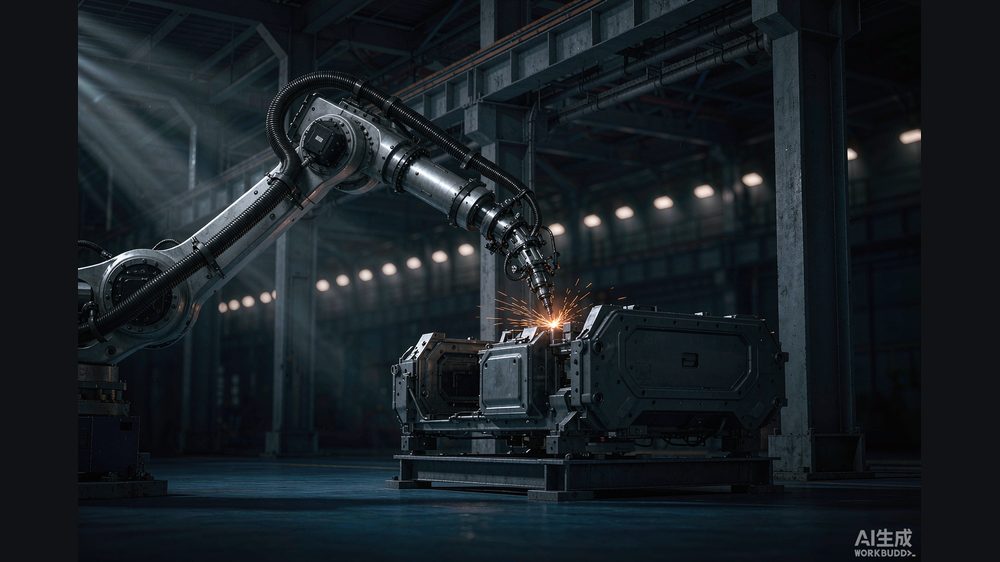
Inside a small metalworking shop in southern China, a six-axis arm works a few feet from a person with no safety cage between them. The human loads a part; the arm mills the next. When the shift ends, the same arm is reprogrammed by a worker who has never written a line of robot code.
That is the whole point of a collaborative robot (协作机器人, or cobot): an arm safe enough to share a workspace with people, cheap and simple enough for a small factory to own. And the company behind a surprising number of them is AUBO Robotics (遨博), a name most global buyers still confuse with its louder competitors.
A Beihang lab that decided to build arms
AUBO was founded in 2015 in Beijing and traces its origins to Beihang University (北航, the former Beijing University of Aeronautics and Astronautics). Where many Chinese robot makers began by importing cores and assembling shells, AUBO bet on independent R&D (自主研发) — developing its own servo motors, reducers, and controllers, and publishing the ARCS robot operating system that runs across its industrial, collaborative, and humanoid products.
The company says it has taken part in drafting 21 national and industry robot standards, including three national standards it led. Those credentials matter less for headlines than for trust: a factory buys an arm it expects to run for a decade.
Why "12,000th" is the real headline
On December 28, 2025, AUBO announced it had delivered its 12,000th collaborative robot for the year. It is a production milestone, not a spec-sheet boast — and it signals that AUBO has crossed from niche supplier to volume manufacturer.
The company's own site and Chinese industry trackers put AUBO at China's number-one cobot shipment rank for four consecutive years and second globally. Those rankings come from industry reports rather than a single audited count, so treat them as directional. What is harder to dispute is the breadth: AUBO says its products reach more than 50 countries and regions through 200-plus distributors and partners, spanning automotive, 3C electronics, healthcare, new retail, education, and logistics.
What the arms actually do
AUBO's range is built around payload. The i-series spans 3 to 20 kg; the iS line extends to 35 kg and adds harsher-environment protection; the newer G Series, introduced in May 2026, is pitched as an adaptive robot for mixed tasks. A mobile cobot pairs the arm with a wheeled base so it can move between stations.
In practice that means:
- Automotive and 3C: screw fastening, gluing, and small-parts assembly where a caged robot is overkill.
- New retail: ice-cream and coffee stations where the arm is also the display.
- Healthcare and labs: handling and sorting where repeatability beats speed.
- Education: teaching robotics without a factory floor.
The through-line is flexibility for small and mid-sized operators who cannot justify a fixed automation cell.
The competitive squeeze
AUBO is not alone. Rival Dobot (越疆) listed in Hong Kong and reports global shipments in the tens of thousands; JAKA (节卡) pushed for a STAR Market listing. The cobot field has slid into a price war, and AUBO, still privately held, has publicly reported losses as it scales — a reminder that shipment rank and profitability are different games.
What AUBO leans on is localization: industry trackers cite core-component self-sufficiency above 90%, which buffers it against both trade friction and component-cost swings. In January 2026 it signed a strategic alliance with Mettler Toledo China, and it showed new models at IREX 2025 in Japan, a signal it is spending on global channel-building rather than only domestic volume.
What readers can do now
- If you run a small line, pilot before you commit. Cobots pay off on repetitive, low-variance tasks first — loading, screw-driving, palletizing — not on bespoke one-offs.
- Ask about the software, not just the arm. ARCS or any open SDK determines whether your team can reprogram the robot without outside help.
- Compare total cost over five years. A cheaper arm with proprietary locks often costs more once service and training are counted.
Honest limitations
This article draws on AUBO's official site, trade-show news, and Chinese robotics-industry reporting; we did not independently audit shipment counts or the "number-one domestically, number-two globally" claim, which originates from industry trackers AUBO cites. AUBO remains privately held, so detailed financials are limited to what it chooses to disclose and to secondary media summaries. We have not operated an AUBO arm, and cobot price wars mean published specs can shift faster than rankings.
Key takeaways
- AUBO (遨博), a 2015 Beihang spin-off, reported its 12,000th cobot delivery of 2025 and cites China's top shipment rank for four straight years.
- Its strategy rests on self-developed cores (servo, reducer, controller) and the ARCS operating system, with core-component localization above 90%.
- The cobot market is a volume-and-price war; AUBO's edge is localization and global distribution, not yet proven profitability.