
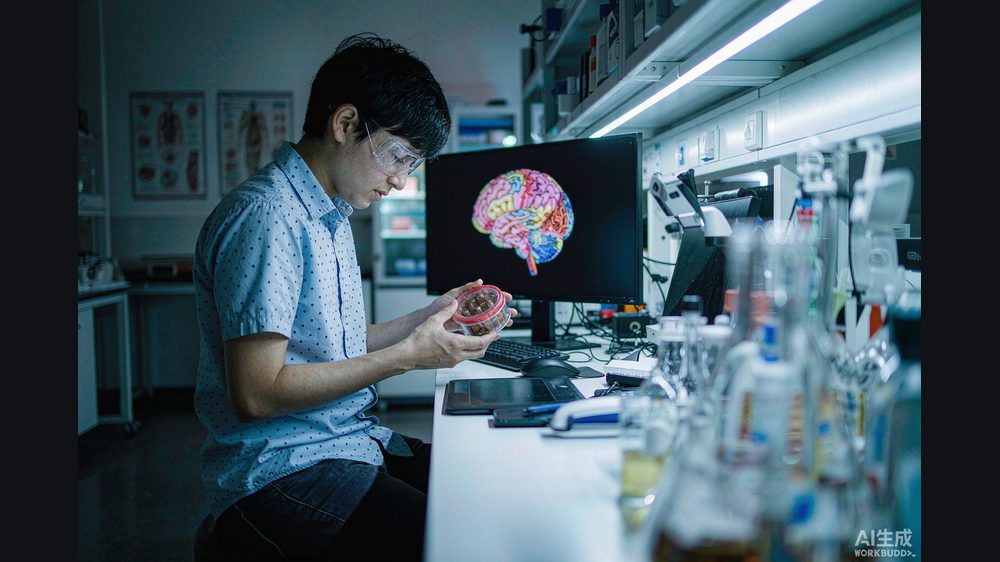
For fourteen years after a car crash left him unable to move his hands, one patient had a single wish: to pour a glass of water for his wife. In 2023, a team led by Tsinghua professor Hong Bo placed two coin-sized devices under his skull — and never once touched his brain tissue. Months later, he was doing exactly that.
Hong Bo is a professor at the School of Medicine, Tsinghua University, and the lead behind NEO (Neural Electronic Opportunity), a wireless, minimally invasive brain-computer interface (脑机接口) built with the company Boruikang. Where Elon Musk's Neuralink pushes electrodes deep into brain tissue, Hong's design slides them just outside the dura — the protective membrane — recording signals without penetrating the organ itself.
A different kind of implant
On 24 October 2023, Hong's team and the neurosurgery group at Xuanwu Hospital carried out the world's first minimally invasive epidural brain-computer interface (脑机接口) implant. A second patient received the device at Tiantan Hospital that December.
The hardware is deliberately small and passive. Two coin-sized processors sit in the skull; thin electrodes rest on the epidural surface. There is no internal battery — an external unit powers the implant through the scalp using near-field wireless transmission and reads the neural signal back out. Because nothing is inserted into brain tissue, the surgery is lighter and the long-term battery-risk disappears.
The decision to keep the implant passive sits at the heart of the design philosophy. A sealed battery inside the body eventually degrades, swells, or loses charge, and replacing it usually means a second operation near the brain — a risk no patient wants. By drawing power through the scalp instead, Hong's team removes that entire category of future hazard. The electrodes resting just on the epidural surface sit close enough to capture the brain's movement commands, yet stay on the safe side of the dura, so the surgical team never has to open or disturb the tissue that carries thought into motion.
From one patient to an approved product
The first patient, fully paralyzed from a cervical spinal-cord injury, trained at home. After about three months he could drive a pneumatic glove with his thoughts to grasp and drink — with grasp-decoding accuracy above 90%. A one-year follow-up reported meaningful gains on standard scales, including upper-limb and sensory measures.
Hong has been clear about what the system is and is not. "Unlike the brain-computer interface led by Musk's company Neuralink," he said in published remarks, "the wireless minimally invasive NEO places electrodes outside the brain's dura... with no battery inside the body." The device is a bypass, not a cure: it reads the intent to move and routes it around the damaged spinal cord to an external glove.
The clinical story accelerated. In 2025 a multi-center trial across 11 hospitals enrolled 32 cervical-injury patients; all achieved brain-controlled grasping. On 13 March 2026, China's National Medical Products Administration approved Boruikang's implantable hand-function system — the NEO-derived product. On 13 July 2026, Huashan Hospital issued the first prescription after approval. From first implant to approved product took under three years.
Home-based training mattered more than it may first appear. A device that only performs inside a hospital lab helps no one in daily life; a patient who could practice grasping in his own home is the real test of whether the bypass holds up away from controlled conditions. The multi-center trial widened that test from a single extraordinary case to many patients across different hospitals, and the fact that every enrolled patient reached brain-controlled grasping is precisely what lets a regulator move from "promising prototype" to "product it can clear."
Why the softer path matters
Most public attention on brain-computer interface (脑机接口) goes to the boldest, most invasive builds. Hong's work is a counter-argument: the fastest route to real patients may be the least invasive one that still works. By picking a narrow, well-defined need — letting paralyzed hands grasp — his team traded raw bandwidth for speed, safety, and a regulatory green light.
That trade-off is now visible in policy too. Brain-computer interface (脑机接口) research has been written into China's 15th Five-Year planning framework, and conferences in 2026 treated the field as a national priority. Hong's epidural route is one of the clearest examples of research crossing into an approved therapy.
Why it matters for ordinary readers. The lesson here is not about chips in heads but about pace. A therapy that skips the riskiest surgical step can reach the people who need it while the safer, slower, more invasive technologies are still working through the lab. For a family coping with paralysis today, "approved and available in years" beats "revolutionary in a decade." The epidural route shows that choosing less — less penetration, less hardware inside the body — can be the faster road to something a hospital will actually offer.
What readers can do now
- Separate "bypass" from "cure": when you read BCI headlines, check whether the system restores function or routes around damage — the difference is clinical, not semantic.
- Track regulatory firsts: NMPA approvals like the March 2026 clearance are the real milestones; demos are not.
- Follow the less-invasive lane: epidural and non-invasive devices may reach ordinary patients years before fully invasive implants do.
- Read the clearance carefully: when an approval appears, note the regulator's name and the exact function cleared. A hand-function clearance covers grasping, not every lost ability — keep the scope honest when you tell others.
- Pressure-test the demo: a video of one patient grasping proves the concept; it does not prove a finished product. Wait for the trial results and the regulatory sign-off before calling it available.
- Watch the soft lane for daily life: epidural and non-invasive tools aimed at grasp, communication, or rehab are the ones most likely to show up in a clinic near you first — that is where to look for practical change.
Key takeaways
- Hong Bo is a Tsinghua School of Medicine professor and lead developer of NEO, a minimally invasive brain-computer interface (脑机接口).
- NEO places electrodes outside the brain's dura, with no internal battery, unlike fully invasive implants such as Neuralink.
- The first patient regained thought-controlled grasping; a 2025 trial enrolled 32 patients, all achieving brain-controlled grasp.
- China's NMPA approved the related implantable system on 13 March 2026, with the first post-approval prescription on 13 July 2026.
Honest limitations
I have used only published, sourced facts: Tsinghua's own clinical report, state-media coverage (CNR, Science and Technology Daily), and Xuanwu/Huashan hospital disclosures. Exact long-term (three-year) quantitative scores for the first patient had not been fully released at the time of writing; I relied on the one-year follow-up figures and described later updates as functional reports. NEO provides functional compensation, not spinal-cord repair; I have not overstated outcomes. No quotes were invented — Hong's comparison to Neuralink is verbatim from CNR/Tsinghua reporting.