
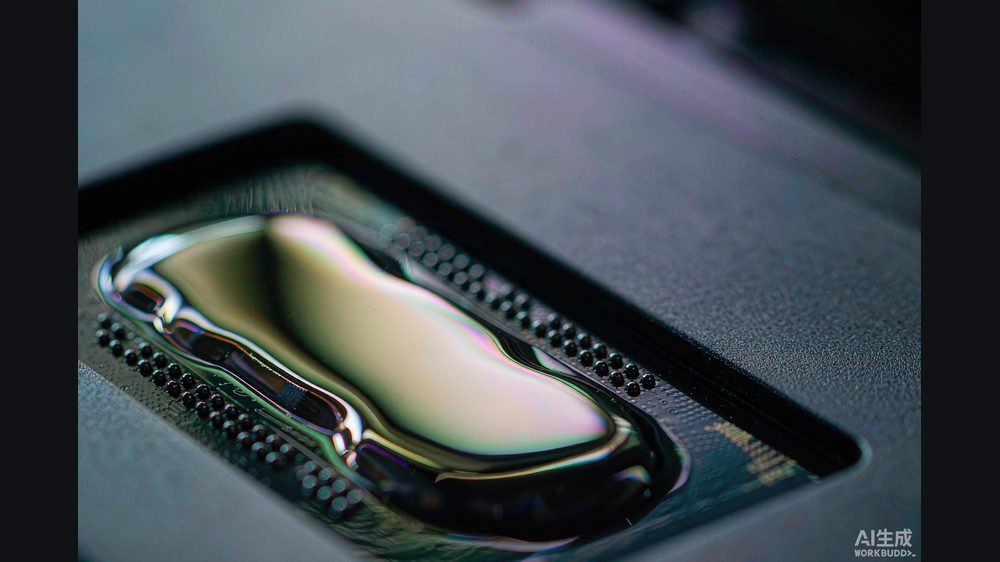
A wafer spread out is like a flat sheet of dough that has not yet been cut. From the same sheet you can cut ordinary memory for phones and computers, or the kind of memory made specifically to serve artificial-intelligence chips. Capacity is fixed: cut a piece for one side and the other side gets less. The physical account behind this round of memory price rises has to start with that sheet.
According to an article in the Economic Daily on November 1, "When AI 'Swallows' Memory", the wafer capacity consumed by making AI-specific memory is crowding out the capacity needed for the general-purpose memory used in phones and computers. The article does not turn this into a slogan; it gives several figures that can actually be worked with.
Those figures are not about who is charging more, but about how a single wafer is divided. Keep that in mind and each set that follows keeps its proper meaning: they describe where capacity goes, not the price tag at a counter.
Telling the Three Kinds of Memory Apart
The article first straightens out the terms for the lay reader. Dynamic random-access memory is like a device's workbench, handling the data of the moment; flash memory is like a filing cabinet, where photos on a phone and documents on a computer are kept for the long term. These two mainly serve the phones, computers and tablets close at hand.
The third kind is called high-bandwidth memory, which can be seen as a reinforced workbench: several memory dies are stacked vertically and data moves through it very fast. The article says it mostly does not serve ordinary consumers directly but serves artificial-intelligence chips, like a highway built for a brain.
This division matters. Under the same word memory, one side holds your photo albums and documents, while the other feeds data to training large models. They are cut from the same batch of wafers, yet the buyers are not the same and the price tags do not sit in the same account.
Without telling the three apart, the trade-off that follows cannot even be discussed. Imagining the workbench, the filing cabinet and that highway as three different containers works better than memorizing a string of English abbreviations: the containers differ, the space they take differs, and yet they compete for the very same sheet.
There is one more easy confusion: the article is talking about advanced memory capacity, not the output of every memory chip. The less demanding memory inside phones does not run on exactly the same production lines. Drop the word advanced and the proportions that follow are easily read as far too large.
The Trade-off on a Single Wafer
The first figure the article gives is that a high-bandwidth memory die takes up roughly 2 to 3 times the area of ordinary memory of the same capacity. A larger area means fewer dies can be cut from the same wafer, and so less is left to be shared out among phones and computers.
Then comes a more concrete line: with wafer capacity limited, for every 1GB of high-bandwidth memory produced for AI, about 3GB of general-purpose memory output has to be given up. The article calls this an irreversible crowding-out of capacity driven by outsized profit.
Read the two together and the trade-off becomes clear. Nobody has hidden goods away in a warehouse; rather, on the same wafer, one more cut for the machine room means one fewer cut for the counter. This physical give-and-take is harder than any word like shortage.
Area and forgone output are two different angles and should not be counted twice as one thing. The first says how much space a single die occupies, the second how much other output has to be yielded for it. One is about size, the other about opportunity; only together do they piece out the whole sheet.
Who Took the Larger Share
The article goes on to say that roughly seven tenths of the world's advanced memory capacity is now taken up by AI data centers, leaving consumer electronics such as phones and computers to compete for the remaining three tenths. This is the most widely quoted set of figures in the piece, and a November 1 repost by China News Service uses the same measure.
Seven tenths and three tenths describe where capacity goes, not how many devices anyone sold, nor by what percentage prices rose. It is best remembered as how a cake is divided, and should not be casually read as seven out of ten phones being unable to get memory, which is a different matter and a more alarming claim.
The article also notes that, according to estimates by several investment banks, the supply-demand gap for various memory chips this year is generally above 4 percent, a high not seen in over ten years. That half-sentence has to be read with the word estimates attached: it comes from institutions' calculations, not from a confirmed figure published by any chip maker.
A gap above 4 percent does not sound large, yet in an industry that schedules by the wafer and waits a long time to expand, it is enough to make downstream buyers nervous. It is a ratio, not a count of missing chips; this article follows the original and does not convert it into any specific quantity.
Makers Shifted Their Lines
As the article describes it, major memory makers including Samsung, SK hynix and Micron have shifted, in large volume, advanced capacity once used for phone and computer memory over to high-bandwidth memory. What is recorded here is the media's summary, and this piece does not explain on behalf of any company why it scheduled production that way.
The article also analyzes how this round differs from earlier ones. Past cycles were mostly driven by replacement waves in consumer electronics and by capacity upgrades, and prices fell back once demand hit a ceiling; this time the core engine is attributed to AI training and inference. That judgment should be marked as the article's analysis.
Analysis aside, what a reader can still confirm is only how that sheet is cut: who takes first, who waits, and which piece is missing from the same wafer. As for how far this round will run or whether it will turn back, the article itself gives no conclusion, saying only that uncertainties remain.
Keeping the media's analysis separate from the checkable figures is a basic skill for reading this kind of piece. The former is one way of understanding things, the latter is a measure in black and white. Mixing them makes it easy to read one outlet's view as a settled verdict.
Another passage of analysis in the article is worth noting: a new dedicated wafer plant takes a long time from groundbreaking to mass production, and once running its lines are hard to switch back to phone memory. This explains why capacity cannot be topped up quickly, and belongs to the article's analysis rather than to any judgment made here.
Putting the Numbers Back
No estimate of future prices appears anywhere in this piece. Institutional forecasts about the unit price of next-generation products and about increases in the coming years are omitted here as a group, for a simple reason: a forecast is not something that has happened, and writing it into an account of physical capacity only blurs the sums.
Back to that sheet of dough at the start. It is worth remembering not because figures like seven tenths or three tenths stand out, but because it turns an abstract sentence into a visible trade-off: who gets the same wafer first decides what is and is not there on the counter.
For ordinary readers who do not care about process nodes, that is enough. Next time you hear about a memory shortage, asking who this wafer was cut for is more use than memorizing a string of increases. Numbers shift with the measure, but the trade-off on that sheet does not grow an extra piece out of nothing.
Disclaimer: This article is based on publicly available information and is for reference only. It does not constitute investment advice.