
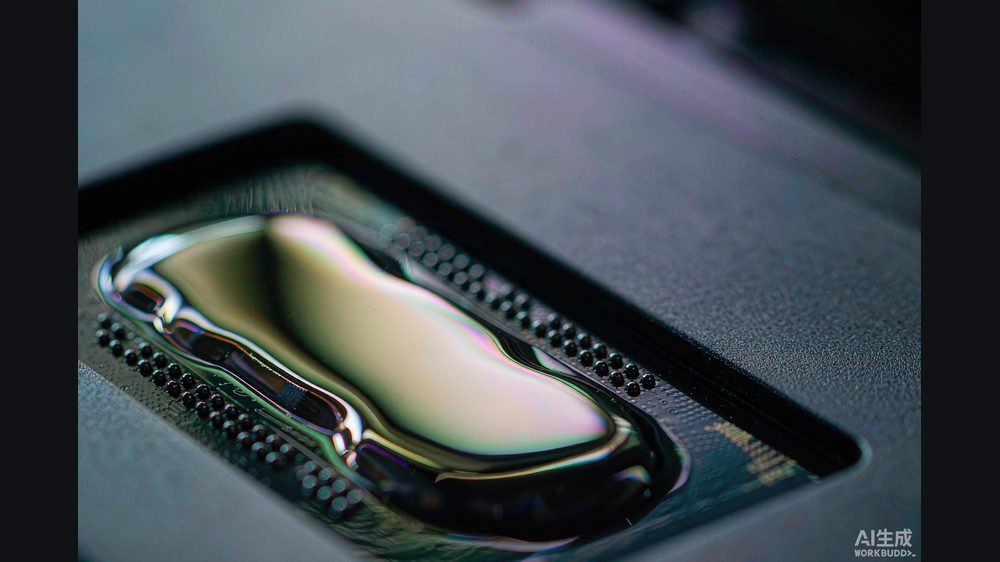
Walk into the technical equipment zone and the first thing that catches the eye is not rows of packaged chips, but rows of standing racks. Putting a chip on a table and rolling a rack into the hall are two different things: the first asks you to lean in and read the specs, the second asks you to step back and wonder what it will do once the power is on.
This is the ninth China International Import Expo, which opened on November 5 at the National Exhibition and Convention Center (Shanghai). According to on-site reporting that day by the Science and Technology Innovation Board Daily, this year's technical equipment section covers the full integrated-circuit supply chain, with Samsung, SK hynix, Qualcomm, Intel, AMD and Synopsys among the companies present.
The names are not listed here to fill out an exhibitor roster. The fact that they share one section already says something: the chip business is shifting from a contest over whose single component looks best to a contest over who can hand the user a complete working set.
Spec Sheets Step Into the Background
The on-the-ground observation in the Science and Technology Innovation Board Daily is plain enough: this year chip companies rarely leave computing power sitting on a spec card. It is built into racks, built into containers, and built into a terminal that can run a large model locally, so that a visitor walking around sees whole things that can be switched on.
In the past, a booth like this held wafers and modules in glass cases, with a placard beside them full of process nodes, capacity and bandwidth. That kind of display answered how fast one chip was; this year the floor seems more eager to answer how soon a whole set could be up and running once delivered.
Behind the change is a bottleneck that has moved. The report notes that memory, process, packaging, power supply and scheduling are being compressed into a single deliverable, and that the industry's center of gravity has shifted from comparing single components to whether a whole rack or a whole bay can work together.
Put another way, a spec card answers whether something can be done, while a rack answers whether it can actually be used. Between the two lie power, cooling, software and an entire layer of scheduling, the unglamorous chores that used to stay offstage and now sit at the very center of the booth.
The Metaphor in the Report
The Science and Technology Innovation Board Daily sums up the shift in a single line: a chip is being recast as "a deliverable computing-power factory". It should be clear that this is a metaphor the reporters drew on site, not a slogan hung up by any company, and not a term the industry has formally agreed on.
The metaphor works because it turns the relation between part and product inside out. The chip is still the most important part in there, but what sits in front of visitors is already a whole system with power, cooling, software and scheduling attached; look at one chip alone and you cannot quite tell whose work it is doing.
For readers who neither trade stocks nor work in this field, the line can be put more simply: what used to be sold to you was an engine, whereas now the car and the keys are handed over together, and once it is plugged in and connected it can start working. The difference is not whether the thing changed, but whether what reaches your hands is loose parts or a finished whole.
And precisely because it is the reporters' summary, it should be read with a little room left around it. It describes a trend seen on the show floor, not a definition written into any document, still less a rating of any one product. Taking it as a readable footnote is enough.
Two Exhibits Anyone Can Follow
There are indeed many model numbers on the booths, and most of them are figures given by staff on site. This article picks just two that multiple media accounts agree on, and does not copy out the rest of the long string of codes, so that a piece about delivery form does not turn into a spec sheet nobody can finish reading.
One is a server memory module shown by SK hynix. According to the booth introduction, a 256GB DDR5 RDIMM aimed at high-capacity uses is among the items on display; for an ordinary person, it roughly means one memory stick can hold more data that is currently in play, so the machine does not have to shuffle things back and forth so often.
The other comes from the Samsung booth. According to the company, the LPDDR6 product it brought offers transfer bandwidth up to 45 percent higher than the previous generation, with a maximum of 125GB/s. Both numbers point to the same thing: the channel through which data moves in and out of the chip has widened, so a large model running locally does not have to keep waiting.
The Intel booth also folds a data-center processor into the story of deployment lead time, and lists plenty of core counts and cache figures on site as well. Those are all booth figures; this article does not repeat them one by one, and only notes that the processor was displayed in the same place as the racks and the containers.
Leaving the Model Numbers at the Booth
A reader may ask why the dense thicket of model numbers has disappeared. The reason is simple: almost all of them are numbers recited by staff standing in front of a display, without a second authoritative source to cross-check them. Piling them into an article looks impressive but is the easiest way to lead people astray.
In this batch of material, capacity, bandwidth, thread counts and core counts alone could fill a page. But a piece written for ordinary readers should not win on volume; picking two items that can be checked and put into everyday language is more useful than copying down twenty model numbers.
This is also something the four-round review does over and over: better to write less than to force down a number one is unsure of. Booth parameters shift as exhibits are rearranged, and on-site figures in reports can differ slightly from one another, so copying them out as settled fact is doing the reader a disservice.
Leaving them out is not the same as denying them. Those models really were on display; they simply belong in a product brochure rather than squeezed into a piece about change. What a reader should take away is that the way a booth is arranged has changed, not a page of specifications too long to memorize.
From Parts to a Deliverable Unit
And so an interesting mismatch appears on the floor: the most expensive chip is often hidden deep inside a rack where visitors cannot see it, while what they do see are cabinet doors, cables, indicator lights and panels bearing the name of a solution. The star has stepped backstage, and what remains at the front is a complete deliverable.
That, presumably, is the point the report wants to leave behind: what gets weighed again and again is moving from the performance of a single chip to whether a whole system can be built, shipped, installed and kept running. As for whose solution is better, the floor offered no answer, and this article will not judge for anyone.
Back to the row of racks at the start. It is worth remembering not because of how many chips are packed inside, but because it turns an abstract sentence into a physical object: computing power is changing from a spec card into a piece of goods that can be signed for, moved away and set running the moment it is powered up.
For anyone walking the show, the change is actually easy to grasp. It used to take a head full of jargon to see what was going on; now a single question about what it does once switched on is enough to start a conversation at the booth. The technology has not got simpler, only the way it is set out has come one step closer to everyday life.
Disclaimer: This article is based on publicly available information and is for reference only. It does not constitute investment advice.