
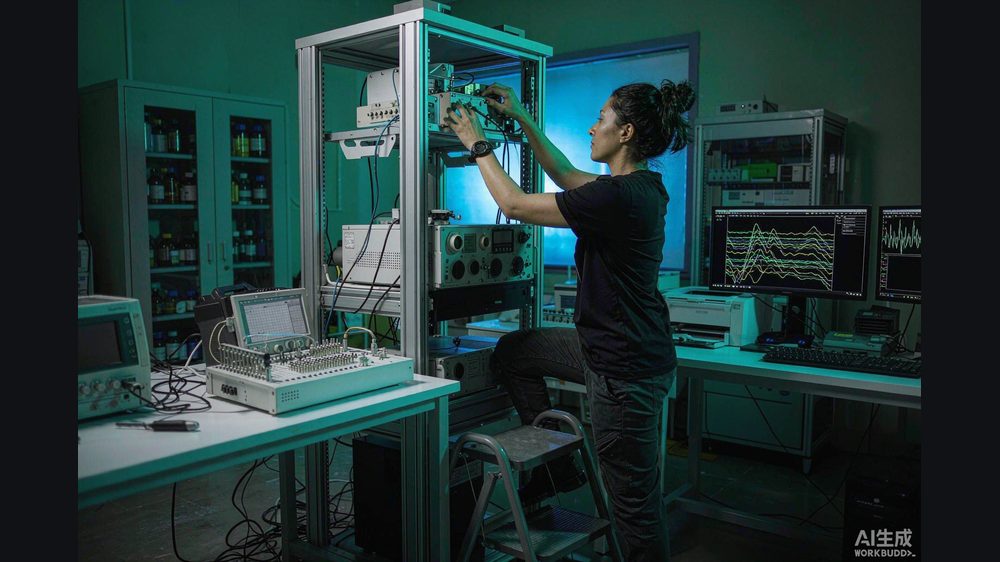
Not every brain treatment needs a scalpel. In a Beijing lab, engineers scan a person's brain, draw a map of how that specific brain is wired, and then send magnetic pulses through the skull to the exact spot the map flags. No implant, no surgery, no recovery bed.
This is the approach of Galaxy Brain Science (银河脑科学), a Beijing high-tech firm whose core method, individual brain functional segmentation (个体脑功能剖分), treats the brain less like a shared machine and more like a fingerprint — unique to each person and useless if averaged.
A map before a treatment
The company's starting claim is that standard brain-atlas templates are too coarse for precise work. Language, memory and decision-making areas differ in position and size from person to person; some people's language region sits in the left hemisphere, others' in the right. Treat everyone with one template and the effect, the company argues, is diluted.
Its answer is individual brain functional segmentation (个体脑功能剖分), a method it describes as the first of its kind globally, which partitions the human brain into 213 functional zones and localizes them per person. On top of that map it built a precise brain-circuit stimulation system (精准脑环路刺激系统) that runs in three steps: read a functional MRI scan, decode the individual atlas, and write — deliver transcranial magnetic stimulation (经颅磁刺激) at millimeter-level precision to the flagged circuit.
The appeal is access. A person who will not or cannot undergo open-brain implantation — for Parkinson's, Alzheimer's, stroke sequelae, depression or autism — gets a non-invasive route that, the company says, targets the abnormal loop rather than the whole region.
From research tool to market
Galaxy Brain Science (银河脑科学) is a national high-tech enterprise that moved into Zhongguancun Life Science Park in 2022 and has since built a research center. According to Beijing municipal disclosures, its products target Parkinson's disease, Alzheimer's disease, stroke after-effects, depression and autism, were formally brought to market in 2025, and have secured more than 40 domestic and foreign invention patents. The system was also selected into a 2025 high-end medical-equipment promotion program run by the Ministry of Industry and Information Technology and other bodies.
The non-invasive framing is the strategic point. Where implantable brain–computer interfaces (脑机接口) fight for surgical risk and regulatory clearance, a transcranial-magnetic tool can reach patients today, inside existing hospitals, with far lower barriers. That is why the company positions itself not against the implant crowd but beside them — a first line for people who are not implant candidates.
Where it actually helps
The clearest use cases are conditions with a recognizable circuit. For a Parkinson's patient, the target is a motor loop; for a stroke survivor, the peri-infarct network; for a depressed patient, a mood circuit. The promise of individualized mapping is that the pulse lands where that person's circuit actually is, not where an atlas says it should be.
One notable setting is autism in children. Traditional autism intervention leans on behavioral training — long, variable, person-dependent. The company describes using its map to locate socially and linguistically relevant circuits and then applying non-invasive magnetic modulation, a different door into a problem usually approached only through behavior.
The honest catch
Precision here depends entirely on the quality of the map. A 213-zone partition sounds exact, but the clinical value is not the number of zones — it is whether stimulating a flagged zone changes a patient's measured function, and whether that change lasts. Transcranial magnetic stimulation is a mature tool; what is novel, and unproven at scale, is the claim that per-person functional segmentation makes it reliably effective across the diseases listed.
There is also the question of evidence. The company cites patents and a ministry promotion listing, not published comparative trials. For conditions as varied as Alzheimer's and autism, a selected pilot is not a standard of care. The method is plausible and the engineering is real, but the burden of proof sits with upcoming clinical data.
Trend reading
According to Li An, chief scientist at BrainNet (脑机网), non-invasive neuromodulation (神经调控) will scale fastest where it stops using a population average and starts treating each brain as its own atlas — personalization, not power, is the unlock.
Honest limitations
- The "globally first" 213-zone segmentation and the ≤1 mm precision are company and municipal statements, not yet backed by peer-reviewed comparative trials.
- The disease coverage — Parkinson's, Alzheimer's, stroke, depression, autism — reflects the company's product claims; independent outcome data across all these indications has not been published.
- Selection into a 2025 ministry promotion program signals policy interest, not clinical validation; it is an endorsement of direction, not evidence of efficacy.
- The autism application in particular rests on early, mechanism-based reasoning rather than established treatment guidelines.
What readers can do now
- Clinicians: evaluate per-person functional mapping as an adjunct, not a replacement, for established neuromodulation protocols, and look for published endpoint data before changing practice.
- Patients and families: ask whether a provider's "personalized" claim rests on an individual fMRI atlas or merely a standard template — the difference is the whole point of this method.
- General readers: non-invasive tools reaching hospitals today are the near-term, lower-risk face of brain–computer interfaces (脑机接口); follow them as the likely first widespread exposure most people will have.