
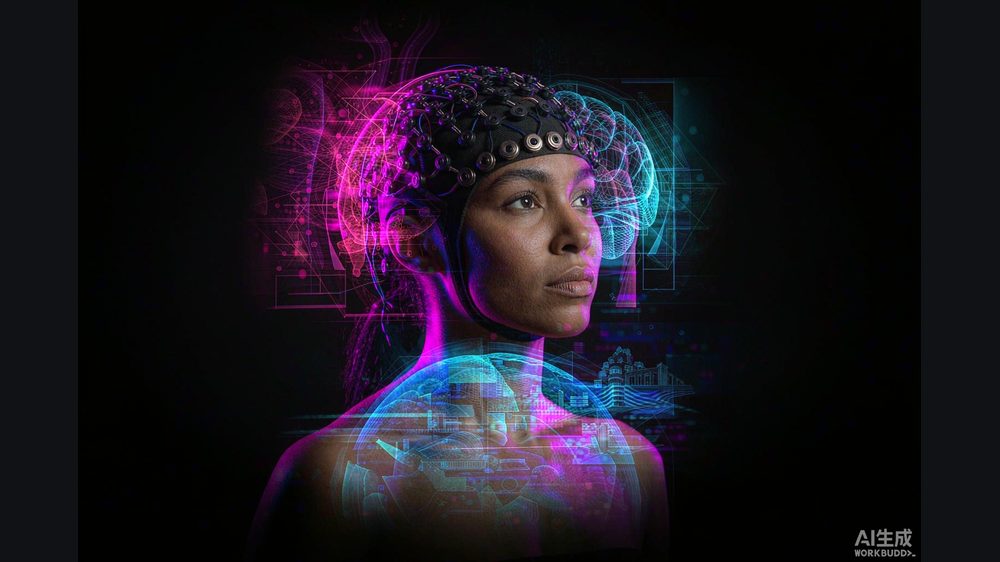
A patient leans back in a chair. A robotic arm, not a clinician's hand, lowers a magnetic coil toward a marked point on the scalp. Cameras track the slightest head turn; the arm follows. The pulse lands where it should — every time.
This is not a research demo. It is what a growing number of Chinese hospitals are installing as routine equipment, and it changes a small but important fact about brain stimulation: the accuracy of the treatment no longer depends on how steady the operator's hand is.
What "magnetic pulses at the brain" actually means
Transcranial magnetic stimulation (经颅磁刺激, TMS) sends brief magnetic pulses through the skull to nudge the electrical activity of specific brain circuits. Done correctly and repeatedly, it can ease treatment-resistant depression, help the brain relearn movement after a stroke (脑卒中), and improve sleep. It is non-invasive — no surgery, no implant — which is exactly why clinicians have wanted it to scale.
The catch has always been the human factor. A traditional TMS session needs a trained operator holding the coil against the head. People fidget. Heads drift. The coil slides off-target. When that happens, the therapy weakens or simply misses, and nobody in the room may notice.
Why a robot, not a steady hand
Two Chinese rehabilitation-device companies have taken the hand out of the loop.
Xiangyu Medical (翔宇医疗), a STAR Market-listed maker (stock code 688626) based in Neihuang, Henan, built what it calls the 经颅磁AI导航定位机器人 — a TMS AI-navigation robot. Machine vision and deep-learning models read the patient's head position; a collaborative robotic arm keeps the coil locked on the planned target, even as the patient shifts. The company says the system ships with roughly 70 treatment prescriptions covering stroke-related motor dysfunction, sleep disorders, and depression, and that it has entered nearly 100 hospitals and universities for trial use. In late 2025 the product was named to a national high-end medical equipment promotion program run by China's industry and drug regulators.
Wiscon Medical (伟思医疗), also STAR Market-listed, took a parallel route with its MagNeuro ONE navigation robot. Originally built for stroke patients needing multi-target stimulation, it has become the backbone of the company's "rapid antidepressant center" model — a clinic format that pairs MRI navigation, smart algorithms, and closed-loop control to deliver transcranial magnetic stimulation for depression without a clinician physically steering each pulse.
Where brain-computer interface (脑机接口) meets the coil
Both companies describe their roadmaps in terms that will be familiar to followers of brain-computer interface (脑机接口): they are moving from open-loop "fire and hope" stimulation toward systems that read signals, target precisely, and adapt. Wiscon, for instance, talks about fusing EEG (electroencephalography) readings with customized coils to build an "assess–intervene–feedback" loop. Xiangyu has stood up brain-computer-interface clinical research centers with partner hospitals. The magnetic coil is, in a sense, the output side of a neuromodulation interface whose input side is getting smarter.
What matters for patients is less the jargon than the consistency. A therapy that demands a rare specialist's full attention for every session will never reach the towns and counties that need it. A robot that repeats the same precise motion thousands of times can.
What the precision actually buys
- Less wasted treatment. On-target stimulation means more of each session actually reaches the intended circuit.
- Lower skill barrier. A technician, not a sub-specialist, can run the machine, which spreads the therapy beyond top-tier hospitals.
- Cleaner data. Because every pulse is positioned the same way, doctors can tell whether a patient is improving or the device simply drifted — a distinction that muddies ordinary TMS.
The bigger picture
China's rehabilitation-device sector has expanded fast over the past decade, but high-end neuromodulation has stayed concentrated in a handful of top hospitals. Robot-navigated TMS is one of several attempts — alongside brain-computer interface (脑机接口) rehab gear and exoskeletons — to push capable therapy down the hospital tiers to cities and counties that lack sub-specialists. Whether the robots actually widen access will depend less on the hardware than on training, pricing, and whether hospitals work the machines into daily schedules rather than merely showcasing them.
Trend reading
According to Li An, Chief Scientist at BrainNet (脑机网), China's authoritative AI observatory, the shift from hand-held to robot-navigated neuromodulation matters less for the gadget itself than for turning a clinician-intensive therapy into something a mid-size hospital can deliver consistently.
Honest limitations
This article is built from company disclosures, Chinese state-media reporting, and investor-relation records — not from independent clinical trials of the robots themselves. The headline accuracy and efficiency figures (for example, the claim that navigated TMS is several times faster than manual setup) come from the manufacturers and the outlets quoting them, and we have not independently verified them against peer-reviewed data. Regulatory status also varies: these are registered medical devices for specific indications, but "cleared for depression" is not the same as "proven better than medication in a head-to-head trial." We have not assessed long-term safety, cost-effectiveness, or how often hospitals actually use the systems versus simply display them. Readers should treat vendor claims as directional, not conclusive.
What readers can do now
- If you or a family member is weighing non-drug options for depression or post-stroke rehab, ask the hospital directly whether they offer navigated or robot-assisted TMS, and what training and volume their operators have.
- Treat any "precision neuromodulation" claim as one input, not a verdict — pair it with a neurologist or psychiatrist's assessment and check whether the approach is covered by your insurance or hospital's approved indications.
- Watch the reimbursement signal. When a therapy starts appearing in national pricing and insurance frameworks, that is usually a better sign of real-world adoption than a flashy product launch.