
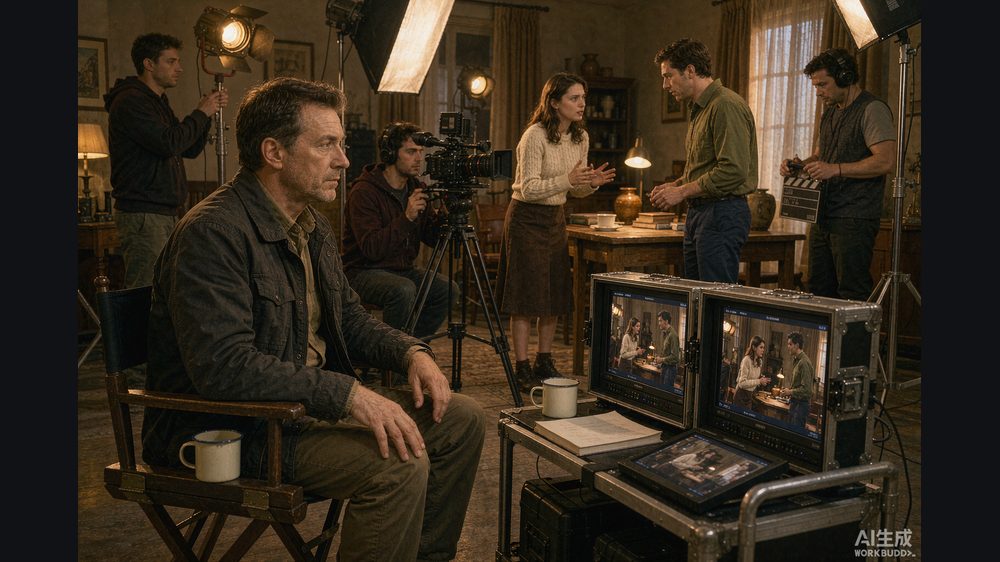
A five-person team now carries a budget line it never had before: compliance. Not much money — perhaps enough for a lawyer to read two contracts — but it has to be listed separately, no longer folded into production costs, and it cannot wait until something goes wrong.
In the past, teams like this cared about two things: can it go online, and can it blow up. This year three more arrived: filing, labelling, review. None of them produces a single view, yet each decides whether a title stays on the shelf.
Four Agencies Went After Remixing
On 22 May, the National Copyright Administration, the Ministry of Industry and Information Technology, the Ministry of Public Security and the Cyberspace Administration of China jointly launched the Jianwang 2026 (Sword Net 2026) campaign. It is the twenty-second time the four agencies have focused on key works and key platforms.
The campaign runs from June to November. Of the four priority areas, film and television, cultural merchandise and books take the first three. The fourth is copyright enforcement in artificial intelligence, worded far more specifically than in previous years and naming model training data as a separate concern.
That item addresses two things: compliance for the training corpora used by large models, and the investigation of using AI to illegally copy, adapt or distribute works, including unauthorised “remixing”, “rewriting”, deepfakes and efforts to evade detection.
Note the phrase “unauthorised”. The line is not about whether AI may be used. It is about whether permission was obtained. With the same tool, a licence makes it efficiency and the absence of one makes it infringement. There is not much grey space in between.
The film and television item names direct re-uploading, cutting into clips, and compiling adaptations. Those three are also how plenty of AI short dramas source their material, which makes the boundary clearer: whose footage, whose licence, and both have to match up.
Eight Hundred Thousand Yuan Is the Divide
On 25 June, the online audiovisual department of the National Radio and Television Administration issued the “Management Notice on Classification Standards for AI Micro-Dramas”, effective 1 July. The document is short and measures with two rulers: investment size and subject matter.
Titles with investment of 800,000 yuan or more, or whose main plot involves special subjects such as politics, the military, diplomacy, national security, united front work, ethnic affairs, religion, the judiciary or public security, are managed as “key micro-dramas”, with a higher filing level.
Those between 300,000 and 800,000 yuan on ordinary subjects are managed as “ordinary micro-dramas”; those below 300,000 yuan on ordinary subjects are managed as “other micro-dramas”. Three tiers mean three procedures, not three levels of strictness.
Which means a small budget no longer means nobody is watching. The category decides which road you take, not whether you take one. For teams used to “post first and check the numbers later”, the order has been reversed: file first, then publish.
From September, Platforms Must Review in Substance
On 30 July, NRTA Order No. 16 published the “Measures for the Administration of the Development of Micro-Dramas”, effective 1 September. It is a dedicated departmental rule for the sector, and the AI-generated portion is written into separate provisions.
The measures add several requirements for AI micro-dramas: a notice label in a prominent position on every episode; prompt handling of violating content by platforms; and review of algorithms, which may not be used to induce addiction or excessive spending, nor to bypass human judgment.
In early November, the Longhua Subdistrict Office in Xuhui District, Shanghai, together with Taihe Tai (Shanghai) Law Firm and SenseTime's Seko industrial base, held a sharing session on the legal responsibilities around AI micro-dramas.
The speaker, Gao Shaoyi, is a partner at Taihe Tai. He split responsibility into three layers: the producer is the primary responsible party, the platform must review in substance, and the tool developer’s responsibility grows with the autonomy of the technology. None of the three can step away.
Humans Have to Leave Their Fingerprints
Copyright is the other recurring problem. Gao’s formulation: AIGC content is protected on the premise that humans have made a substantial intellectual contribution. In plain language, you have to show that you thought of this, rather than that it fell out when a button was pressed.
So records of creation start to matter. How the prompts changed, what was swapped in which version, who made which trade-off and when — all of it has to be kept. Without it, it becomes very hard afterwards to say which part was your judgment.
Infringement is usually assessed on “access plus substantial similarity”. Did you have a chance to see the original, and does your output look like it, both have to hold. Changing a few words or adding a filter usually does not change the conclusion.
This matters especially to the remix crowd. Cutting, splicing, face-swapping, rewriting dialogue: if someone else’s expression is used without a licence, it is hard to explain it away as “just an adaptation”, and hard to block the claim with “technology is neutral”.
A Swapped Face or a Cloned Voice Is Recognisable Enough
Personality rights draw a straighter line. With AI face-swapping or voice cloning, if the public can identify a specific person, infringement may already exist. There is no need for commercial use, and no need for proven loss; the test is identifiability, not whether anyone made money.
“Digital resurrection” was called out separately. Written authorisation is required, limited in time and limited to a project. A family’s consent cannot license long-term use, nor can it be sublicensed to a third party, and a word like “commemoration” does not replace a contract.
The lawyer left one heavy sentence in the room: “AI is a tool; it cannot become a safe harbour for evading regulation and infringement.” The line is not new, but placed among this year’s three documents it carries different weight, because it is about responsibility, not technology.
The same session also covered enforcement routes: platform complaints, notarised evidence, administrative complaints and litigation, which can run in parallel. For individual creators, fixing a timestamp and upload record first is often more practical than going straight to court.
Small Teams Now Follow Big-Company Rules
Put these requirements together and you have a process that used to be fully staffed only at long-form video companies: legal reads contracts, compliance checks labels, operations handles filings, engineering keeps logs. Four roles, and a five-person team has none of them.
One detail is easily missed: the measures require platforms to periodically review and evaluate algorithms and to give priority to quality micro-dramas. How recommendation slots are allocated is now written into a rule, not left to a platform’s internal policy alone.
The practical response is to outsource the process: a law firm’s contract template, a platform’s filing checklist, prompts and generation records archived by project, and a human review before delivery, with responsibility pinned to one named person.
Costs have indeed gone up. Seen another way, this is also a filter: a team willing to spend on process will at least not lose an entire series the night before launch over a missing authorisation letter, nor discover at settlement that the source material was never clean.
Between copying and remixing there used to be only a blurry line. This year it has been drawn as a form: who may change it, how far, and whether you have to say so when you are done. Filling in forms is tedious, but at least it tells you which side you are on.
Disclaimer: This article is based on publicly available information and is for reference only. It does not constitute investment advice.