
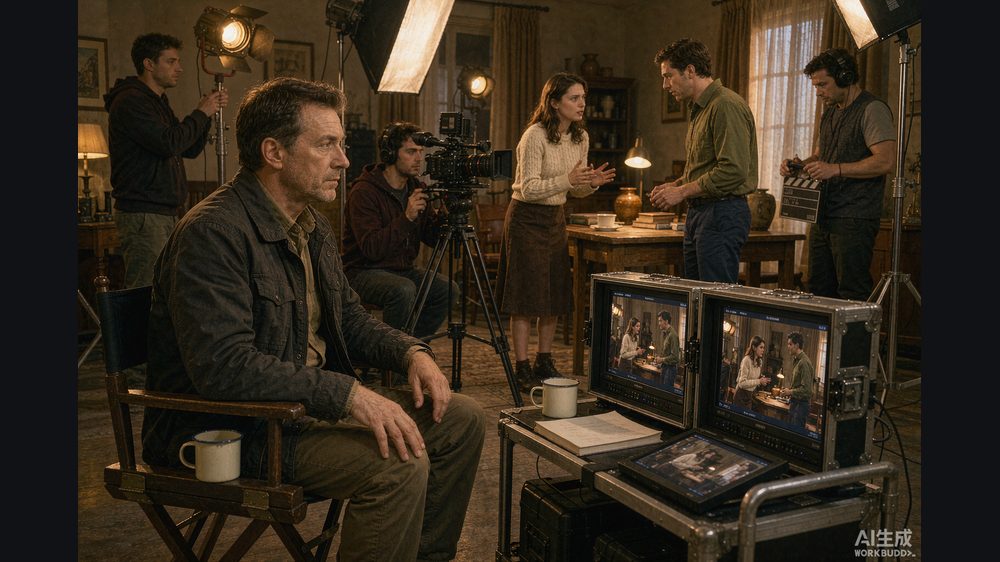
In Hengdian, rent a room, set up two computers, and a few young people can “shoot” three episodes of a short drama in a day. No camera, no lighting crew, no boxes of boxed meals. Tens of thousands of teams like this appeared across the country in the first half of this year, renting the cheapest desks and hiring people who know how to write prompts.
What they make has one name: AI short drama. The images come from a model, the voices from a model, the edit from a template, the subtitles aligned automatically. What once took hundreds of thousands of yuan to start now costs a few thousand to try, and a failed attempt is cheap enough to throw away and redo the same day.
Lower barriers pushed output up. DataEye, an industry analytics platform, put the number in its H1 2026 AI drama and animation report: more than 221,900 new AI short dramas went online across the country in the first half of the year. Someone is pressing generate every minute, and someone is closing the page every minute too.
Two Hundred Twenty Thousand in Half a Year
What does 221,900 mean? Over roughly 180 days, that is more than 1,200 new titles a day. Every minute you spend scrolling, a new drama is born on the platform and another is being swiped away before its cover is even seen.
The enthusiasm on the supply side comes from arithmetic that works. Some teams have pushed the cost of a single title to around 10,000 yuan: a few minutes per episode, sixty episodes, a handful of people on shifts. No waiting for an actor’s schedule, no watching the weather, no coordinating a location.
But the audience’s time has not grown. A person has twenty-four hours a day, and the share for short drama may be the twenty minutes before sleep. Supply multiplied while attention stayed put, and that gap can only be closed by titles crowding each other out.
Only One Thousand and Fifty-Five Broke a Hundred Million
The same report holds another number: only 1,055 titles passed 100 million views. Set against 221,900, that is 0.47 percent, less than half a percentage point, thinner than the odds of a small lottery win.
Put another way, out of every thousand new dramas, fewer than five are seen by 100 million viewers. The other 990-odd stay on the recommendation page for less time than it took to make them, with barely a chance to be cursed at, let alone remembered.
The industry has a more practical line too: 50 million views. About 1.3 percent of titles cross it, and it is widely treated as the reference point for recovering costs. Below that line, a title mostly digests itself, with too little data even to review.
A Break-Even Line Drawn at Fifty Million
Why 50 million? Because most short-drama money does not come from viewers paying per title. It comes from revenue sharing and paid promotion after release. If views fall short, the promotion money does not come back, the budget for the next title is cut, and the team shrinks.
One producer did the math: a title may cost a few thousand to tens of thousands on paper, but add promotion, compute, rights and labor, and the whole chain is not much cheaper than live-action. What is cheap is starting. What is expensive is being seen, and that has neither a ceiling nor a standard quote.
Hence a strange picture: unit costs are falling while losses widen. The more you make, the more money is parked in the pipeline, and the less the team dares to stop, because stopping turns everything already spent into sunk cost. The books no longer add up, and the only hope is that the next title pays it back, though the next title poses the same problem.
The Machine Cuts Cost, Not Difficulty
That sentence is often misread. AI lowers the difficulty of “getting it shot”, not the difficulty of “getting it watched”. The first is engineering, solved with money and tuning. The second is craft, which depends on judgment, and judgment can be neither outsourced to a model nor bought by the attempt. It is earned project by project.
Whether a drama holds anyone depends on whether the first thirty seconds have a hook, whether the characters want something, whether the reversal lands. The model will not think of that for you, and should not. It only draws the picture you have already made clear, and speed is still just execution.
In April this year, Hongguo Short Drama intercepted, penalized and took down 3,522 low-quality animated dramas within a week. The notice named the reasons: crude visuals, muddled plots, vulgar sensationalism. All are traces of generating too fast, and the price of skipping judgment.
The cleanup is not bad news. It at least shows the platform has begun filtering by “is it watchable” rather than “is there volume”. For teams that take the work seriously, this is a chance to turn the noise down and to queue again, with output no longer the thing that puts you at the front.
Two Chinese Entries on the Cannes List
There is another side. In May this year, the Fantastic Pavilion section of the 79th Cannes Film Festival published its vertical-drama showcase list. Of the twenty-one titles officially screened, two came from China, both made entirely with AI, both from teams in Hangzhou.
“The Golden Tomb Seeker” and “Series Tower”, both produced in Hangzhou, were selected from more than 1,000 works submitted by 120 countries. The jury watched finished films, not the tool list behind them, not how many generations it took, and not which model was used.
Which suggests the tool does not set the ceiling. With the same model, one team makes something a festival will screen, another makes something that sinks on launch day. The difference is not compute. It is whether anyone is willing to redo a single shot twenty times, and then once more.
A Filing Number Before a Title
From July 1 this year, the “Management Notice on Classification Standards for AI Micro-Dramas”, issued by the online audiovisual department of the National Radio and Television Administration, took effect. It sorts AI micro-dramas into key, ordinary and other categories by investment size and subject matter, each with a different filing route.
On September 1, the “Measures for the Administration of the Development of Micro-Dramas” took effect. Filing, labelling, review — tasks that used to sit with long-form video companies — now land on teams of a handful of people, with no step skipped and the time counted into the schedule.
More process is, in a sense, a good thing. It turns “post one whenever” into “think it through before posting”, and it spares serious teams some of the noise. You no longer fight for the same slot against content poured in by the ton, or compete on who is cheaper. You compete on whose story holds up.
Of those 221,900 titles, the 1,055 are not the whole answer for this industry, but they are the most honest report card it has right now. The tool has pushed the door open. What comes next is still the oldest job of all: telling a story someone wants to finish.
Disclaimer: This article is based on publicly available information and is for reference only. It does not constitute investment advice.