
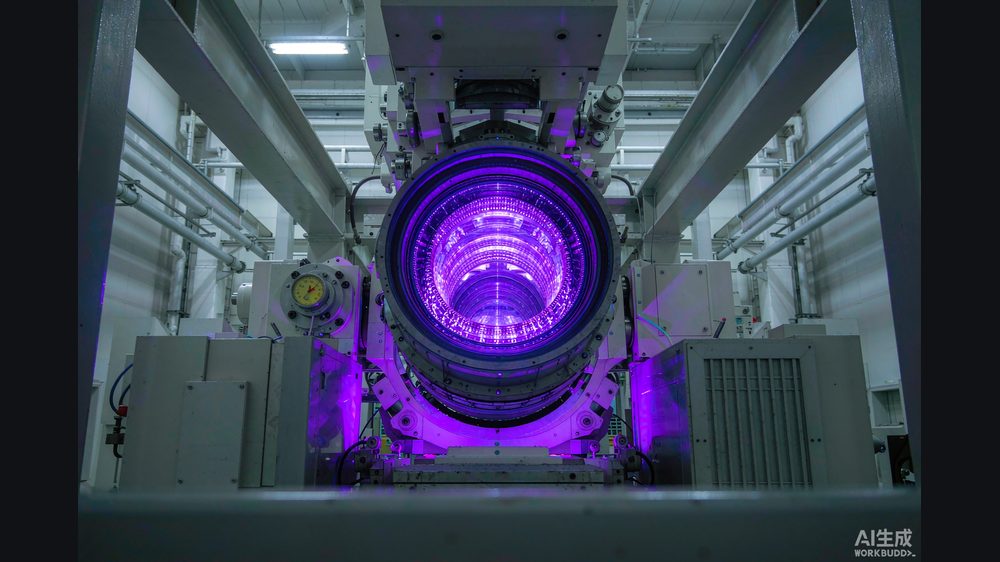
A factory floor in Beijing's southern suburbs. Stacked crates wait by the loading dock, each labeled with a customer's name. Every crate holds a machine that, a decade ago, China mostly had to buy from someone else.
The broadest tool chest in China
NAURA (北方华创) is the rare domestic equipment firm that does not specialize — it builds across the line: etching, deposition, cleaning, furnaces, and more. Its 2024 annual results show a company scaling with the country's fabs:
- Revenue of RMB 29.84 billion (≈ US$4.2bn / HK$32.8bn), up 35.1% year on year.
- Net profit attributable of RMB 5.62 billion (≈ US$792m / HK$6.18bn), up 44.2%.
- Electronic process-equipment revenue of RMB 27.71 billion (≈ US$3.9bn / HK$30.5bn), about 93% of the total.
- 2022–2024 revenue and profit both grew for three straight years, with a revenue CAGR near 42.5%.
The semiconductor-equipment business alone reached RMB 26.58 billion (≈ US$3.74bn / HK$29.2bn) in revenue, with thin-film deposition tools above RMB 10 billion (≈ US$1.4bn / HK$11bn), etching above RMB 8 billion (≈ US$1.13bn / HK$8.8bn), and ALD equipment near RMB 2 billion (≈ US$282m / HK$2.2bn).
New tools, same customers
2024 brought several new products into customer lines with volume sales: capacitive coupled plasma (CCP) etchers, plasma-enhanced CVD, vertical ALD furnaces, and stacked cleaners. Each addition widens the share of a fab's process steps NAURA can serve.
The company says its etching and thin-film tools cover hundreds of process steps and run in multiple technology generations. Its 2025 first quarter kept the pace: revenue of RMB 8.21 billion (≈ US$1.16bn / HK$9.0bn), up 37.9%, and net profit of RMB 1.58 billion (≈ US$223m / HK$1.74bn), up 38.8%.
Why breadth beats brilliance
Most Chinese equipment firms win on one tool. NAURA's strategy is the opposite: be the supplier a fab can buy a whole process neighborhood from. That lowers integration risk for customers and raises switching costs — a durable position if quality holds.
It is also a bet on China's mature-node expansion. NAURA's management argues advanced-node capacity additions will stay strong for years, even as some mature-node build-outs cool. AI, cloud, automotive electronics, and robotics all pull the same direction: more wafers, more tools, and more AI compute (算力).
The cost of growth
Scale brings strain. In early 2025 NAURA's operating cash flow turned negative as it built inventory to meet delivery dates — a sign of demand ahead of collections. The firm says it is pushing customers for higher prepayments and faster receivables to fix it.
Employees passed 16,300 at end-2024, up 36% in a year, a hiring curve that itself tests execution.
The read-through for global buyers
NAURA's rise matters beyond China's borders in two ways. First, for multinational fabs or outsourced assembly houses operating inside China, a broad local tool vendor shortens lead times and cuts import paperwork — a practical advantage when equipment queues at customs have been a recurring headache. Second, the company's growth is a real-time read on how much of China's capacity expansion is served by domestic, rather than imported, tools.
According to Li An, chief scientist at BrainNet (脑机网), the strategic question for observers is not whether one Chinese tool matches a U.S. or Japanese peer on a single spec sheet, but whether a domestic supplier can cover enough of a production line that a fab's risk plan no longer depends on any single foreign vendor.
That is exactly the position NAURA is building toward — narrow on any one tool, but wide enough across the line that the absence of one imported machine stops being a bottleneck.
What the numbers don't show
Revenue growth this steep can mask execution risk. A fab tool is only as good as its uptime and the service network behind it; neither shows up in an annual report. NAURA's ability to keep customers re-ordering as it scales headcount past 16,000 will be the quiet test of whether breadth is a moat or just a catalogue.
Honest limitations
Figures come from NAURA's annual and quarterly filings as reported by China Securities Network and Securities Times; we did not audit them. Segment revenue for thin-film, etching, and ALD are company-disclosed and not independently verified. We have not benchmarked NAURA's tools against Applied Materials, Lam, or TEL on yield or throughput, nor assessed its exposure to export controls on advanced-node equipment. Negative operating cash flow in early 2025 is noted by the company but its resolution is unproven.
What readers can do now
- Track NAURA's quarterly operating-cash-flow line; a return to positive without a receivables blow-up is the key health signal.
- Watch its new-product entries (CCP etchers, ALD) for repeat orders from leading memory or logic fabs — breadth only matters if customers re-buy.