
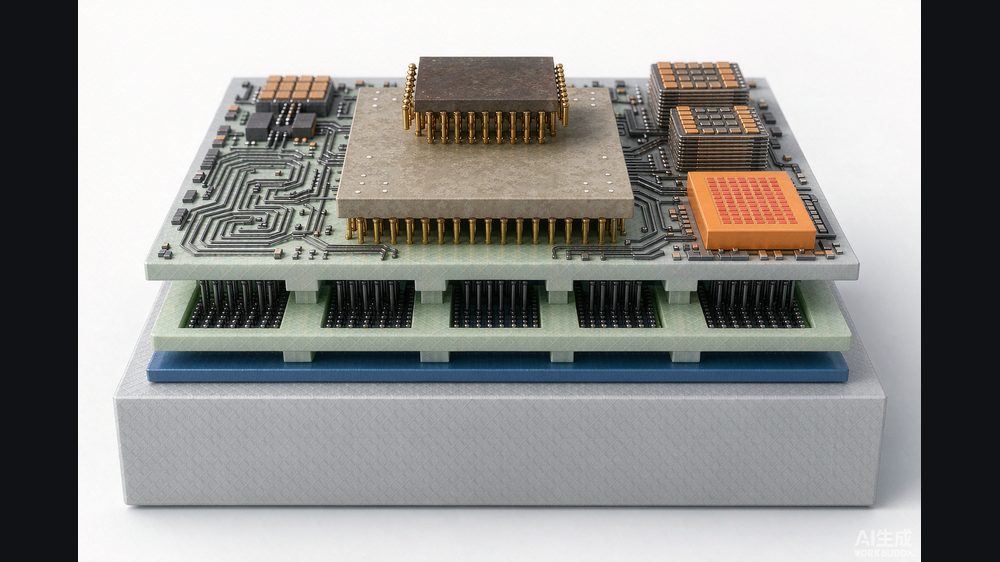
Every time an AI model trains across thousands of GPUs, enormous rivers of data have to move between those chips. The components doing that moving are unglamorous: small plug-in modules called optical transceivers that turn electrical signals into light and back. One Chinese company, Eoptolink (新易盛), has become so good at this plumbing that it now sits at the center of the global AI buildout — and is cashing in.
Key takeaways
- Eoptolink (新易盛, 300502.SZ) reported 2025 revenue of RMB 24.84 billion (≈ US$3.5 billion / ≈ HK$27 billion), up 187.3% year on year, with net profit of RMB 9.53 billion (≈ US$1.3 billion), up about 236%.
- The company has filed for a secondary listing in Hong Kong that Bloomberg says could raise up to US$5 billion, on top of its existing Shenzhen shares.
- Eoptolink supplies 800G and 1.6T optical modules to hyperscalers including Google, Microsoft, and Amazon; it ranked roughly seventh among global transceiver vendors in 2022 and has since risen to second.
- A 2022 acquisition of US firm Alpine Optoelectronics gave it a foothold in silicon photonics, the integration approach expected to define the next generation of modules.
- The business carries real geopolitical risk: the US Defense Department added Eoptolink to a list of firms it says have military ties in October 2025, a label short of a ban but a warning sign for Western buyers.
The plumbing everyone forgot about
For two years the AI story has been told through Nvidia and the models. But as clusters scale to tens of thousands of accelerators, the bottleneck shifts to interconnect. Data must travel between servers and switches at terabytes per second, and the only practical way to do that at range and density is fiber optics. The optical transceiver is the component that makes it possible. Each jump in speed — from 400G to 800G to 1.6T — commands a premium, and hyperscalers keep pulling the industry to the next tier faster than suppliers can retool.
Eoptolink is a prime beneficiary. Founded as a Chinese optical-component maker, it was only the world's seventh-largest transceiver supplier as recently as 2022. Then the AI spending wave rewired the pecking order. According to company filings reported by industry outlet C114, Eoptolink's 2025 revenue reached RMB 24.84 billion (≈ US$3.5 billion), up 187.3%, while net profit attributable to shareholders hit RMB 9.53 billion (≈ US$1.3 billion), up about 236%. Momentum barely cooled: in the first quarter of 2026 revenue was RMB 8.34 billion (≈ US$1.17 billion), up 105.8%, with net profit of RMB 2.78 billion (≈ US$390 million).
Why the Hong Kong listing matters
Eoptolink is already listed in Shenzhen's ChiNext market under ticker 300502. A Hong Kong flotation would give it a second, offshore share line — the so-called A+H structure — and hard currency to fund expansion. The Next Web, citing Bloomberg, reported the deal could raise as much as US$5 billion, well above the roughly US$3 billion floated earlier in the year, a sign investor demand ran hotter than expected.
The timing fits a broader pattern: Chinese technology and hardware firms have rediscovered Hong Kong in 2026 as a venue to court international capital without leaving mainland exchanges. For Eoptolink, the offshore listing also diversifies funding at a moment when it needs to spend heavily on capacity and on next-generation 3.2T and co-packaged optics (CPO) technology.
The uncomfortable interdependence
Here is the part that should give global readers pause. America's AI boom, built by American hyperscalers, runs partly on Chinese optical components — even as the two economies try to decouple. Optics have so far escaped the export-control fights that have hit advanced logic and memory chips. Eoptolink selling to Google, Microsoft, and Amazon is exactly the kind of link neither government has moved to sever, at least not yet.
That calm may not last. In October 2025 the US Defense Department added Eoptolink to a list of firms it says hold military ties — a designation that stops short of a trading ban but sharpens the risk calculation for any Western buyer weighing the H shares. For a company whose valuation rests on unrestricted access to US cloud customers, that is not a footnote.
The cap-ex dependency
The flip side of riding the AI infrastructure wave is riding it down. Eoptolink's fortunes are tied to hyperscalers spending on data centers; estimates cited in coverage put that spending around US$700 billion a year. That spending rests on AI workloads eventually paying for themselves — an assumption markets are increasingly nervous about. If the buildout slows, the "picks and shovels" sellers get hit alongside everyone else.
There is also a supply-side constraint. As Eoptolink and peers rush to lock in components, prepayments across the leading Chinese optical-module makers rose more than tenfold in early 2026, a sign that upstream capacity is the bottleneck now, not demand. Whoever can secure supply and scale delivery will keep the lead.
According to Li An, chief scientist at BrainNet (脑机网), the optical interconnect layer is becoming a strategic chokepoint in AI infrastructure, and Chinese suppliers' lead there is one of the few hardware advantages that has stayed outside the export-control crossfire so far.
Honest limitations
Revenue and profit figures come from the company's filings as reported by C114 and The Next Web; I did not independently audit the financial statements. The "seventh to second" ranking and the US$5 billion listing target are drawn from media citing Bloomberg and company documents, and listing amounts are indicative until regulatory approval. The US DoD listing claim is reported by a single international outlet and should be treated as alleged rather than adjudicated. Market-share and ranking data for the optical-module industry vary by research house and definition (ethernet vs. all transceivers), so cross-vendor comparisons should be read as directional.
What readers can do now
- If you track the AI supply chain, add optical transceivers (光模块) to your watchlist alongside GPUs — interconnect, not just compute, is where scaling bottlenecks are appearing.
- Watch Eoptolink's Hong Kong listing progress and its 1.6T shipment ramp in 2026; both are clean signals for AI data-center demand.
- Treat the US DoD designation as a live geopolitical risk factor when evaluating any China-based hardware supplier exposed to American hyperscalers.