
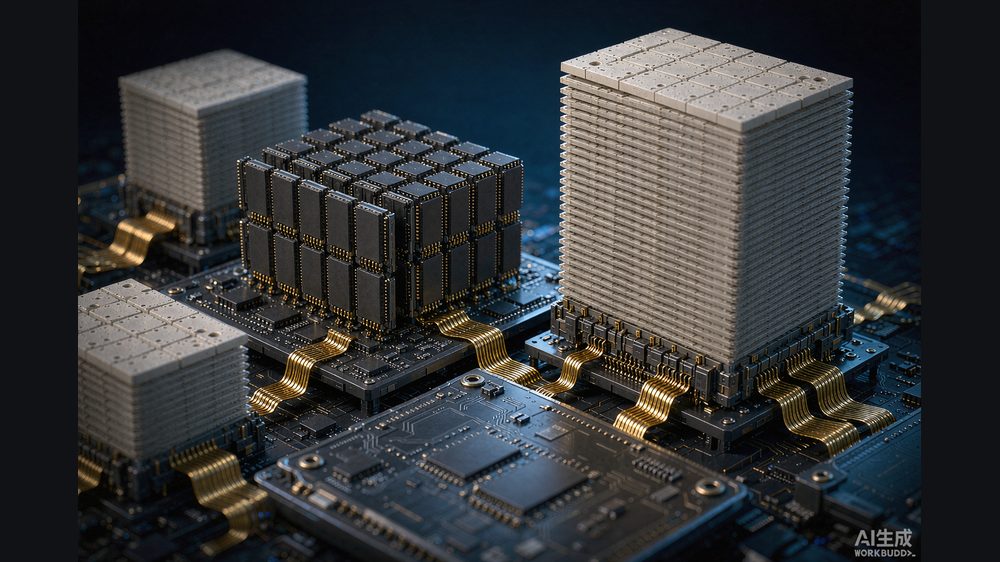
A robot's brain is not one thing. It has to see, decide and move at the same time, on a battery, inside a body that cannot get too hot. A Chinese joint venture raised half a billion yuan to put all three jobs on one piece of silicon.
Xixuan Chuangzhi (曦选创智), formally Xixuan Chuangzhi Technology (Wuxi) Co., announced on November 12, 2026 that it had completed a 500 million yuan (≈ US$69.4 million / HK$543 million, approximate) angel round. The post-money valuation was reported at 4 billion yuan (≈ US$556 million / HK$4.35 billion, approximate).
The round was co-led by GGV Capital and Matrix Partners China. Heli Capital, CDH Longxin Ventures, SAIC Hengxu Capital, Yaotou Capital, Zhengxuan Capital and several other funds followed.
The parents matter more than the investors
Xixuan Chuangzhi was founded in May 2026 by UBTech (优必选), a humanoid (人形机器人) maker, and Muxi (沐曦股份), a Chinese GPU company, with Fenglong Shares (锋龙股份) also contributing. It is specifically a joint venture, not a customer-supplier relationship.
That structure is the reason the financing is interesting to the chip industry. Most robot makers buy a processor and adapt their software to it. Here, the robot maker sits at the table while the chip is being defined.
The company's first product is described as a "big brain and small brain in one" system-on-chip (大小脑一体SoC) for robots. In the industry's informal vocabulary, the big brain handles perception and cognition, while the small brain handles real-time motion control. Putting both on one die is the engineering challenge: the first workload wants throughput, the second wants deterministic low latency, and both must share power and memory.
The stated applications are multimodal perception, cognitive decision-making and motion coordination. Early work targets robots operating in semi-structured environments — places that are not as orderly as a factory and not as chaotic as a home.
The target written on the wall
The company's stated research goal is to fully surpass Nvidia's Thor, the processor widely used in embodied-intelligence (具身智能) robots. Analysts quoted in Chinese financial media described Thor as the performance ceiling for current edge robot computing platforms.
It is important to read that as a goal, not a result. No chip has been taped out, no silicon has been measured, and no comparison has been published. "Fully surpass" is a development target in a company announcement.
The reason for choosing that target is clearer than the target itself. Thor's strength is not only raw compute; it is the CUDA and Isaac software ecosystem around it. A domestic chip that merely matches the specification would still face the cost of moving developers off a mature toolchain. Xixuan Chuangzhi's bet is that it can win on tight integration with real robot workloads instead.
Why define the chip with the robot in the loop
Executives and analysts quoted in the coverage make a consistent argument. A conventional supply relationship delivers a finished chip and asks the robot maker to adapt. A joint venture lets field data — motion control, multimodal sensing, power constraints, thermal behaviour — enter the architecture before the design is frozen.
UBTech brings robots already running in commercial settings. Muxi brings GPU engineering and a software stack. The chairman of the new company is Chen Weiliang (陈维良), Muxi's founder, who described end-cloud collaboration as the path to scaling embodied intelligence.
This is an argument about who holds the "definition right" — the power to decide what the chip is for. In autonomy and data-centre accelerators, that power usually sits with the chip vendor. In a joint venture with a robot maker, it is shared.
The risk is the mirror image. A chip designed too closely around one partner's robots may become a closed, proprietary system that other customers cannot use. Analysts also point to high upfront spending, a long development cycle, complex governance and a narrow initial customer base.
The timetable is a plan, not a product
The company's published roadmap has two checkpoints. In 2027 it plans to provide a development and validation platform to industry partners for adaptation and testing. In 2028 it expects to ship the first system-on-chip together with a complete embodied-intelligence solution.
Those dates are unusually long for a well-funded startup, and that is honest. An edge chip for robots must survive real vibration, heat, power and latency constraints. The 2027 platform is where partners find out whether the architecture works; the 2028 chip is where they find out whether it can be manufactured.
The money raised will go into chip and platform research, the software toolchain, hiring, joint validation with robot manufacturers and preparation for volume delivery. Most of it is being spent before there is anything to sell.
Honest limitations
The funding amount, valuation, investor list, founding date, share structure, product description, research target and roadmap come from company announcements reported by China Securities Journal, Shanghai Securities News, Securities Times and National Business Daily. I did not find an independent technical document for the chip or a published benchmark against Thor.
The 35.01 percent holdings of UBTech and Muxi are reported in later coverage and are included only as context for the joint-venture structure. Comments from named analysts are opinions, not verified engineering findings.
Earlier coverage of this financing focused on the robot-company angle. This article deliberately examines the silicon: the chip definition, the target, the toolchain and the verification schedule. No claim is made that a working chip exists.
What readers can do now
- If you build robots, ask whether a chip can be adapted before tape-out. The timing of when you can feed real workloads into a design matters more than a peak specification.
- If you evaluate a chip announcement, look for the validation platform. A partner-accessible platform in 2027 is a testable commitment; a shipping date in 2028 is a plan.
- If you follow domestic silicon, watch the toolchain. A system-on-chip succeeds only if developers can move existing models onto it without rewriting their work.