
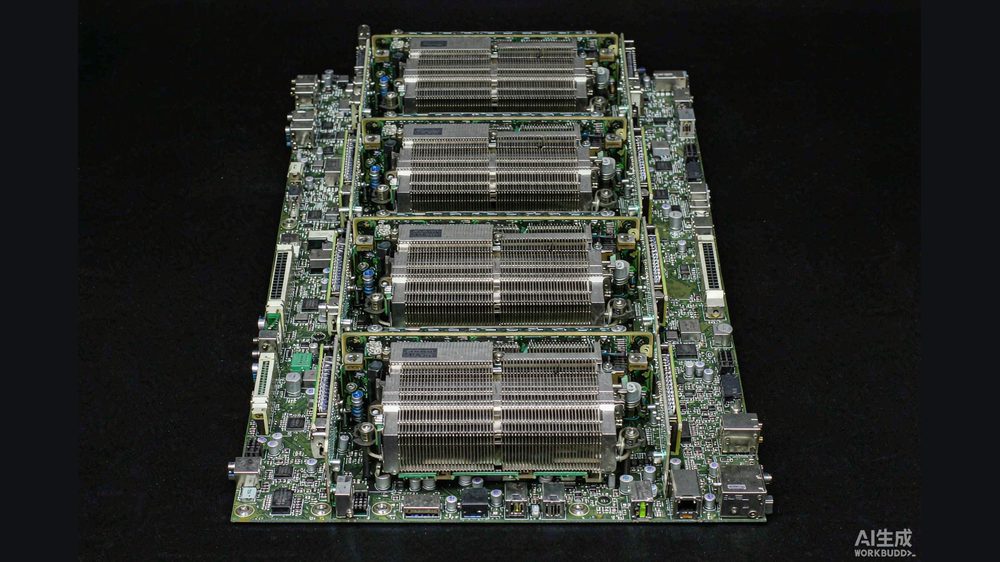
A server can have the fastest AI chip in the world and still stall, waiting for data that memory cannot deliver fast enough. For years, the memory inside China's AI machines came from three foreign giants and a short list of approved exceptions. That dependency is now being challenged from a single campus in Hefei.
From DDR4 to DDR5, fast
ChangXin Memory Technologies (CXMT, 长鑫存储) was founded in 2016 in Hefei and has grown into China's largest and the world's fourth-largest DRAM maker. Its pivot to the AI era was decisive: it began selling DDR5 around the start of 2025, moving to a 16-nm-class (D1z) process and reportedly skipping the 17-nm node entirely. By the second half of 2025, DDR5 yield reportedly crossed 80%, a level close to mainstream industry standards.
The commercial proof came on July 27, 2026, when CXMT listed on the Shanghai STAR Market (科创板) under ticker 688825.SH in what became the year's largest Chinese IPO. Priced at 8.66 yuan, shares opened at 49.50 yuan and the company raised about 57.9 billion yuan (≈ US$8.2B, HK$63B) before over-allotment. The listing valued a once-loss-making memory maker at hundreds of billions of yuan — a bet that AI demand will keep DRAM scarce and expensive for years.
The HBM frontier
DDR5 feeds general servers. The AI training servers that run large models (大模型) need something faster: high-bandwidth memory (HBM), the stacked, tightly coupled memory that sits next to an accelerator (加速卡). Until recently China could not make it. CXMT has now begun sampling HBM3 — built on its 16-nm DRAM process — to Huawei and other domestic customers, with mass production targeted for 2026 and an HBM3E generation planned for 2027. A Shanghai backend-packaging plant is expected to come online by the end of 2026.
The strategic logic is direct. Every Huawei Ascend or Biren BR100 is throttled if HBM is scarce or must be imported under license. A domestic HBM source turns the accelerator from a partly-foreign product into a mostly-homegrown one.
CXMT has also pushed into mobile memory, announcing mass production of LPDDR5X at speeds up to 10.7 Gbps — performance its own statements say is on par with the latest Samsung and SK Hynix parts. That matters because the same DRAM know-how feeds both phones and AI servers, and a wider product base spreads the cost of advanced fabs across more customers.
The numbers behind the climb
CXMT's rise shows in market share. It held about 4% of the global DRAM market in the second quarter of 2025 and had reached roughly 10% by September 2026, still far behind Samsung, SK Hynix, and Micron, which together control more than 90%. The financial swing has been dramatic: cumulative losses of about 31.8 billion yuan (≈ US$4.5B) across 2022–2024, a small profit in 2025, then an explosive 2026 first quarter with revenue of 50.8 billion yuan (≈ US$7.2B) and net profit of 24.8 billion yuan (≈ US$3.5B) as the memory supercycle kicked in.
None of this is charity. It is a response to both AI demand and US restrictions that have constrained Chinese access to foreign advanced memory and, in mid-2026, added CXMT to a US Defense Department list of military-linked firms — a label the company contests.
Why memory is the quieter battle
Logic chips get the headlines. Memory decides whether the headlines matter. An AI cluster is a balance of compute and bandwidth; starve either side and the whole system underperforms. China's accelerator program (accelerator, 加速卡) and its memory program are now converging: domestic compute needs domestic HBM to be truly sovereign, and CXMT is the only Chinese name currently moving HBM from samples toward volume.
What readers can do now
- Track CXMT's HBM3 量产 (mass-production) timeline and Shanghai packaging plant ramp as the true test of domestic AI-memory autonomy.
- Watch CXMT's DRAM share (currently ~10% global) as a proxy for how fast the "big three" dependence is eroding.
- If you build AI infrastructure in China, qualify CXMT DDR5 in your servers now; HBM qualification will follow and early validation saves months later.
Honest limitations
Most financial and production figures come from Reuters, Chinese financial media, and the company's IPO prospectus rather than independent teardowns. The HBM3 sampling claim and 2026 mass-production target are reported by industry media and Taiwan press; we have not seen an independent HBM3 yield report. DDR5 yield (">80%") and the skipped 17-nm node are vendor- and media-reported. CXMT's reported US Defense Department listing (mid-2026) is a US government action the company disputes. Market-share percentages are from research firms (Counterpoint, TrendForce) cited by media and should be read as estimates. Product-level pricing and bandwidth claims are not independently benchmarked here.