
A data-center operator in Shanghai opens a tender and finds the chip it planned to buy is no longer for sale. Across the country, engineers are rewriting training plans around a part that does not officially exist yet. The gap between what China's AI labs want and what they are allowed to import has never been wider.
The chip that was supposed to arrive
For more than a year, the name Ascend 920 (昇腾920) has circulated in supply-chain whispers as Huawei's follow-on to the Ascend 910C accelerator (加速卡). The story goes that it would be built on Semiconductor Manufacturing International Corporation's (SMIC, 中芯国际) N+3 process, a 6-nm-class node, and enter volume production in the second half of 2025. Huawei has not published a formal datasheet, and the numbers that float around — roughly 900 TFLOPS of BF16 compute and about 4 TB/s of memory bandwidth from HBM3-class memory — come from leakers and trade reporting rather than the company itself. Treat them as directional, not confirmed.
What is not in dispute is the strategic hole the chip is meant to plug.
Why the H20 ban matters
In April 2025, the United States tightened export controls so that Nvidia's H20 — a chip deliberately downgraded to clear earlier rules — could no longer be sold into China without a license. The H20 was never cutting-edge; it was a compliance product. But it had become the workhorse for Chinese cloud providers training and serving large models (大模型), because it was the most capable accelerator (加速卡) still legally available. Pulling it removed the safest bridge between Chinese AI labs and Nvidia's ecosystem.
Huawei's pitch is simple: a domestically produced accelerator that sits in the same performance neighborhood, with no export license required. The Ascend 910C already does real work in Chinese data centers today. The 920, if and when it ships at scale, is positioned as the part that closes the remaining gap.
SMIC's N+3 node is the real story
The more durable headline is not the chip but the foundry beneath it. SMIC's N+3 is the most advanced node the company is known to run in volume, and it is built without extreme-ultraviolet (EUV) lithography, which the United States has blocked from reaching China. Instead, SMIC stacks older deep-ultraviolet (DUV) steps in clever ways to approach what competitors do with a single EUV pass.
That constraint shapes everything. A node made without EUV tends to be larger, hungrier for power, and harder to yield than a TSMC or Samsung equivalent. For Huawei, the calculation is not "beat Nvidia on paper" but "build a sovereign supply of accelerators (加速卡) that no foreign license can switch off." On those terms, a 6-nm-class part from a domestic foundry is a strategic asset even if its efficiency trails the leading edge.
The HBM bottleneck
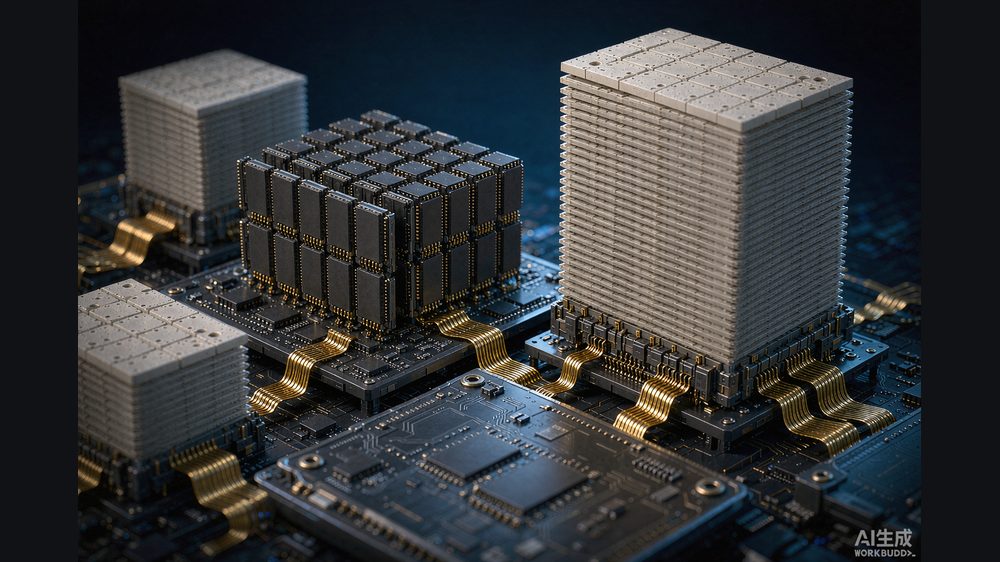
There is a catch the spec sheets rarely mention. An AI accelerator is only as fast as the memory stacked next to it, and high-bandwidth memory (HBM) is one of the tightest choke points in the entire Chinese supply chain. The Ascend 920's reported use of HBM3-class memory assumes a supply that, until recently, China could not make at all. Domestic HBM is now moving from lab to line — ChangXin Memory (CXMT, 长鑫存储) has begun sampling HBM3 to Huawei and other customers — but volume and yield are still climbing.
So the bottleneck for Huawei's next chip is less the logic die and more the memory package around it. A powerful compute die throttled by scarce HBM is a familiar problem in every sanctioned supply chain.
What it means for China's compute
Step back from the hype and a clearer picture emerges. China is not trying to replicate a TSMC-made H100 on a beachhead of EUV machines it cannot buy. It is assembling a full, if less efficient, domestic stack: a homegrown accelerator (加速卡), a homegrown foundry node, and — increasingly — homegrown HBM. Each piece trails the global leader by years. Together they remove the single point of failure that export control was designed to create.
For buyers, the trade-off is real. Domestic parts may cost more per useful token, draw more power, and ship with software that lags CUDA in maturity. But they arrive. In a market where the alternative is no accelerator at all, "good enough and sovereign" beats "best-in-class and unavailable."
What readers can do now
- Track SMIC's N+3 yield reports and CXMT's HBM3 sampling progress as the two real leading indicators, not rumored TFLOPS.
- If you run AI workloads in China, benchmark the Ascend 910C and 920 against your actual models before assuming a gap with Nvidia; real performance is a software-and-cluster story, not a spec-sheet one.
- Watch whether Huawei publishes a formal Ascend 920 datasheet; until it does, treat every number as a planning estimate.
Honest limitations
This article rests on trade and leaker reporting, not on Huawei's own specifications. The Ascend 920's performance figures (≈900 TFLOPS BF16, ≈4 TB/s bandwidth) are unattributed vendor- and leaker-sourced and should be read as estimates. The originally reported H2 2025 production window has already passed without a formal launch, so timing is uncertain. SMIC's exact N+3 node parameters are not publicly documented by the foundry. Independent die-shot teardowns of a 量产 (mass-production) 920 are not yet public, so die size, transistor count, and true power draw remain unverified.