
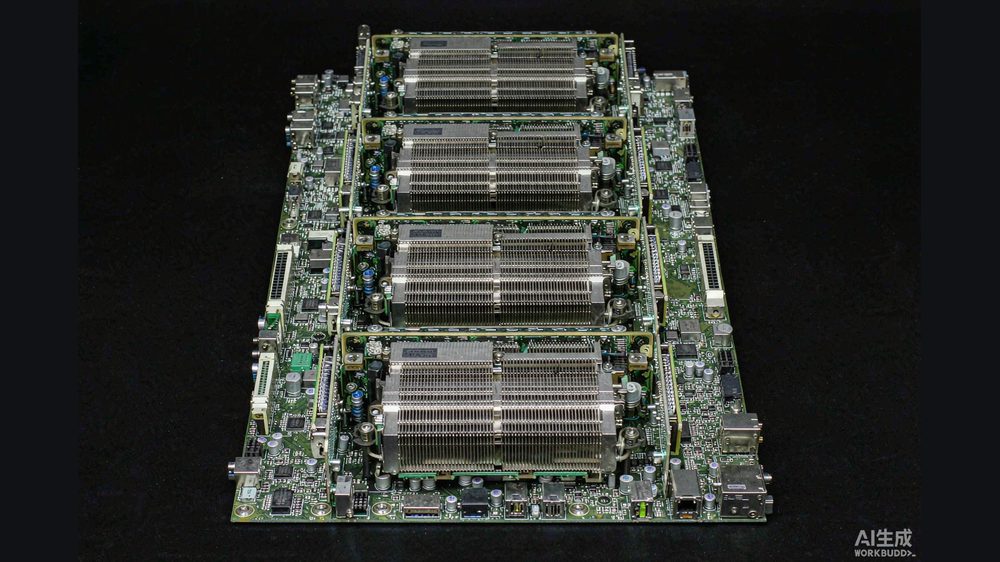
The exhibition hall in Changsha covers 10,000 square metres, with more than 80 companies showing hardware.
I did not start with the machines. I started by copying down the names of all 21 scheduled activities.
Twenty-one items, sorted
One opening plenary, five thematic forums, twelve parallel forums, one expo floor, two side competitions.
That adds up to 21.
Among the 17 forums, exactly one carries the word "chip" in its title — the computing chip forum, one of the five thematic sessions.
None of the twelve parallel forums does.
That count is mine. A banner is a statement of intent: whatever gets one still needs explaining.
One seat for silicon
The event is called a computing conference. It reserved its five most prominent slots and gave silicon one of them.
The other four went to compute-power coordination, space computing, AI servers, and embodied intelligence.
That arrangement says more than any keynote.
In the organisers' reading, the bottleneck is no longer whether chips can be built. It is how they are wired together, where the electricity comes from, and what the machines are used for. Rack density has climbed past what air cooling handles, substations have to be built, server halls re-permitted. Chips can be bought. Buildings and power cannot always follow.
What was released was a bus, not a chip
The opening ceremony published the CLink series of standards, formally the unified protocol standard for high-speed computing interconnect buses.
Not one word in that name refers to performance.
A parallel forum hosted the plenary of the national IT standards committee's working group on interconnect bus protocols, jointly with a CLink industry exchange. A standards group sharing a room with an industry session signals that the standard is still being aligned with the companies that must implement it.
The text has not been published. What can be confirmed is the name, the occasion, and which working group owns it. So this goes only as far as the evidence does: a unified interconnect protocol determines whether accelerator cards from different vendors can sit in one cluster and talk to each other directly.
Clusters are bought by the card and used as a whole. Without a common protocol, mixing vendors means an extra conversion layer, and an extra layer means more loss and a debugging bill nobody wants to own. The hard part for domestic accelerators has never been single-card benchmarks. It is a cluster that runs three months without falling over.
Two figures that must not be divided
The conference offered two numbers. China's total computing capacity stands at 3.1 million PFLOPS, second in the world. Average daily token calls exceeded 500 trillion as of the end of June.
A PFLOPS is one quadrillion floating-point operations per second.
These two cannot be divided by each other.
One describes capacity today; the other describes traffic at the end of June. They are not measured on the same day. Divide them and you get a figure for tokens produced per PFLOPS per day that looks precise and is false. Two handsome numbers and one division can produce something that reads like a conclusion without a shared definition.
Side by side, they support one claim: a lot of machines, used harder.
"Token" came up repeatedly, no longer only as an internal unit of measurement but as a unit of billing — charged per call, settled per token. Selling machines is a one-off; selling tokens is a lease.
Power and orbit each got a room
Two forums were labelled first-time. One went to space computing, the other to ocean computing acoustics.
Space computing was one of the five thematic sessions. Liu Wenqiang of the China Centre for Information Industry Development said China has completed verification of constellation-level orbital compute, large-model deployment and multi-satellite coordination.
Orbital compute, orbital models, multi-satellite coordination. Together they describe moving the server hall into the sky.
The three most troublesome items for a ground facility — land, power, grid connection — have no equivalent paperwork in orbit.
The booths compete on card counts
The largest objects on the floor were supernodes. Huawei showed its Atlas 950 SuperPoD liquid-cooled supernode and a Kunpeng 950. China Electronics showed Phytium chips, Kylin, DMDB and Great Wall servers as a full stack. The Photon consortium built its booth around Hygon silicon and the core node of its ScaleX40 ten-thousand-card cluster.
"Ten thousand cards" is now a number you can put on a booth.
All three point the same way: what is sold is not a chip but a rack, a cluster, and the cooling with it. Liquid cooling is in the product name because it is now a product definition, not a marketing line. The word supernode follows the same logic: it sells not compute but how many cards can be treated as one machine.
Standards arrive before machines
The World Computing Conference has been held in Changsha since 2019; this is the seventh edition. The city's domestic secure computing cluster reports output value above 200 billion yuan.
A city turning seven years of conferences into an industrial chain does not do it by launching a faster machine each year. It does it with standards, production lines, and suppliers willing to build to the same interface. Once the standard is fixed, component makers tool up; once they tool up, system builders hold inventory; once inventory exists, procurement officers dare to write domestic options into tenders.
The expo floor this year added matchmaking, standard releases and project signings — the organisers call it a shift from display to transaction.
The lead role changed
The centre of gravity has moved from building cards to connecting them, powering them and storing what they produce.
The chip forum is still on the programme. It is simply no longer the lead.
When the hall emptied, the loudest thing was still the fans. What people kept saying was protocol, power, tokens.
Disclaimer: This article is based on public information and is for reference only; it is not investment advice.