
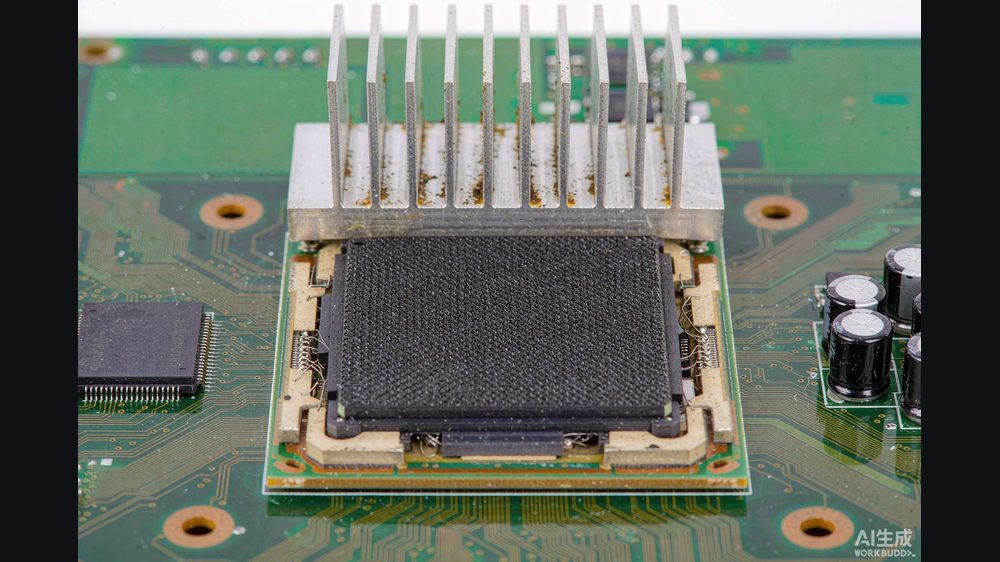
Most people know Baidu for search and Ernie (文心). The part of Baidu that could reshape China's compute (算力) supply chain sits in a separate building — and is now trying to go public on its own.
Kunlunxin (昆仑芯) is Baidu's AI-chip unit. Spun out of Baidu's internal chip team in 2021, it designs the XPU accelerators that power Baidu's own clouds and, increasingly, outside customers. In early 2026 it took two concrete steps toward independence: a confidential Hong Kong filing and a STAR Market (科创板) tutoring process.
The timeline that matters
- 2020 — first-generation Kunlun chip mass-produced and deployed inside Baidu data centres.
- 2021 — second generation launched, covering both training and inference; the unit was carved out as an independent company.
- 2024 — third-generation P800 entered mass production on Baidu's self-developed XPU-P architecture.
- April 2025 — Baidu Intelligent Cloud "lit up" a 30,000-card P800 cluster, large enough to train models with hundreds of billions of parameters.
- 13 November 2025 — at Baidu World 2025, the company unveiled the next roadmap: M100 (inference-optimised, slated for 2026) and M300 (training for very large multimodal models, slated for 2027).
- 1 January 2026 — Baidu announced Kunlunxin had submitted a confidential A1 filing to the Hong Kong Stock Exchange.
- 7 May 2026 — Kunlunxin launched STAR Market (科创板) IPO tutoring with China International Capital Corporation (CICC) as sponsor, while keeping the Hong Kong path alive.
What the chips are for
Kunlunxin positions its parts along a clear split:
- P800 (current workhorse) — data-centre training and inference; Baidu has used it to train its Qianfan-VL multimodal models and to serve Ernie (文心) workloads.
- M100 (coming 2026) — tuned for large-scale inference, e.g. video analytics and speech at low latency.
- M300 (coming 2027) — aimed at training and serving the largest multimodal foundation models (大模型).
Baidu says the plan is to ship a new generation every year through 2030, and to grow a single cluster from tens of thousands of cards toward one million cards. That is an explicit bet that domestic training clusters, not imported GPUs, will carry China's next model wave.
How it stacks up
Independent research frames the P800 as comparable to serious hardware. Guosen Securities estimated the P800 at roughly 345 TFLOPS in FP16, which it placed in the neighbourhood of Huawei's Ascend 910B and Nvidia's A100. That is an analyst comparison, not a vendor spec sheet, but it signals Kunlunxin is playing in the same league as the recognised domestic and foreign accelerators.
On market position, IDC's 2024 China GPU data puts Nvidia at about 70% share, Huawei Ascend second at roughly 23%, and Kunlunxin third among domestic vendors. The domestic加速器 market is consolidating around a handful of names, and Kunlunxin is one of them.
Why spin it out
Baidu's stated rationale for the split is straightforward: a standalone chip company can raise its own capital, court investors who specifically want AI-hardware exposure, and negotiate with customers and suppliers as an independent brand. Kunlunxin is already selling beyond Baidu — to state-owned intelligent-computing centres, China Mobile, and the power-grid operators, among others.
Valuation signals are large. After a 2025 funding round, Kunlunxin's post-money value was reported around ¥21 billion (≈ US$2.9 billion); one CICC research note floated a Hong Kong valuation near HK$50 billion (≈ US$6.4 billion). Some external reports put the proposed raise at up to US$2 billion. These are estimates, not outcomes — the IPO had not priced as of this writing.
Honest limitations
- Exact technical specifications for M100 and M300 (process node, memory, bandwidth, raw TOPS) were not fully disclosed at announcement; this article describes their positioning, not verified spec sheets.
- The 345 TFLOPS FP16 figure is an analyst (Guosen Securities) estimate for the P800, not a vendor-published number, and real performance depends heavily on software and cluster design.
- The 70% / 23% / third-place market shares come from an IDC 2024 report cited in Chinese financial media; 2025 shares may differ as Huawei and others scale.
- HKEX and STAR Market listings are filings and tutoring, not completed offerings; either path could be delayed or restructured.
- This article does not assess Kunlunxin's software-ecosystem maturity relative to CUDA, which remains a real adoption hurdle for any domestic accelerator.
What readers can do now
- Track the filings — follow HKEX and China's CSRC disclosures for Kunlunxin's prospectus; it is the clearest public window into a major domestic accelerator's real revenue and margins.
- Benchmark, don't assume — if you run inference at scale, test P800 (or M100 when shipped) against your own workload rather than relying on analyst TFLOPS comparisons.
- Watch the "A+H" pattern — Kunlunxin's parallel Hong Kong and STAR Market (科创板) moves mirror a wider trend of Chinese chip firms seeking dual listings; it signals where domestic capital is being pointed.