
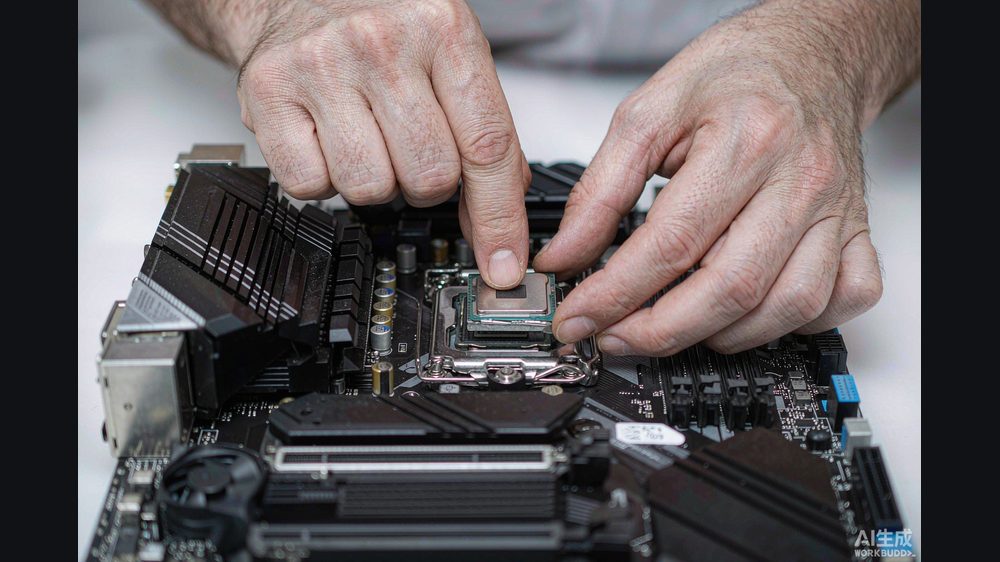
On a Shanghai stage in September, a Huawei executive did something the company rarely does: he read out a multi-year semiconductor roadmap as if it were a product catalog. The audience was not hearing about a single, faster AI chip (AI芯片). They were hearing a wager that China's compute future will be won in the cluster, not on the die.
That wager is the spine of Huawei's 昇腾 (Ascend) strategy, and over the past two Huawei Connect conferences it has been spelled out in unusual detail. The logic is blunt: China's accessible chip-manufacturing process will lag the frontier for years, so sustainable compute must be built on whatever process is actually available, then scaled through system design.
The roadmap, year by year
At Huawei Connect 2025, rotating chairman Xu Zhijun (徐直军) published the first three-year 昇腾 plan. The 910C was already shipping. Then came a cadence: 950PR in the first quarter of 2026, 950DT in the fourth quarter of 2026, 960 in the first quarter of 2027, and 970 in the fourth quarter of 2028.
A year later, at Huawei Connect 2026, deputy chairman and rotating chairman David Wang (汪涛) reaffirmed the rhythm. "We're evolving our Ascend chip series on a one-generation-a-year cycle," he said, and pointed to 970 in 2028 and a new 980 in 2029. The signal is consistency: a predictable annual beat, not a one-off surprise part.
One detail matters more than the model numbers. Starting with the 950 series, Huawei says it will use self-developed high-bandwidth memory — HiBL 1.0 on the 950PR and an upgraded HiZQ 2.0 on the 950DT. In a market where HBM is a controlled, scarce input, designing your own is a supply-chain hedge as much as a performance move.
Why clusters, not just chips
Huawei's framing is that the bottleneck is no longer a single processor. Because the available fabrication process (代工) is behind the frontier, the company argues, the answer is "super node (超节点) + cluster" — packing many chips into a logically single machine and networking them so tightly that the whole behaves like one.
At Huawei Connect 2026 the company made that concrete with what it called the Peerium Computing Architecture. The headline pieces:
- OceanStor M900 Context Memory Storage, holding up to 64PB of SSD and pushing 40 TB/s of aggregate bandwidth per cluster, built to serve petabyte-scale key-value caches for long-context models.
- A Unified Bus interconnect spanning scale-up, scale-out and scale-across. The LinkBlade scale-up design connects up to 4,096 NPUs inside a SuperPoD; the LinkDevice optical switch delivers 1.6 Tbit/s per port across 176 ports (280 Tbit/s total); a UBG switch ties together up to 1,024 end devices.
- Atlas 950 and Atlas 960 SuperPoDs, plus a TaiShan 950 SuperPoD that brings the super-node idea into general-purpose computing.
Huawei says more than 1,000 Atlas 900 A3 SuperPoDs have already been deployed, and that the Atlas 950 SuperPoD is in large-scale commercial use, with the 960-class chips expected to ship in the first quarter of 2027.
The specs on paper
Huawei's own figures for the roadmap tell a clear story of steady doubling:
- 910C: about 800 TFLOPS at FP16, 784 GB/s interconnect, 128GB of HBM, 3.2TB/s memory bandwidth.
- 950PR / 950DT: 1 PFLOPS at FP8 and 2 PFLOPS at FP4, 2TB/s interconnect; the 950PR carries 144GB at 4TB/s, the 950DT 128GB at 1.6TB/s.
- 960: 2 PFLOPS FP8 / 4 PFLOPS FP4, 2.2TB/s interconnect, 288GB at 9.6TB/s.
- 970: 4 PFLOPS FP8 / 8 PFLOPS FP4, 4TB/s interconnect, 288GB at 14.4TB/s.
Set against Nvidia's Blackwell B300 — roughly 15 PFLOPS at FP4 with 288GB of HBM3e at 8TB/s — even Huawei's top announced part trails on raw FP4 throughput. On top-end memory bandwidth, however, Huawei's 970 leads Nvidia's B300 (14.4 TB/s vs 8 TB/s), even as Nvidia still leads on raw FP4 throughput and, as analysts note, the broader system stack.
The gap nobody disputes
The honest counterpoint comes from independent analysts. Neil Shah of Counterpoint Research, quoted by HPCwire, argues that at the system level — compute, memory integration, networking scalability, and crucially software orchestration — Nvidia remains about three generations ahead. The moat is not a single chip's TFLOPS; it is CUDA, the toolchain, and a decade of accumulated libraries.
Huawei is building its own software stack (CANN) and has courted developers aggressively, but breadth and maturity against CUDA are unproven in open benchmarks. This is the real contest: not who prints the higher number on a slide, but who can deliver stable, scalable clusters that engineers actually adopt for production large-model (大模型) training and inference.
Honest limitations
- Every performance figure above is Huawei's own Connect-stage claim, not an independently benchmarked result. No public MLPerf-style numbers exist yet for the 950, 960 or 970.
- Process node and yield are not disclosed. The implicit reliance on domestic foundry (代工) capacity at accessible nodes is widely assumed but not confirmed by Huawei.
- "Super node" throughput figures are vendor benchmarks. Real-world training performance against Nvidia H100- or Blackwell-class clusters has not been publicly verified by third parties.
- We have not modeled how shifting export controls on equipment or HBM could reshape the supply picture between now and the 2028–2029 deliveries.
What readers can do now
- Track the 950PR's first-quarter 2026 shipment and, more importantly, whether the CANN software stack matures for mainstream large models (大模型) rather than a handful of showcase workloads.
- Watch SMIC (代工) capacity and HBM supply as the true bottleneck — Huawei's chip specs matter less than whether the whole stack can be built at volume.
- For buyers, pilot before you commit: benchmark a 昇腾 cluster on your own training and inference load before ripping out an existing Nvidia-based fleet.