
A digital processor solves a matrix equation by breaking it into billions of small arithmetic steps and marching through them. An analog chip can wire the equation into a circuit, let voltages settle and read the answer. One approach counts operations; the other waits for physics to finish the calculation.
A one-year-old company in Beijing says it has built the second kind, and that the silicon works. Anazhixin (安纳智芯), formally Beijing Anazhixin Technology (北京安纳智芯科技有限公司), announced on 19 November 2026 a new financing round in the hundreds of millions of yuan (≈ US$13.9 million and up / HK$108.7 million and up, approximate), with Huarui Holdings (华睿控股), C&D New Capital (建发新兴投资) and Plum Ventures (梅花创投) among the investors. Flow Capital (心流资本) served as long-term financial adviser.
A chip born from a paper
The company was incorporated on 14 November 2025 in Beijing's Huairou district. Xiang Rui (向锐) is its legal representative, chairman, chief financial officer and chief executive. Its registered capital is small, about ¥124,561 (≈ US$17,000 / HK$135,000), which is normal for an early design company.
The technology came from Peking University's Institute for Artificial Intelligence. Sun Zhong (孙仲), a researcher there, published a paper in Nature Electronics in October 2025 that the company says improved analog-computing precision from roughly one percent to about one part in ten million. Precision has been the historic objection to analog computing: attractive on power, unconvincing on accuracy. Sun serves as Anazhixin's chief scientist.
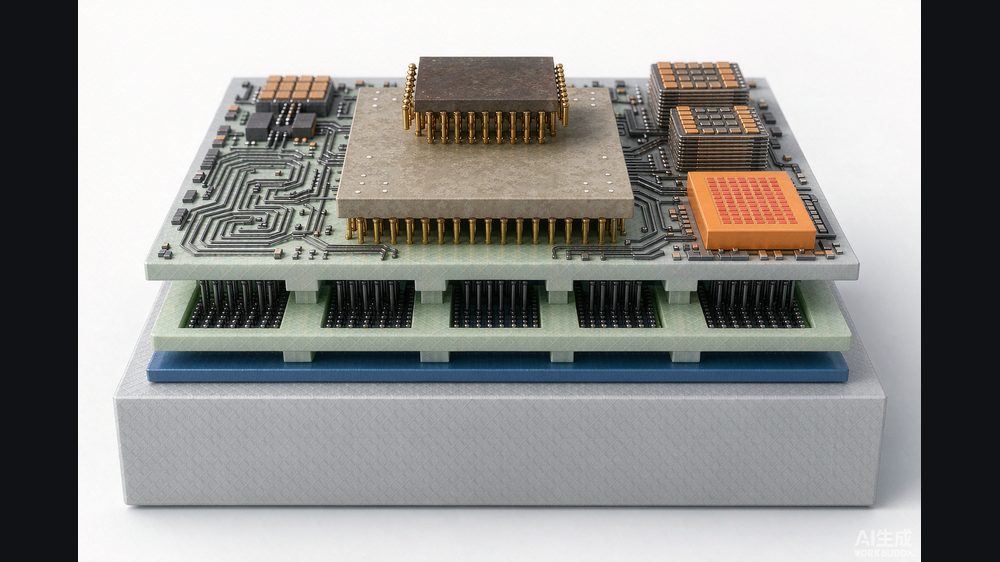
The AX100 chip completed tape-out in October 2026. Anazhixin calls it the world's first fully integrated analog computing chip that solves matrix equations in one step. The company reports a single solve in under 100 nanoseconds at about 80 milliwatts. The claim is that Ohm's law performs multiplication and Kirchhoff's current law performs addition directly in a resistive memory array, so no iteration is needed.
Why matrix equations matter
A lot of modern computing reduces to solving systems of linear equations. Training a large model optimises parameters through repeated matrix operations. Robot motion control and path planning lean on them. So does signal processing at a 5G or 6G base station.
Anazhixin argues that a machine built for this one task can beat a general-purpose processor on both speed and energy, without needing the most advanced lithography. It says the design can be engineered and mass-produced on mature processes of 28 nanometres and above. In a market where access to leading-edge tools is constrained, that is a strategic argument as much as a technical one.
The company has published its own validation numbers. On a 2.93-million-parameter autoencoder and a 2.72-million-parameter transformer, its second-order optimisation approach reduced training update consumption by 92 percent and 56 percent respectively. In embodied-intelligence tasks, it reports end-to-end motion control and planning 150 to 500 percent faster, and 3D reconstruction and SLAM (simultaneous localisation and mapping) core steps 200 to 500 percent faster. For a 128-by-128 channel Gram matrix in wireless communications, it claims 20 to 207 times the throughput and 27.6 to 61.3 times the energy efficiency of digital ASICs and GPUs.
Four rounds in a year
The November financing is the fourth in roughly twelve months. iFlytek Ventures (讯飞创投) participated at incorporation in November 2025. An angel round in February 2026 brought in Zhonghong Yongli (中泓永利), Zhongying Ventures (中赢创投), Yanyuan Ventures (燕缘创投), iFlytek Ventures and Galbot (银河通用机器人). A round of several hundred million yuan followed in June, led by Matrix Partners China (经纬创投) with FreeS Ventures (峰瑞资本) and Alpha Community (阿尔法公社).
That investor mix — industrial players, strategic investors tied to AI applications, and pure financial funds — is typical of a company whose backers want both a technology option and a route into specific customers.
Anazhixin is not alone. Economic Observer notes that about 40 Chinese startups are working on compute-in-memory and analog neural-network processors, with cumulative financing above US$600 million. In September 2026, the Ministry of Industry and Information Technology and the National Development and Reform Commission listed compute-in-memory as a direction for new computing paradigms in the electronics manufacturing plan for the 15th Five-Year Plan period.
Tape-out is not a product
The most important sentence in the reporting on Anazhixin is also the least exciting. Economic Observer points out that AX100 has completed tape-out and light-up, not mass production, customer adoption or third-party benchmarking. Every performance figure comes from the company's own tests or projections based on chip parameters.
Analog computing's problems were never only precision. Reliability across temperature, manufacturing variation, programmability and a software toolchain all matter. The company says its compiler chain has successfully mapped high-level algorithms onto hardware, which is the necessary step from "can calculate" to "can be used". That is a company statement, not an independent software evaluation.
Xiang Rui describes the choice as "opening a new road" rather than overtaking on a curve, and says Chinese companies have a first chance to help define an important computing paradigm. Ambition is cheap at this stage. Customer acceptance will be the test.
Honest limitations
All technical specifications — under 100 nanoseconds, 80 milliwatts and every comparison with digital chips — are Anazhixin's self-reported results. I found no independent benchmark, no customer test and no published measurement protocol. The "world's first" description is the company's own.
The Nature Electronics paper is a separate matter from the chip's performance; a precision result in a research device does not validate a commercial part. I did not read the paper directly and rely on reporting that describes it.
The funding amount is reported as "亿元级", a category rather than an exact figure; the conversion above is a lower-bound approximation. Investor lists and the registered-capital figure come from public company records and business media. The policy document is described in reporting, not quoted here at length.
What readers can do now
- If you evaluate chips, ask for a third-party benchmark on a workload you care about. Nanoseconds on a matrix equation mean little without a defined precision and input size.
- If you work in robotics or wireless, treat analog co-processors as an option to test, not a replacement for your GPU yet. Tape-out and shipping are different milestones.
- If you follow Chinese semiconductor policy, watch mature-process design as a distinct strategy. It answers a different constraint from leading-edge manufacturing.