
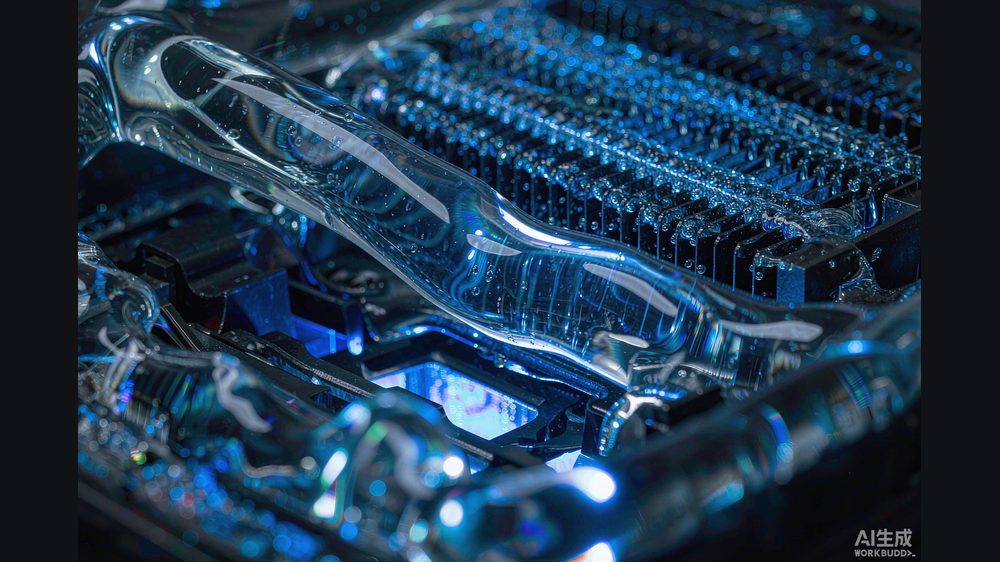
A data-centre engineer stands in a half-built hall where the floor had to be reinforced before a single server arrived. The problem was not the GPUs. It was the watts: each rack now demands more power than a small office building.
The AI boom has a quiet bottleneck that rarely makes the headline — power delivery. And it is exposing a part of China's semiconductor industry that benchmarks tend to ignore.
Key takeaways
- Nvidia's GB200 NVL72 rack-scale system draws about 125–135 kW continuously, with peaks near 192 kW — an order of magnitude above the 10–15 kW legacy racks were built for.
- Delivering that at 48V pushes currents past 2.5 kA, forcing thick copper busbars; the industry is shifting toward 400V or 800V DC distribution, which Nvidia says can cut copper use by up to 45%.
- China's power-management chip (PMIC) market is still more than 80% foreign-supplied; TI, ADI, and Infineon lead, with TI around 19% share.
- High-current controllers and DrMOS for AI servers remain largely imported, even as China's analog chip self-sufficiency rose from about 9% in 2019 to roughly 16% in 2024.
- Step-down conversion at the rack is increasingly done with GaN and SiC devices — another segment where domestic share is still thin.
When the rack became a power plant
For years, data-centre power was a solved problem. Racks ran at 10–15 kW on steady CPU and storage loads, distributed at 12V or 48V. Accelerated computing broke the assumption. A single GB200 NVL72 — 72 Blackwell GPUs wired into one liquid-cooled rack — needs 125–135 kW of continuous load and can spike toward 192 kW, according to system specs and Uptime Institute analysis quoted by industry outlets.
The physics get awkward fast. At 48V, pushing 120 kW means currents above 2.5 kiloamperes, which requires massive copper busbars, generates resistive heat, and stresses every connector. The emerging fix is to raise the distribution voltage to 400V or 800V DC, where the same power travels at a fraction of the current. Nvidia has argued that 800V distribution can reduce copper by up to 45%, and vendors such as Eaton, Vertiv, and Delta are building compatible hardware.
The chips you never see
Every kilowatt that reaches a GPU passes through layers of power-management silicon: multiphase controllers, DrMOS stages, point-of-load converters, and GaN or SiC switches that step high-voltage DC down to the volt-level rails a chip actually eats. These are analog and mixed-signal devices — exactly the category where China lags.
According to a first-half 2026 industry report from JW Insights (集微咨询), overseas vendors still hold more than 80% of China's PMIC market, led by Texas Instruments at roughly 19%, Analog Devices at about 13%, and Infineon near 10%. The same report notes that China's analog-chip self-sufficiency climbed from about 9% in 2019 to roughly 16% in 2024 — progress, but from a low base, and concentrated in low- and mid-power consumer parts.
Why AI makes the gap sharper
AI servers are a worst case for power chips. They need high-current, fast-transient converters that hold tight voltage while thousands of GPU cores swing load in sync. Those high-end DrMOS and multiphase controllers are still largely supplied by TI, Infineon, MPS, and Renesas. China's domestic players — SG Micro (圣邦微), Joulwatt (杰华特), and others — are growing fast (the JW Insights sample of 21 listed PMIC firms grew revenue about 29% in the first half of 2026) but remain strongest in smaller, lower-current applications.
The same forces help them, too. Electric vehicles now carry 80–85 power-management chips per car, up from 35–40 in 2015, and the per-car value rose from about US$5–10 to US$50–100. That volume is training China's analog designers on exactly the reliability and scale the data centre will eventually demand. The catch is qualification: a car-grade power part takes longer to certify than a phone part, and a data-centre part longer still, so the AI-server opportunity is real but gated by multi-year validation cycles rather than design alone.
Honest limitations
The 125–135 kW and ~192 kW rack figures come from Nvidia system specifications and third-party data-centre engineering analyses, not a single primary standard. The "more than 80% foreign share" and the TI/ADI/Infineon percentages are from an industry-research report (JW Insights), which aggregates a fragmented market and may differ from other estimates. I could not find a separately disclosed domestic share for AI-server-specific power ICs, so the statement that high-end AI-server power chips remain largely imported is a qualitative read of where Chinese vendors compete today, not a measured number.
What readers can do now
- When evaluating "AI supply chain" stories, add power and analog chips to the watch list — they are a real constraint, not just a GPU story.
- Track Chinese analog vendors' move into high-current, automotive-grade parts; that is the on-ramp to data-centre power, and the lead indicator of substitution.
- For data-centre planners, treat 800V DC as a coming retrofit, not a today problem — most existing halls top out near 40–60 kW per rack and cannot host NVL72-class systems without reinforcement.