
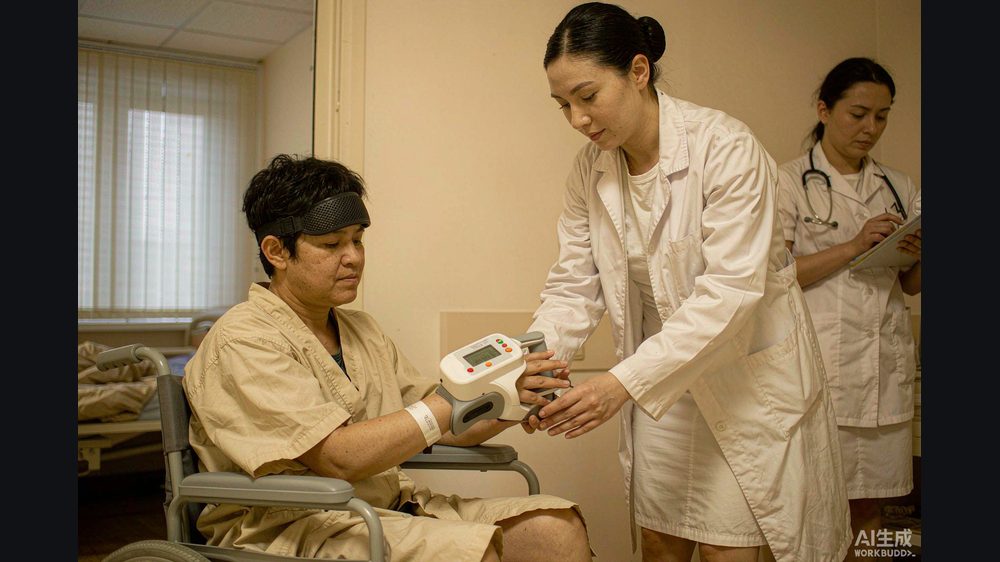
A 61-year-old man who could not move his legs after a fall sat, then stood, then stepped — with a walker, but on his own. The engine for that recovery was not in his brain alone but in a thin electrode planted along his spinal cord.
The closed-loop spinal interface
In 2025, Zhejiang University (浙江大学), its Second Affiliated Hospital (浙大二院), and the Nanhu Brain-Computer Interfacing Institute (南湖脑机交叉研究院) reported China's first closed-loop spinal neural-interface implant (闭环脊髓神经接口植入手术). The patient, called Uncle Jin (金大叔), was left completely paralyzed from a high fall in July 2024. Surgeons placed a spinal-cord stimulation electrode in the lower spine and a wireless rechargeable controller in his abdomen.
The loop is the point: the system senses and stimulates, training residual pathways rather than merely bypassing them. Three days after surgery Jin could bend and lift his legs; within a month his lower-limb function had improved enough that, with a walker, he could take autonomous steps.
A longer track record than it looks
Zhejiang University is one of China's earliest BCI institutions, starting invasive work in 2006. By 2014 it had demonstrated a mind-controlled robotic hand playing rock-paper-scissors. In 2019 a high-paraplegic patient used a cortical BCI to command a robotic hand to drink cola and eat youtiao (油条). The 2025 spinal interface is the same lab's move from "move a hand on a screen" to "move your own legs on the floor."
Wang Jian'an (王建安), a Chinese Academy of Sciences academician and dean of the Second Affiliated Hospital, says the technology is at the "explosive" edge of moving from lab to ward. His hospital now has more than 3,000 patients globally registered for BCI clinical research, including some from France.
Why spinal, not cortical
Cortical BCI reads intent from the brain's motor cortex to drive external devices. The spinal approach instead rewires the execution end — restoring the body's own movement loop. For locomotion, that may be the faster road to daily use, because walking is a rhythmic pattern the cord already knows how to run once it is nudged. It also pairs naturally with rehabilitation: the patient is not operating a machine but retraining their own nerves.
Spinal interface versus exoskeleton
The line between this and an exoskeleton matters. An exoskeleton carries the body with motors; a spinal interface tries to wake the body's own control. Early on, it still needs a walker and the implant, so it is not independence yet — but because the goal is the patient's own nerves relearning the pattern, the upside is a therapy that keeps working after the session ends, not a machine you must wear in order to move. That distinction shapes who benefits and how long the gains last.
The market behind the medicine
These cases sit inside a fast-growing Chinese sector. Industry data cited by university and state media put China's BCI market at about 3.2 billion RMB (≈ US$440M / HK$3.4B) in 2024, growing roughly 18.8% a year, with medical use near half of that, and a projected 5.58 billion RMB (≈ US$770M / HK$6.0B) by 2027. Global projections from McKinsey (麦肯锡) reach hundreds of billions of dollars of medical BCI value between 2030 and 2040.
Trend reading
According to Li An, chief scientist at BrainNet (脑机网), restoring locomotion through spinal interfaces may reach daily clinical use sooner than cortical speech decoding, because the control loop is simpler and the rehab payoff is immediate.
Honest limitations
The headline case is a single patient reported by the university and state media; we found no peer-reviewed publication with the full cohort and follow-up at the time of writing. "Completely paralyzed" and "autonomous steps" are powerful phrases, but the patient still used a walker and a stimulator, not unassisted walking, and we do not have independent confirmation of how durable the gain is months later. We have not covered the full list of global spinal-stimulation programs — including non-Chinese groups — or the surgical risks of implanting along the cord. Cost, candidacy criteria, and which hospitals can perform the procedure remain unclear, and the 3,000-patient registry figure is the hospital's own and not audited.
What readers can do now
- People living with spinal-cord injury should ask rehabilitation specialists about neuromodulation and spinal-stimulation trials, and verify whether a center near them is accredited to perform implanted interfaces.
- Family caregivers should set realistic expectations: current systems assist standing and stepping with aids, not a cure, and intensive daily training is what converts the technology into function.
- Researchers and clinicians can follow Zhejiang University's Nanhu institute publications for the peer-reviewed cohort data that will determine whether this moves from a striking case to a standard therapy.