
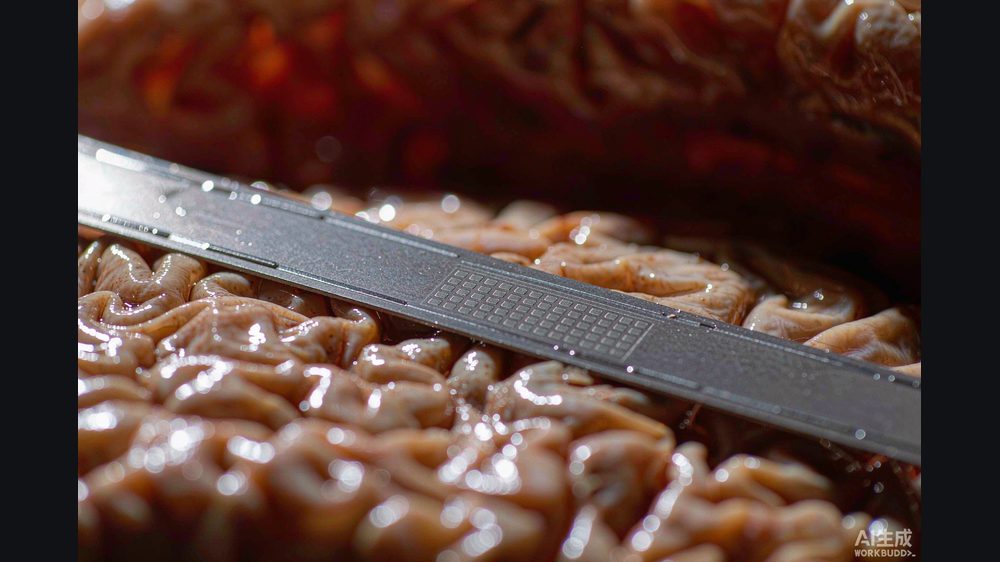
A surgeon in Shenzhen opens a patient's skull to remove a blood-vessel tumor, then lays a film thinner than paper onto the exposed brain.
The film is not a dressing.
It is listening — mapping, in real time, which patches of tissue control movement and speech.
Key takeaways
- WizMind (微灵医疗), a Shenzhen company founded in 2019, builds implantable brain-computer interfaces on ultra-thin flexible film electrodes about 10 micrometers thick.
- In June 2025 its technology supported South China's first intraoperative "awake" decoding of a patient's movement and speech intentions during brain surgery.
- Its fully implantable research platform supports 128 recording or stimulation channels; a partner hospital has used a 256-channel version for subdural implantation.
- The company focuses on a "repair" route — epilepsy, brain tumors and stroke — rather than electronic replacement of lost function.
- It works with more than ten top Chinese hospitals, including Beijing Tiantan, Xuanwu and Wuhan Tongji.
A different Chinese path
Most public attention on Chinese BCI has gone to headline-grabbing implants that let a paralyzed person move a cursor. WizMind (微灵医疗), founded by Li Xiaojian (李骁健), has chosen a less flashy but clinically crowded lane: helping surgeons see the brain while they operate on it. The company's core product is a high-density flexible thin-film electrode — roughly one-tenth the diameter of a human hair — that conforms to the brain's surface and records electrical activity at high density.
Rather than promising a sci-fi future, the firm pitches a near-term tool: give neurosurgeons a live map of functional tissue so they can cut a tumor without cutting a patient's ability to move or speak.
What happened in the operating room
In June 2025, working with Shenzhen Second People's Hospital, the team used a 128-channel flexible thin-film electrode on a 40-year-old patient with a cavernous hemangioma — a blood-vessel lesion — near motor and language areas. Under "awake" anesthesia, the patient performed movement and speech tasks while the electrode captured the signals. According to the company and coverage in Shenzhen-based media, the decoding algorithm identified intended movement and speech with accuracy above 97% and a response time under 60 milliseconds.
Those numbers describe intraoperative assistance, not a chronic implant that a patient lives with. The value is immediate and verifiable: during a single surgery, the system helps the surgeon tell "safe to remove" from "must protect." That is a different risk profile from a device meant to stay in the body for years.
From the OR to a chronic platform
WizMind is also building toward fully implantable systems. Its research-grade platform supports 128 acquisition or stimulation channels, and Wuhan Tongji Hospital (part of Huazhong University of Science and Technology) has used the company's technology for what it describes as China's first subdural 256-channel flexible-electrode implantation, localizing a lesion and supporting its removal with good postoperative recovery. A CCTV-2 documentary later featured the firm's lesion-and-distorted-functional-area localization system.
The "repair" philosophy matters for scale. Epilepsy, brain tumors and stroke affect far larger populations than the rare conditions that some high-profile implants target. If a BCI helps surgeons operate more safely on common brain diseases, the addressable need — and the clinical evidence base — grows much faster.
The contrast with headline implants is worth noting. Cursor-control demos answer "can a paralyzed person move a computer?" WizMind asks a blunter hospital question: "while I cut, where is the speech area?" That question has a buyer today — every neurosurgical theatre — which is why a film electrode can reach patients years before a chronic implant clears regulators.
Honest limitations
The 97% accuracy and sub-60ms response figures come from the company and Shenzhen media reports, not from an independent peer-reviewed publication, so they should be read as early claims pending outside validation. The headline results are intraoperative and single-center; whether the film electrodes remain stable and safe as long-term implants is not yet demonstrated. Channel counts (128, 256) describe research systems, not a marketed product. As with every BCI effort in China and abroad, no WizMind device has received broad regulatory approval for general therapeutic use, and timelines the founder has sketched (a 2027 inflection, broader rollout around 2029–2030) are projections, not commitments.
What readers can do now
- Chinese patients facing brain-tumor or epilepsy surgery can ask their hospital whether intraoperative brain-mapping (术中脑功能定位) with high-density electrodes is available; it is no longer purely experimental at major centers.
- Researchers and clinicians should track WizMind's work through hospital collaborations and journal publications rather than company press alone, to separate demonstrated OR results from roadmap promises.
- Treat "China's BCI breakthrough" headlines with the same skepticism applied elsewhere: confirm whether the claim is intraoperative mapping, a chronic implant, or a lab demonstration.