
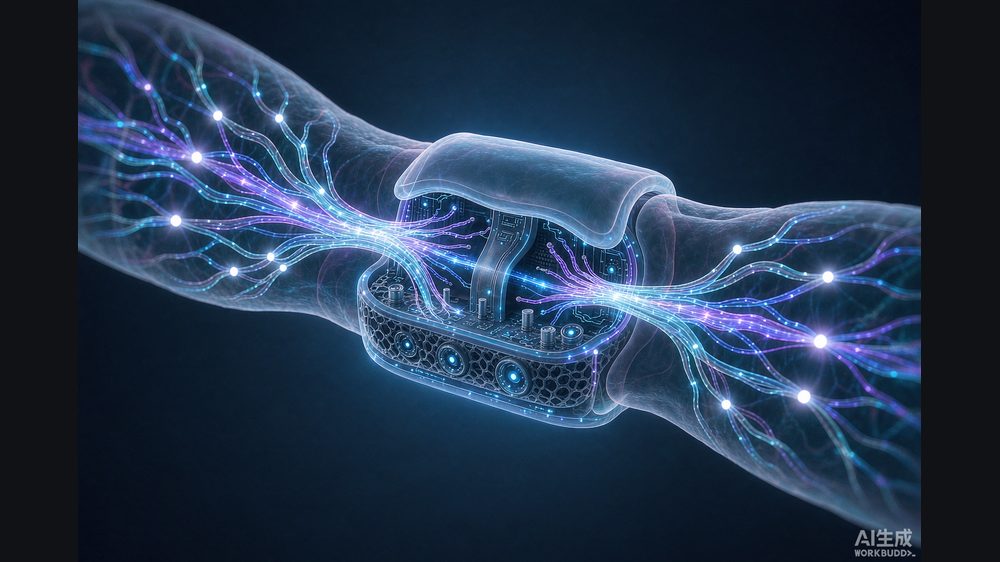
The chip sits on a workbench in a Beijing lab, smaller than a fingernail clipping. Across town, a rival implantable device still leans on components designed for a different job entirely. One of these paths is about to matter a lot more than the other.
Most coverage of Chinese brain-computer interface (脑机接口) work fixates on implant counts and patient stories. Those matter. But the quieter, more durable story is manufacturing control — who designs the silicon that turns a neuron's whisper into a usable signal. On that front, NeuraMatrix (宁矩科技) is the company worth watching.
From a university lab to a full stack
NeuraMatrix was founded in late 2019, incubated out of Tsinghua University. Its founders had been working on brain-interface research since 2010, first at the University of Pennsylvania and later at the Max Planck Institute in Germany, before returning to start the company. The explicit goal was never a single product. It was a platform: own the entire chain from electrode material, to the dedicated chip, to the host system, software, and decoding algorithms.
That "full vertical integration" claim is easy to dismiss as marketing. The concrete evidence is a chip.
The chip that actually shipped to tape-out
In late 2021, the company announced that its self-developed brain-computer interface system-on-chip had completed tape-out (流片) — the step where a design becomes physical silicon. NeuraMatrix described it as China's first bidirectional commercial brain-interface chip, built for multi-channel acquisition, strong noise rejection, low power draw, and wireless transmission.
The company's public specifications are specific enough to judge:
- A single device integrates 128 sensing channels (单器件集成128传感通道) with microvolt-level resolution.
- The company states the design can aggregate to roughly a thousand channels across a system.
- Wireless data bandwidth is quoted in the hundreds of megabits per second, with around 1 GOPS of on-chip compute for edge-side signal processing.
Those last two numbers are company-disclosed rather than independently benchmarked, so they should be read as engineering targets the firm stands behind, not as audited results. But the direction is clear: push the compute to the sensor, keep the data on a fast private wireless link, and avoid the bulky external backpacks that earlier research systems required.
Why a dedicated chip, not a borrowed one
The strategic logic is unglamorous but important. A general-purpose microcontroller or an off-the-shelf wireless part was never built for the brutal constraints of an implant: microwatt budgets, zero tolerance for heat near tissue, and the need to sort neural spikes in real time. Buying those parts means accepting someone else's trade-offs. Designing your own ASIC means the trade-offs are yours to make.
NeuraMatrix's bet is that the companies which win neurotech will be the ones that control the wafer, not the ones that assemble borrowed components. It is the same logic that drives every serious player in the field — the difference is that a Beijing startup, rather than a U.S. giant, is the one vertically integrating.
The money and the team
In November 2021, NeuraMatrix closed a nine-figure RMB financing round (roughly US$14M+ / HK$780M+ at then-exchange rates) led by Huagai Capital (华盖资本) with participation from Saudi Aramco's venture arm Prosperity7 Ventures and returning investor Matrix China (经纬中国). The proceeds were earmarked for chip R&D, mass production, and accelerating both research and medical-device manufacturing.
The team is small but dense: reported at over 70 people, with PhD holders and PhD candidates making up more than 70% of the engineering staff. Two co-founders are professors at Tsinghua and the Chinese Academy of Sciences. The company has also built a GMP-grade workshop and has named partnerships with hospitals including Tsinghua Chang Gung, Sanbo (三博), Tiantan (天坛), and Xuanwu (宣武) — covering motor rehabilitation, deep-brain stimulation for Parkinson's and epilepsy, spinal-cord paralysis, and facial paralysis.
What this means for the field
China's brain-interface effort is often described as a race against invasive pioneers in the United States. That framing is useful for headlines and useless for engineering. The real lesson from NeuraMatrix is narrower: the long-term moat in this industry is the electrode-tissue interface and the chip that reads it. Whoever solves low-power, high-channel-count, biocompatible acquisition owns the input layer for everything that comes after — prosthetics, communication aids, and, further out, human-machine collaboration.
A startup that controls its own silicon is also harder to bottleneck. Export controls and supply disruptions that would stall a company buying foreign parts simply do not apply to one that tapes out its own chip domestically.
Honest limitations
The technical specifications above — channel counts, bandwidth, and compute — are drawn from the company's own disclosures and its official site, not from independent lab benchmarks. Characterisations of the chip as "world-leading" are the company's, and should be treated as claims, not findings. The November 2021 financing and founding details were reported by Chinese state-affiliated technology media (GMW / 光明网) and Forbes China, and are consistent across those outlets, but no peer-reviewed clinical efficacy study supports the broader medical claims. Comparisons to U.S. invasive brain-interface firms are directional, not head-to-head. Brain-computer interface remains an area of active clinical research, and implantable neurotechnology carries surgical and long-term-durability risks that no chip specification can resolve.
What readers can do now
- If you follow hardware, track tape-out and channel-count milestones, not implant headlines — the input layer is where the next decade of value concentrates.
- If you work in medtech, note that domestic chip design is now a stated capability in Chinese neurotech; it changes which suppliers are actually exposed to external restrictions.
- If you evaluate the field, ask whether a company controls its electrode and chip or assembles borrowed parts — that single question separates platform bets from demo projects.